Municipals move to build digital profiles of returnee migrant workers
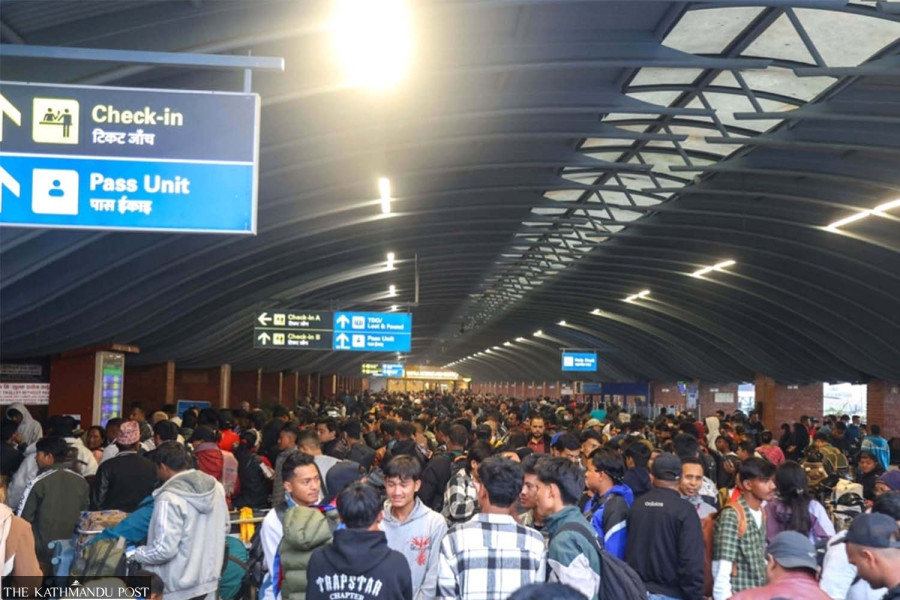
Local governments prepare draft directive to document skills, investment plans and earnings of returning labour migrants amid lack of national records. In the Nepali month of Jestha (mid-May to mid-June) alone, 30,480 people returned from foreign employment, while 20,327 obtained new labour approvals. Post file photo
Local governments in Nepal are preparing to build digital profiles of migrant workers returning from abroad, as part of a new effort to systematically manage reintegration programmes, according to a draft directive prepared by the Municipal Association of Nepal.
Officials say the federal government currently lacks a reliable database of Nepali workers who return after foreign employment, creating gaps in policy planning and reintegration support.
The draft directive proposes that municipalities collect detailed information from returnees at the ward level, including the nature of their work abroad, skills acquired, experience gained, income earned and potential areas of investment. This data would then be used to create individual digital profiles.
The aim is to standardise reintegration programmes across local governments and better utilise the knowledge, skills, technology and capital brought back by returnee workers, the association said.
“There is a major challenge in reintegrating returnee migrant workers into the domestic labour market. Local governments are under pressure to design effective programmes, and this directive is intended to provide a framework,” said Kalanidhi Devkota, executive director of the association.
Labour migration remains a key feature of Nepal’s economy, with a growing number of workers repeatedly leaving for foreign employment due to limited job opportunities and challenges in entrepreneurship at home. Data from the Department of Foreign Employment shows a rising trend of repeat migration in recent years.
In the Nepali month of Jestha (mid-May to mid-June) alone, 30,480 people returned from foreign employment, while 20,327 obtained new labour approvals. In the last fiscal year, 333,000 workers received renewed labour permits to go abroad again.
The proposed directive also outlines the creation of a skills mapping system and a digital roster of returnees. Workers who have acquired skills abroad but lack formal certification would be able to undergo skill testing under a dedicated programme. Currently, Nepal has no formal mechanism to certify skills gained overseas.
It also proposes incentives for private firms and institutions that employ skilled returnees, including recognition and awards.
For returnees or their families who want to start businesses through collective investment or partnerships, the directive suggests technical and financial support, along with tax concessions.
“Such workers will be encouraged to invest collectively in partnerships or joint ventures,” the draft states. “Families using income earned from foreign employment to run businesses will receive technical, financial and other necessary support, and such enterprises may be granted tax and fee exemptions.”
Officials and local leaders say the policy could help channel remittance savings into productive sectors.
Tirtharaj Bhattarai, mayor of Diktel Rupakot Majhuwagadhi Municipality in Khotang, said programmes should be designed to direct migrant capital into local production. “We need policies that channel returnee capital into local resource-based production,” he said. “That would help utilise idle resources and improve market linkages.”
Manoj Kumar Shah, mayor of Janakpurdham Sub-metropolitan City, stressed the need for coordination between federal and local governments on reintegration policies. He said municipal directives should be recognised and supported at the federal level.
The draft also proposes partnerships with banks, financial institutions and cooperatives to provide concessional loans to returnee workers and facilitate market access for goods and services produced through their enterprises.
“It will coordinate with banks, financial institutions and cooperatives to ensure access to soft loans,” the directive states.
However, stakeholders say existing federal pilot reintegration programmes have not been effective and lack proper mechanisms to reach returnee workers.
Ramesh Khadka, who returned to Biratnagar-9 after seven years of work in Malaysia, said he still struggles to decide what to do next. “I had some skills, but they are not valued here. Even starting a small business requires capital and market knowledge,” he said. “Sometimes I feel I cannot do anything. I worry that I might lose the little savings I brought back.”
Hom Karki is a reporter with two decades experience covering migrant workers issues and the Nepali diaspora. He was previously based in the Gulf for Kantipur Daily.




 19.47°C Kathmandu