Supreme Court orders immediate removal of pavement encroachments, issues four-point mandamus order
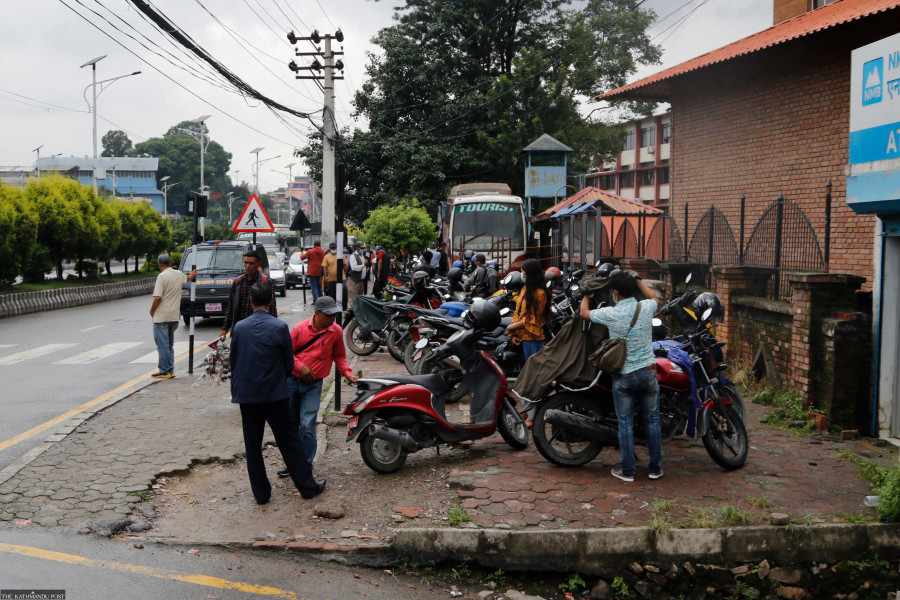
Court says blocked pavements violate constitutional rights to dignity and freedom of movement, directs coordinated action by government bodies and Kathmandu Metropolitan City to clear obstructions and improve pedestrian safety. Court cites multiple fatal accidents, says unregulated pavements and open drains have turned into public safety hazards. Post file photo
The Supreme Court has issued a four-point mandamus order directing the government to immediately remove encroachments on roadside pavements, ruling on a writ petition filed by advocate Sudhigya Pant.
Making public the full text of its verdict delivered on December 2, 2024, the court clarified that pedestrians have a constitutional right to use pavement without obstruction.
The court stated that when structures are built or obstructions are created on pavements, pedestrians are forced to walk along the edge of roads, increasing the risk of accidents. This, it said, results in a violation of the right to life.
“It appears that the obstruction of pavements due to structures or other barriers forces pedestrians to walk along the road edge, increasing the risk of road accidents, thereby undermining the right to live with dignity,” the verdict said. “The right to walk freely and safely on well-managed pavements falls under the right to live with dignity guaranteed by Article 16 of the Constitution. Similarly, such obstructions also violate the freedom of movement under Article 17.”
The Supreme Court also cited three incidents to support its reasoning. These include the death of a cyclist who fell into an open drain on October 29, 2018; the death of a rhinoceros that fell into a trench dug during road construction on January 23, 2022 and and the death of a child who fell into an open drain on September 25, 2021.
Based on these incidents, the court concluded that the constitutional right to live with dignity, as guaranteed under Article 16, had been violated due to the lack of safe and accessible pavements.
“It is evident that the authorities responsible have not been proactive in ensuring the enforcement of the right to live with dignity and freedom of movement. They have also ignored encroachments carried out by bodies under their own jurisdiction,” the verdict said. “As coordination among responsible agencies has not been ensured to protect citizens’ fundamental rights, a four-point mandamus is issued under Articles 47 and 133 (2) and (3) of the Constitution for the enforcement of fundamental and public rights.”
Under the first point, the court directed that in cases where police posts have been set up, or any other encroachment has been made under the Home Ministry or its subordinate bodies, the government, the Ministry of Home Affairs, the Ministry of Physical Infrastructure and Transport, the Ministry of Urban Development, and Kathmandu Metropolitan City must issue necessary directives and remove such encroachments.
Under the second point, the court ordered that in areas where pavements have been encroached upon by private individuals, companies, or non-governmental organisations by placing construction materials, platforms, staircases or other structures, Kathmandu Metropolitan City and the concerned ministries must coordinate and issue a public notice giving a reasonable deadline to remove such encroachments. If they are not removed within the given time, authorities must take appropriate action to clear them.
Under the third point, the court directed all relevant federal units and subordinate bodies to maintain, repair and manage pavements under their jurisdiction where drains are open, or pavements are damaged, to prevent future deaths or loss of property caused by falls or accidents.
Finally, the court said that if any confusion arises regarding jurisdiction in managing or removing encroachments on pavements, all concerned agencies must coordinate based on cooperation, coexistence and mutual assistance.




 24.12°C Kathmandu