Indian restrictions halt Nepali tea exports, forcing factory closures
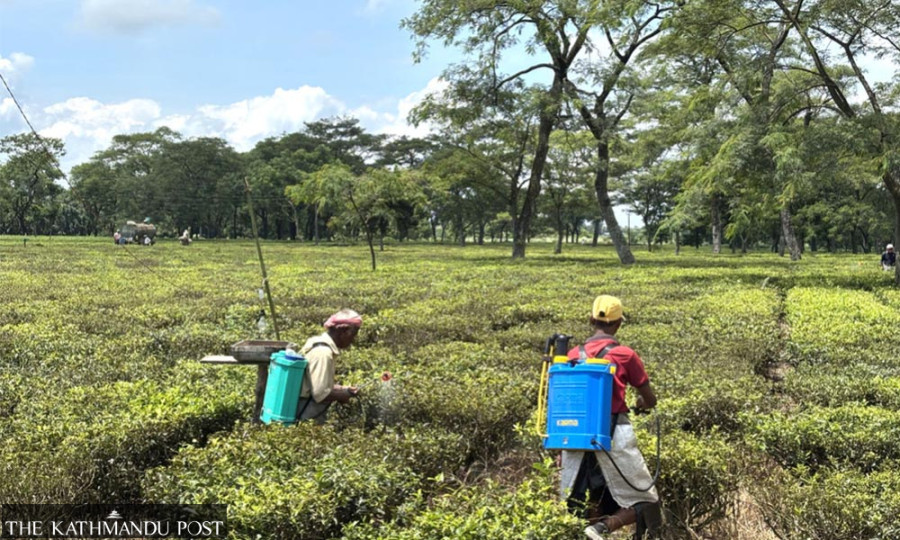
Tea producers describe India’s new quality-testing regime as a non-tariff barrier that has paralysed exports and forced dozens of factories to suspend operations. Parbat Portel/TKP
Nepal’s tea industry has plunged into a severe crisis following the introduction of new quality-testing requirements by the Tea Board of India, bringing exports to a standstill and forcing dozens of factories in the eastern districts of Ilam and Jhapa to shut down.
Fifty-three tea factories in Ilam have ceased operations, while 30 factories in Jhapa have announced plans to suspend production within a few days. Industry representatives warn that the closures could jeopardise the livelihoods of thousands of workers and farmers dependent on the sector.
In Jhapa alone, around 20,000 workers and farmers rely on the tea industry for their income.
Following the export disruption, 53 factories in Suryodaya Municipality decided to halt production from June 15. According to the Suryodaya Orthodox Tea Producers Association Nepal, more than 300,000 kilograms of Nepali tea that has already reached the Indian market remains held up under mandatory quality-testing procedures. In addition, over 700,000 kilograms of processed tea lies unsold in factory warehouses.
Factory owners say storage facilities have reached capacity as sales have stopped, making it increasingly difficult to clear payments owed to farmers for green tea leaves.
Dilli Shrestha, president of the association, said factories could no longer continue operating when finished tea remained unsold.
“The tea processed from green leaves purchased from farmers has not been sold. Warehouses are full. As we still need to settle payments to farmers, we have reached a point where it is no longer possible to keep the factories running,” he said.
Under a Standard Operating Procedure (SOP) introduced by the Tea Board of India on May 1, every consignment of tea exported from Nepal must now undergo compulsory quality testing.
According to tea producers, obtaining test results takes more than two weeks. During that period, consignments cannot be sold, and if a sample fails the test, the tea must either be returned or destroyed, significantly increasing commercial risk.
Gopal Kattel, general secretary of the association, said the current disruption was more serious than previous obstacles faced by the industry.
“In the past, exports were obstructed under various pretexts. This time, they have created a situation where even tea that has already reached the market cannot be sold,” he said.
Tea entrepreneur Punam Rai criticised the Indian authorities’ approach, arguing that quality concerns should have been addressed at the border.
“If there was genuinely a quality issue, testing should have been conducted at the customs. Preventing sales after the product has already entered the market is difficult to justify,” Rai said.
The crisis is expected to have a direct impact on thousands of tea growers. In Suryodaya Municipality alone, 2,995 farmers are engaged in tea cultivation. The municipality produces around 20 million kilograms of green tea leaves annually across 33,655 ropanis of land.
According to Indra Adhikari, an agriculture officer at the National Tea and Coffee Development Board, Nepal exports more than 7 million kilograms of orthodox tea each year, with over 90 percent destined for the Indian market.
Suryodaya Municipality has described the Indian measure as a non-tariff barrier and urged the federal government to pursue immediate diplomatic efforts to resolve the issue.
Industry representatives, farmers and local elected officials argue that the crisis extends beyond Ilam and should be viewed as a national economic concern affecting production, exports, employment and foreign-exchange earnings.
A meeting of the Nepal Tea Planters Association on Sunday decided to shut down 30 large and small tea factories, along with more than a dozen tea estates in Jhapa, from June 18.
According to Shivkumar Gupta, senior vice-president of the association, the closures will remain in effect until India removes the restrictions imposed on Nepali tea exports.
“We have decided to continue the shutdown until India lifts the obstruction,” Gupta said.
Factory owners say exports have been severely disrupted, with vehicles carrying Nepali tea stranded in India because of the new testing requirements.
Tea is cultivated on more than 10,000 hectares of land in Jhapa, where over 20,000 farmers and workers are directly involved in the sector. The closure of factories and tea estates is expected to affect thousands of families dependent on the industry.
Entrepreneurs say difficulties in accessing the Indian market have left factories holding large stocks of ready-to-export tea, while payments to farmers for green tea leaves have already begun to suffer.
Tea traders have called on the government to initiate urgent diplomatic negotiations with India to remove the barriers and resume exports.
Suhang Nembang, a lawmaker from Ilam, has also urged the government to intervene at the highest level.
He called for diplomatic engagement through the Prime Minister’s Office; the Ministry of Foreign Affairs; the Ministry of Industry, Commerce and Supplies; the Ministry of Agriculture and Livestock Development; and Nepal’s embassy in New Delhi to secure the release of tea consignments awaiting clearance.
In a social media post, Nembang stressed that the testing process should be transparent, predictable and time-bound.
“Tea leaves do not wait for administrative procedures and diplomatic correspondence,” he wrote. “Today’s delay puts at risk a year of hard work by farmers, investments by industries and the livelihoods of thousands of workers.”
He also called for the expedited clearance of stranded consignments, mutual recognition of certificates issued by Nepali laboratories and concessional working-capital support for the affected establishments.




 14.7°C Kathmandu