Advanced technology is transforming archaeological conservation in Lumbini
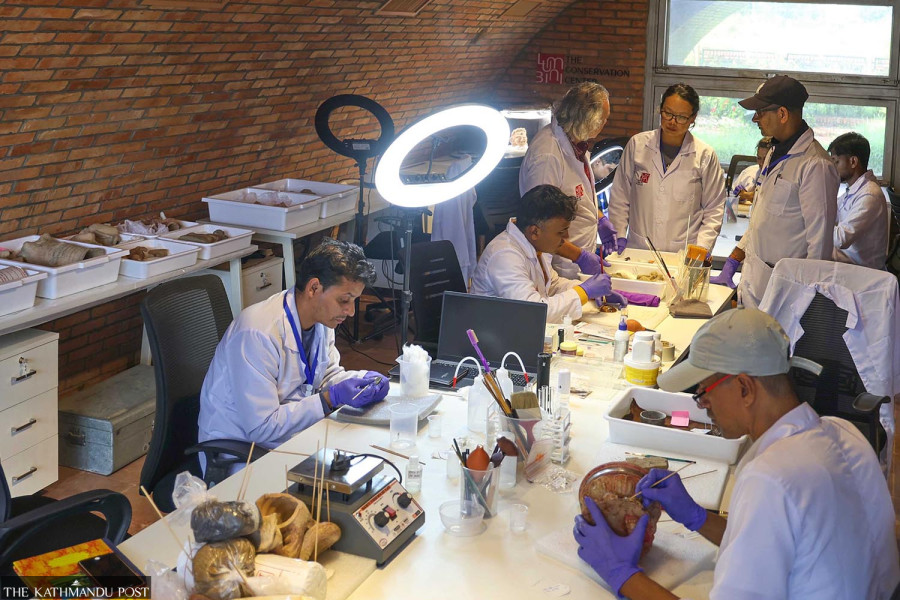
During a four-week training last month, a team of archaeologists conserved 100 historical objects discovered within the Lumbini area. Participants in a training on archaeological conservation at the Lumbini Museum in Lumbini last month. The four-week training was held in a modern conservation lab at the museum. Manoj Paudel/TKP
Dressed in a spotless white apron, trainee Chandra Prakash Pathak kept his gaze firmly fixed on the ancient artefact resting on the table before him. In the field of archaeological conservation, people have to be extremely careful when handling ancient objects, and even a simple mistake or moment of distraction can permanently alter or destroy the authentic form. Pathak stood motionless, fully absorbed in his work.
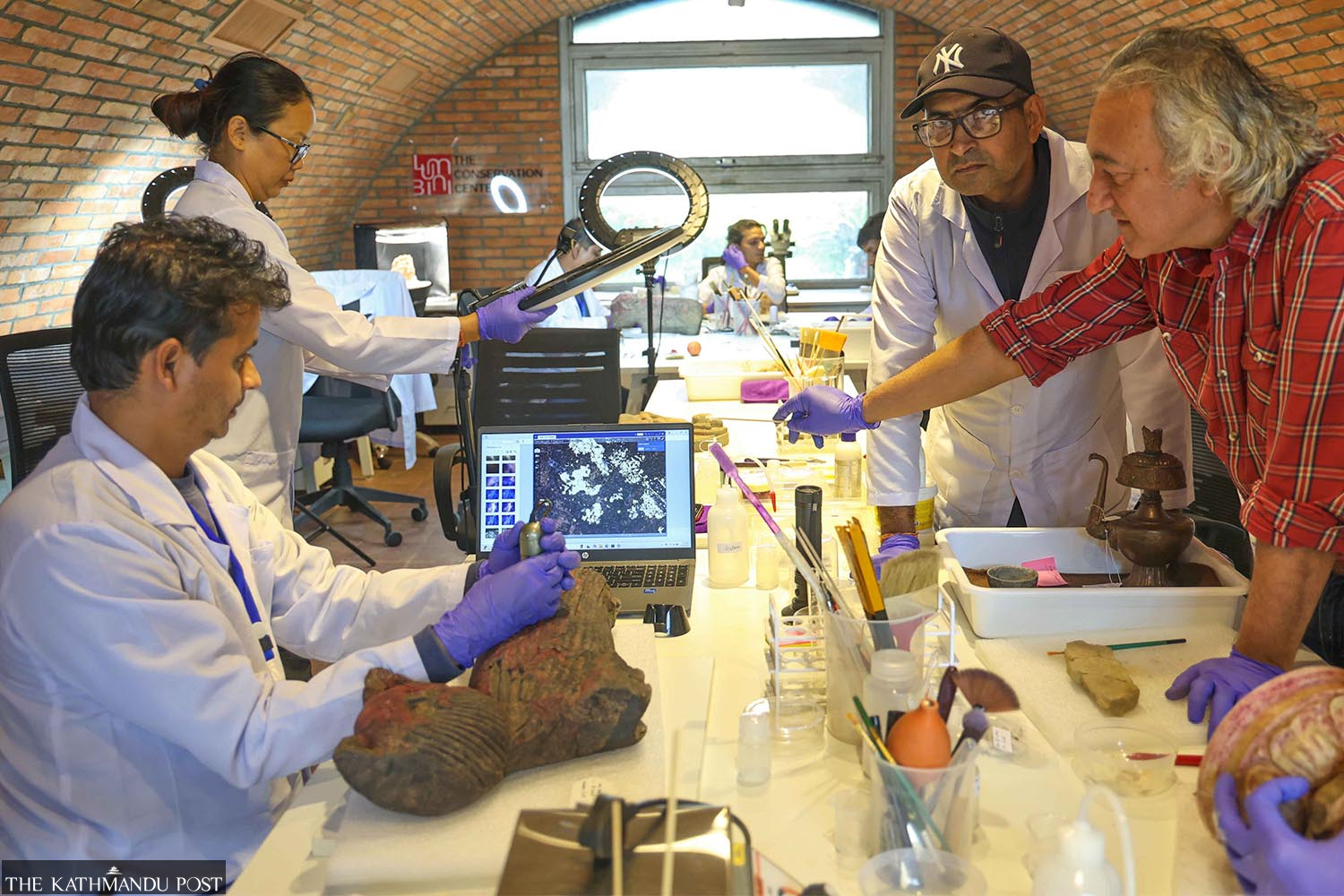
"To conserve an archaeological object effectively, the absolute first step is identifying its underlying decay," said Shanti Sharma, a senior archaeology officer and the chief of the Tilaurakot Museum in Kapilvastu. Peering through a specialised laboratory lens, she carefully adjusted her instrument. "Right now, I am placing these ancient fragments directly under a microscope to pinpoint microscopic structural damage before determining an intervention."
Sharma, who has spent years participating in major excavations across the Lumbini area—including the ancient sites of Lumbini, Ramagram and Tilaurakot—previously relied primarily on theoretical knowledge. Working alongside global experts has allowed her to elevate those concepts into practical, technical expertise.
Sharma is currently mastering scientific methods to classify and treat ancient items made of terracotta, stone, and iron. "Before this, our training was mostly confined to textbooks. Being able to apply these advanced techniques directly in a high-tech laboratory to save museum pieces is incredibly fulfilling,” she said.
Sharma and Pathak are part of a specialised group of ten archaeologists, officers, and advanced students undergoing intensive training to preserve historical relics. This initiative marks the first time that such advanced lab equipment and scientific diagnostic methods have been systematically introduced for heritage conservation in Nepal.
The training was led by Anupam Sah, a globally renowned art conservation specialist and head of the Mumbai-based Anupam Heritage Lab. Participants learned to document every phase of an artefact's treatment, creating digital logs detailing whether an object underwent manual, mechanical, or chemical conservation.
The Lumbini Museum building, originally constructed with financial assistance from the Government of India, is currently operated by the Buddhist Foundation. Manoj Paudel/TKP
Manual and mechanical techniques remain the preferred methods to safeguard historical integrity, according to Himal Upreti, the chief archaeology officer of the Lumbini Development Trust. "We have gained an immense amount of practical skill. Chemical treatments are reserved for severe cases. Even then, we perform patch tests on invisible or reverse sides of an artifact first, observing the chemical reaction before proceeding with full restoration,” he said.
The intensive hands-on workshop, which ran from April 18 to May 18, was made possible following the establishment of a state-of-the-art conservation laboratory inside the Lumbini Museum. The facility features advanced diagnostics, including photogrammetry tools, endoscopy cameras, ultrasonic ablators, magnetic stirrers, moisture meters, light meters, and high-intensity ultraviolet torches.
The Lumbini Museum building, originally constructed with financial assistance from the Government of India, is currently operated by the Buddhist Foundation under a 35-year management agreement signed with the Lumbini Development Trust on September 1, 2018.
The rigorous preservation protocol taught during the session requires conservators to thoroughly document each relic before physical handling begins. The objects are photographed from multiple angles and assigned unique tracking codes.
The introduction of ultraviolet light torches has revolutionised the authentication process. By casting varying degrees of fluorescence across an object's surface, the light immediately reveals past restoration attempts, modern patches, or synthetic alterations, allowing experts to verify the historical layers of an artefact.
During the training session, the team successfully conserved 100 historical objects discovered within the Lumbini area. The treated items included medieval iron hoes, three ancient terracotta ring wells, and delicate clay and stone sculptures depicting Shakyamuni Buddha and various deities.




 14.72°C Kathmandu