Government unveils plans to boost IT exports and digital economy
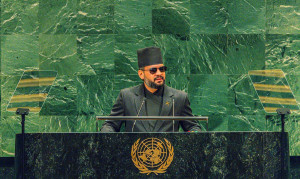
Policies and programmes for 2026-27 prioritises AI, remote work, digital infrastructure and technology-driven growth. President Ramchandra Paudel presenting the government's policies and programmes for the next fiscal year at the joint meeting of the federal parliament on Monday. Post Photo
The government, through its annual policies and programmes, has announced plans to promote Nepal as a technology hub, unveiling measures to expand IT exports, digital infrastructure, and technology-based employment.
The policy document that guides the government’s priorities for fiscal year 2026-27, presented before a joint meeting of the federal parliament by President Ramchandra Paudel, said the Balendra Shah administration would introduce a legal framework for remote work, allowing Nepalis to work from within the country for foreign employers.
The policies and programmes set for the next fiscal year state that the government will prioritise software, digital services, cloud services, cybersecurity, green computing, and artificial intelligence exports as part of efforts to transform Nepal into a knowledge-based economy.
The government also announced plans to establish high-capacity data centres, expand public digital infrastructure and provide tax incentives for research and innovation in the information technology sector. The policy includes provisions for government co-investment in IT research and development.
Paudel said the government aims to develop Nepal as a “tech hub” and gradually move the economy away from dependence on labour exports towards digital trade and high-value service exports.
The government also announced that all economic transactions would gradually be integrated into digital platforms as part of a broader push towards a cashless and transparent economy.
A remittance investment matching fund will be established to channel remittance income into productive sectors, while institutional investors will be encouraged to participate in the capital market and bond market expansion.
The President said a new national employment policy would be introduced to integrate skills, education, labour market information, social security and employment services.
The government also plans to launch a national apprenticeship programme based on a “learning while earning” model and introduce a digital skills passport system to document and certify the skills of returnee migrant workers.
To support startups, the government plans to streamline services through the ‘Startup Nepal’ platform, including easier registration, tax facilitation and access to seed capital.
In the agricultural sector, Paudel said the government would encourage returnee migrant workers to engage in farming and promote pesticide reduction in agricultural production.
The policy document also states that concessional loans and farmer identity card services will be made more accessible, while vaccination campaigns against livestock diseases, including foot-and-mouth disease, will be expanded.
The government has also pledged to review the tax structure to reduce pressure on entrepreneurs and middle-class households and automate VAT and tax refund systems.
Paudel further said foreign aid, private investment and public borrowing would be directed towards high-return projects, while public enterprises would undergo spending cuts and restructuring, including mergers.
The policies and programmes for the next fiscal year also include commitments to provide investment visas to foreign investors, separate the regulatory and service-provider functions of the Civil Aviation Authority of Nepal, and control illegal extraction of stone and gravel.
The government said it would continue a policy of zero tolerance against corruption and improve public service delivery as part of an economic recovery drive.




 15.18°C Kathmandu