President Paudel presents government’s policies and programmes
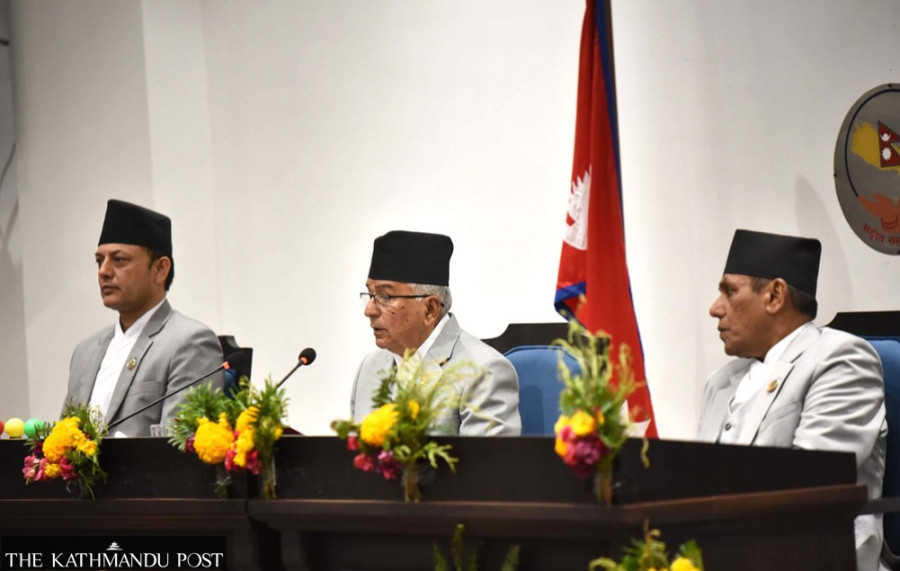
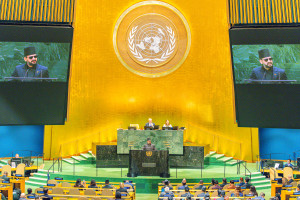
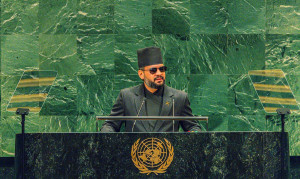
The policy document for fiscal year 2026-27 focuses on jobs, technology, investment, governance reform and social protection. President Ramchandra Paudel (centre) presenting the government's policies and programmes in the meeting of the federal parliament on Monday. Angad Dhakal/TKP
President Ramchandra Paudel on Monday presented the government’s policies and programmes for the fiscal year 2026-27, outlining plans to modernise the economy through digitalisation, technology-driven employment, investment reforms and governance restructuring.
Addressing a joint meeting of the federal parliament, Paudel said the government would introduce a legal framework for remote work, allowing Nepalis to work from Nepal for foreign employers.
The government also announced plans to formulate a new national employment policy integrating skills, education, labour market information, social security and employment services. A national apprenticeship programme based on a “learning while earning” model will also be launched.
The policy document states that skills acquired by returnee migrant workers will be documented through a digital skills passport and linked to international professional certification systems.
The government said it would promote Nepal as a “tech hub”, with plans ranging from artificial intelligence exports to green computing services. The policy also includes provisions for establishing high-capacity data centres, co-investment in the information technology sector and tax incentives for research.
Paudel said all economic transactions would gradually be made digital and cashless as part of efforts to build a transparent and technology-friendly economy.
The government also announced plans to establish a remittance investment matching fund to channel remittance income into productive sectors.
To expand the capital market, the policy proposes bringing in institutional investors and strengthening the bond and debt markets.
The document also includes a commitment to review the tax structure and reduce the burden on entrepreneurs and middle-class families.
The government said it would provide project shares instead of compensation to people affected by development projects, with legal arrangements to be introduced later.
President Paudel also announced that the government would prepare a discussion paper within the next fiscal year on possible amendments to the constitution.
The government pledged structural reform of the Civil Aviation Authority of Nepal by separating its regulatory and service-provider functions.
The policies and programmes further state that investment visas would be provided to foreign investors to encourage foreign direct investment.
The government also announced measures to control illegal extraction of stone and gravel and crack down on illegally operating crusher industries.
In the agriculture sector, the government said it would encourage returnee migrant workers to engage in farming, promote pesticide reduction and make farmer identity cards and concessional loans more accessible.
An extensive vaccination campaign against livestock diseases, including foot-and-mouth disease, will also be launched, while insurance coverage for small farmers will be expanded, the policies and programmes stated.
The policies and programmes also include commitments to formulate a women entrepreneurship strategy, support children with intellectual disabilities and make all public bodies fully disability-friendly in the coming fiscal year.
The government said foreign aid, loans and private sector investment would be directed towards high-return projects. It also pledged spending cuts and mergers of public enterprises as part of broader public sector reforms.
Paudel said the government would continue a policy of zero tolerance against corruption and improve public service delivery as part of an economic recovery campaign.




 15.03°C Kathmandu