As displaced families languish in Banepa holding centre, children watch the school year pass them by
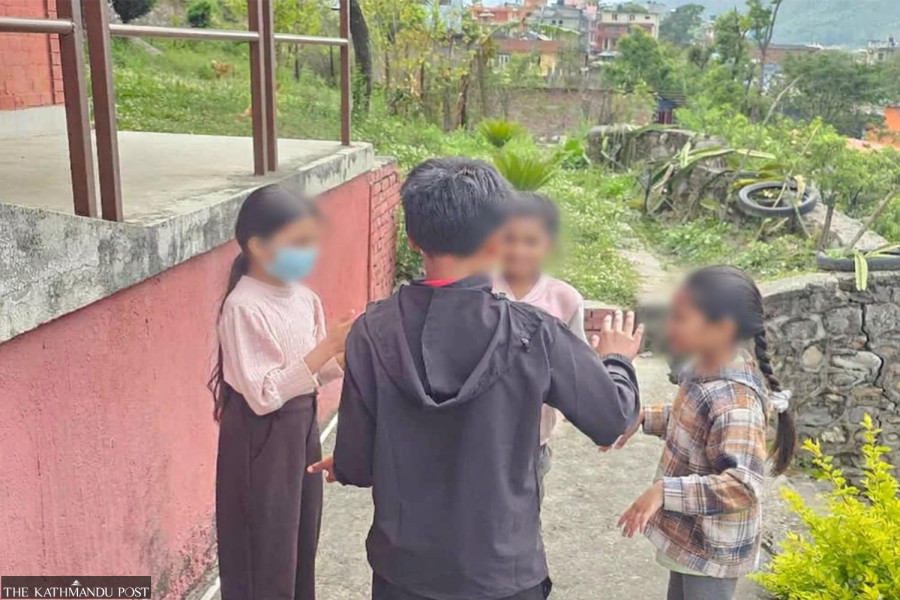
As authorities conduct verification and resettlement screening, dozens of displaced children remain stranded in a temporary holding centre away from their classrooms. Children playing in the holding centre at the Nepal Red Cross Society's training centre in Budol, Banepa-6, Kavre. Jyoti Shrestha/TKP
As the sun dipped behind the hills on Sunday, the rhythmic sound of school bells and the chatter of students heading home filled the air at Budol in Banepa. For most, it was the end of another routine day in the new academic session. But for nine-year-old Roshani Niraula, watching from the periphery of the Nepal Red Cross Society Training Centre, the sight was a painful reminder of a life she was forced to leave behind.
“When will we be allowed to go back to school?” asked Roshani, her eyes fixed on a group of students in uniforms walking past the gates. “Will I ever be able to study like I did before?”
Roshani’s life, along with those of nearly a hundred others, was upended two weeks ago when the Kathmandu Metropolitan City’s bulldozers rolled into the Manohara squatter settlement in Kathmandu. Her home was reduced to rubble, and her educational journey was abruptly severed. Until recently, Roshani was studying at Mount SEB School in Narephant, Kathmandu in the fifth grade.
After the eviction, Roshani among others were taken to Balaju and finally brought to this temporary holding centre in Kavre—far from her books, her teachers and her friends.
“Since the day we were forced out of Manohara, I haven't had anyone to play with,” Roshani said. “The new session has started, but I am just sitting here. Every day I miss more lessons.”
Roshani is not alone. The training centre currently houses 28 children, all of whom are grappling with the trauma of displacement and the sudden halt of their education. The facility, repurposed as a holding centre under the coordination of the Ministry of Urban Development, hosts approximately 100 individuals ranging from two-week-old babies to nonagenarians.
For 13-year-old Rohan Pariyar, the lack of clarity regarding his future is the heaviest burden. A resident of the Thapathali settlement, Rohan attended school in Kupandole and was preparing to enter grade 6 when the dozers raged at his shelter. Today, he possesses no books, no stationery, and no uniform.
“We are being moved from one place to another—first Balaju, now Banepa,” said Rohan. “Being moved around from place to place makes our education feel even more uncertain. Wherever they take us, we shouldn't have to miss out on our schooling.”
Bandika Raigai used to finish her school homework before evening. Once her work was done, she would go out to play with her friends. For the last two weeks, however, she hasn’t been able to go to school or play with them in the holding centre.
The Balendra Shah-led government cleared squatter settlements along the riverbanks and roadsides and those that encroached on the public land in various places. As a result, thousands of families became homeless. While authorities argue that the settlements are illegal and obstruct river restoration, rights activists maintain that forced evictions without a resettlement plan violate basic constitutional rights.
Had the eviction not occurred, eight-year-old Bandika would currently be settling into grade 3. “I should have been buying new books and notebooks by now. I miss my friends the most,” she said. “At the settlement, we were all together. Here, everything is new and strange. If I could just go to school, maybe I could make new friends and feel normal again.”
The psychological toll on these children extends beyond the loss of the classroom. Manika Yadav, who completed grade 2 in Thapathali, expressed a deep-seated hurt over the labels frequently used by society. “Many people call us ‘Sukumbasi children’ (squatter children),” she said. “It feels bad when they say it like that. It makes us feel like we don’t belong anywhere.”
Manika often asks her mother when they can leave the centre. She said that some of her friends, like Hyubrani Karki, managed to move to Kirtipur and have already resumed their classes. “Hyubrani is already back in school. But we were sent here to Kavre,” Manika said. “No one has told us which school we will go to.”
While the families wait, the men of the settlement continue to commute to Kathmandu every morning to work as daily wage labourers, returning to the centre at night. The women and children remain behind, with meals provided by a local hotel.
Responding to the growing concerns over the children’s education, Khagendra Bista, a sociologist with the High Powered Committee for Integrated Development of Bagmati Civilisation under the Ministry of Urban Development, emphasised that the current arrangement is strictly temporary.
“This is not a long-term settlement; it is a short-term holding phase,” Bista said. “We are currently in the process of data collection, screening, and verification to identify genuine landless families. The government intends to manage their resettlement systematically once the screening is complete.”
According to Bista, the authorities aim to complete the verification process within 10 to 15 days. Regarding the educational hiatus, he insisted that the disruption would be brief. “We are aware that the children’s education is being affected by these transitions,” he said. “However, this will not be a long-term issue. Once the genuine landless are identified and relocated to a permanent management site, their schooling will resume immediately.”
Despite these official assurances, the history of squatter resettlement in Nepal remains fraught with delays and broken promises. For the children in Budol of Banepa, every day spent waiting for a ‘screening process’ is another day the school bell rings without them.




 14.79°C Kathmandu