Two-day weekend followed supply crunch from Iran war. If it will fuel productivity in Nepal is the concern
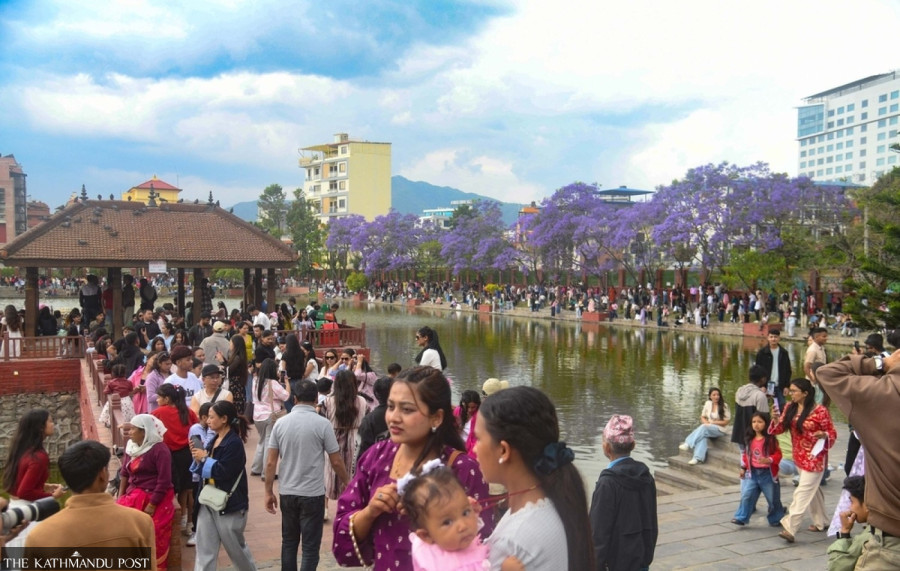
Nepal has tried the two-day weekend before—in 1990, in 1999, in 2022 and again now. Each time, it arrived as a crisis measure and left when the crisis faded. Weekend rush at Kamalpokhari. Deepak KC/TKP
When the Nepal government announced a two-day weekend on April 5, it had one primary goal: save fuel. Whether it is actually working is a different question altogether. According to Nepal Oil Corporation data, Nepal imports over 752,000 kiloliters of petrol and 1.4 million kiloliters of diesel annually—a fuel burden that, combined with what NOC spokesperson Manoj Thakur described as tentative losses of around Rs30 billion, made reducing consumption a matter of urgency for the government.
According to Thakur, a comparison of fuel data from 15 days before and after April 5 showed petrol consumption actually rose by three percent, while diesel consumption fell by roughly 19 percent. A longer 21-day comparison showed petrol down 10 percent and diesel down nearly 30 percent. But NOC itself is cautious about what those figures actually mean. ‘‘It is very difficult to say that fuel consumption decreased solely because of the holiday,’’ Thakur said.
Construction work has stalled across the country due to rising diesel prices and a bitumen shortage, and NOC has simultaneously cut bulk diesel sales by 20 percent to manage its own losses. ‘‘Since NOC is also cutting supply by 20 percent, it is very difficult to claim the holiday is the sole reason,’’ he said.
In other words, the policy's central justification, that it saves fuel, cannot even be cleanly verified by the organisation that tracks fuel consumption. And yet the question the country is now debating has quietly shifted from whether the policy saves fuel to whether it should be made permanent. That is a very different question, and one Nepal has faced—and failed to answer—before.
Nepal has been here before, its attempts at a five-day work week stretch back further than most people realise. The idea was first tested in 1990 – a period Ramchandra Man Singh, a former secretary of the Government of Nepal, witnessed firsthand as a civil servant—when offices affiliated with the judiciary adopted the arrangement with consequences that quickly soured public opinion. Service delivery deteriorated almost immediately. Bureaucrats began leaving their offices early on Fridays and arriving late on Mondays, squeezing the actual work week to something far shorter than intended.
Then, in 1991, the Administration Reform Commission formally recommended a two-day weekend to reduce load-shedding and energy consumption. The government of Prime Minister Krishna Prasad Bhattarai implemented the recommendation in the Kathmandu Valley fully eight years later, in 1999. It was rescinded in less than a year. History repeated itself in 2022, when the government of Prime Minister Sher Bahadur Deuba introduced the same policy on May 15, again citing fuel prices and depleting foreign exchange reserves. It lasted exactly one month before being reversed on June 15.
Singh experienced it differently from how it is often described in hindsight, while he was working in the Ministry of Finance. ‘‘The policy seemed to diffuse or fade away before it could even provoke a strong reaction because it wasn't enforced properly,’’ he said. In his own ministry, the holiday made little practical difference; the workload meant staff came in regardless. What undermined the policy more broadly, he recalls, was not public resistance but institutional failure.
‘‘Even when the start time was set for 9:00 am, people weren't able to follow it strictly. It became more of a ritual than a functioning system.’’
Poor public transport compounded the problem at a time when few people owned private vehicles, making punctuality difficult even for those who wanted to comply.
The pattern is consistent and telling. Every time Nepal has moved toward a two-day weekend, the trigger has been a crisis: load-shedding, fuel shortages, economic stress, rather than a genuine commitment to worker welfare or productivity reform. The policy arrives as an emergency measure and departs when the emergency fades. Even Thakur acknowledges the risk: ‘‘If the government gives a holiday to save fuel, but people just use that day to go travelling, then the policy won't yield the expected results.’’
Before the current implementation, there was a serious attempt to approach this question properly. In 2020, Yogesh Bhattarai, then-minister for culture, tourism, and civil aviation, formed a committee to study whether a two-day weekend could boost domestic tourism, an industry that was devastated by the Covid-19 pandemic.
The committee studied 127 countries, 116 of which practised a five-day work week. Of the 43 Asian countries examined, 38 had five weekdays. Nepal was, at the time, the only SAARC member state with a single-day weekend.
‘‘At that time, we found that most European countries have two days off, and their per capita income is very high,’’ Bhattarai said. ‘‘Nepal didn't have two days off, yet the production capacity remained weak. This showed that having many holidays doesn't necessarily decrease production capacity. The main thing is how efficiently people work.’’
His committee's findings suggested that if even 10 percent of the nearly 8 million people who would gain an extra day off spent it travelling, domestic tourism would receive a meaningful boost. Before the findings could be acted upon, another wave of Covid-19 struck. The report was then forgotten.
Now, Bhattarai says the current government's decision lacks the long-term vision his committee had tried to establish. ‘‘It needs a long-term vision encompassing tourism and productivity,’’ he said. ‘‘If the fuel crisis ends, the holiday might be removed. That alone won't make it sustainable.’’ He is, nonetheless, in favour of making it permanent. ‘‘Working five days with satisfaction can result in higher production than working six days,’’ he said.
If the debate at the policy level sounds cyclical, the experience on the ground is more nuanced and varies sharply depending on where you are in the country.
At Sanima Bank's branch in Kathmandu, one of the employees said, the transition has been largely smooth. Customer complaints have not increased, loan processing has not been disrupted, and the workload feels manageable within five days. Her one concern is structural: most private banks do not pay overtime, yet staff routinely stay until 8 or 9 PM. ‘‘Either the timing needs to be fixed or overtime remunerated for,’’ she said. Without addressing that, she warned, the policy's benefits for banking staff will remain limited.
The picture looks entirely different from Jumla. Hema Mahat (Rokaya), a Primary Third Level teacher at Shree Sambhunath Gyankunja Secondary School in Chandannath-9, said her municipality has already decided not to observe Sunday as a holiday. Her concern is less about whether the policy will hold and more about what it means for the curriculum. ‘‘Before, we had four Saturdays off a month. If we add four Sundays, that's eight days off. We’ve always struggled to finish the course; with eight days off, it will be impossible.’’
She added that in rural Jumla, students frequently miss school during agricultural seasons regardless of official holidays. ‘‘They don't come during work seasons anyway; they are busy in the fields.’’ She said, ‘‘Honestly, I think schools are better off without the two-day weekend.’’
Singh's concern about the current implementation echoes Mahat's. His worry is less about the idea itself and more about who bears the cost of getting it wrong. ‘‘For people travelling from remote areas to get work done, if they miss a window and the office is closed for two days, they might have to stay an extra two days, which is difficult for them,’’ he said.
The disruption extends into the private professional sector as well. Pranita Jha, a tax consultant based in Lazimpat who handles PAN registration, VAT compliance, and audit entries, says her work depends on coordinating simultaneously with auditors, accountants, and government tax officials.
When any one of those parties is unavailable, the entire chain stalls.
‘‘Since auditors and accountants are all closed on Saturday, even if I open my audit firm, I cannot complete the work alone,’’ Jha said. ‘‘So I have to close too.’’ She is unconvinced that Nepal needs the extra holiday at all. ‘‘We already have plenty of festival holidays throughout the year. One day off is enough.’’
Where the ground-level experiences of Mahat and Jha speak to daily disruption, economist Pradeep Panthi offers a broader structural argument. A Research Fellow at the Policy Research Institute, Nepal's government-linked economic think tank, he argued that Nepal lacks the structural preconditions for this policy to deliver what it promises.
‘‘Although Nepal has recently graduated to lower-middle-income status, it remains characterised by a large informal sector, estimated at 42.66 percent of GDP, which is relatively low labour productivity, and weak institutional discipline,’’ he said. ‘‘In contexts where the rule of law, monitoring, and accountability mechanisms are limited, compressing work into fewer days does not necessarily translate into higher efficiency and may instead reduce effective output.’’
Panthi also raises the equity dimension that tends to be overlooked in public debate. The benefits of a two-day weekend, he argues, will disproportionately accrue to the formal sector. Informal and daily-wage workers, who constitute a large share of Nepal's working population, derive little benefit from a policy designed around office schedules.
He does not dismiss the policy entirely. Greater time for family care, reduced work-related stress, potential gains in domestic tourism, and modest energy savings are all genuine possibilities. But he is clear that these gains require prior structural reform: stronger governance, higher productivity, and a gradual formalisation of the labour market.
‘‘A durable transition would require prior structural reforms to raise productivity, strengthen governance, and gradually formalise the labour market, rather than adopting a policy model designed for more advanced economies,’’ Panthi said.
Among younger Nepalis, the two-day weekend provokes a more impatient kind of frustration, not with the idea itself, but with how it has landed.
Agrim Adhikari, a 23-year-old student in Kathmandu, said the policy's biggest failure so far is not productivity or scheduling, but communication. ‘‘People still hold the concept that banks don't open after 12:00 PM on Fridays,’’ he said. ‘‘Now, people are even showing up at banks on Sundays and having to return home because they didn't realise it was a holiday. The change hasn't been communicated effectively.’’
Adhikari is not opposed to the idea of a two-day weekend in principle, but he is sceptical that Nepal is ready for it right now. ‘‘It currently feels like the policy has been enforced rather than integrated,’’ he said. ‘‘Integrating a two-day weekend directly into society is causing problems with people's planning and business models.’’
Adhikari points to the confusion still surrounding office schedules, whether institutions should close entirely or work in shifts as evidence that the groundwork simply was not laid before the policy was announced.
For him personally, Sunday feels like an unused day rather than a meaningful rest. ‘‘Productivity doesn't just happen because it's Sunday; it doesn't work that way,’’ he said. ‘‘This policy doesn't feel beneficial for students yet because it feels forced rather than structured through surveys or an understanding of people's choices.’’
Bhattarai believes that society has shifted from joint families to nuclear ones, from cooking at home to eating out, from six-day rhythms to something more flexible. ‘‘If implemented gradually now, it will likely succeed,’’ he said. But he is also clear that implementation alone is not enough. The policy needs to be packaged with tourism incentives, cultural leave provisions, and strict enforcement of working hours on the remaining five days.
The structural problems Panthi identifies—weak accountability, low productivity, and large informality—are the same ones that led the 1990 and 1999 experiments to failure.
What the last three decades make plain is that Nepal does not have a policy problem. It has an implementation problem and, more fundamentally, a vision problem. The two-day weekend never failed because it was a wrong idea; it failed because it has always been introduced as a short-term fix for an immediate crisis. There is no plan for what policy to follow once the crisis ends.
Singh, who has watched this debate play out across three decades of public service, is not opposed to the idea but is firm on what it needs. ‘‘While it's currently being framed as a way to reduce fuel consumption, making it permanent requires looking at all sides,’’ he said. ‘‘It might increase economic activity through tourism, but you must address service delivery issues in the health and education sectors. All these factors must be considered before any permanent implementation.’’
Aarya Chand is a reporter at The Kathmandu Post covering social issues. Before moving to the social beat, Chand was an intern covering culture and lifestyle for the Post.




 15.26°C Kathmandu