A single coffee sapling transforms farming prospects in Dolakha village
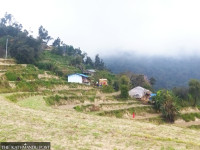
Farmers, cooperatives and the local government in Kattike of Bhimeshwar Municipality-5 have joined hands to plant 1,700 saplings and expand commercial coffee farming. Ram Sharan Budhathoki of Bhimeshwhor-5, Dolakha in his coffee field. He has 40 mature coffee plants in his field, while another 100 new saplings are growing. Kedar Shiwakoti/TKP
Forty-five years ago, Kirantichhap, then under Mati Village Development Committee and now part of Bhimeshwar Municipality, was known as one of the district’s major commercial centres. Ram Sharan Budhathoki of Kattike in Bhimeshwar Municipality-5 used to run a business there while also teaching at a nearby school.
At the time, a horticulture centre supported by the Swiss government operated in Kirantichhap to promote fruit farming suited to the local geography, including mangoes and lychees. Budhathoki received a coffee sapling from the centre as a gift, though he knew little then about the plant he had brought home.
The “Arabica” variety tree planted at the time still stands in his field today. Seeds from that original tree have since produced around 40 coffee plants around his home. Despite this, Budhathoki never seriously considered coffee farming as a commercial venture.
He said he planted the coffee merely out of interest, as he had neither technical knowledge nor any understanding of the market.
“I still don’t know how to process or use the coffee produced in my own field,” he said. “In such a situation, how could I think of commercial farming?”
Budhathoki said he planted the sapling simply because it had been gifted to him by foreigners.
“I had only heard about coffee before but had never seen it growing,” he said. “When the tree started producing red berries, I did not pay much attention. Only later did I realise it was coffee.”
Now, more than four decades after that first plantation, Kattike is being developed as a coffee pocket area.
After identifying the local soil and climate as suitable for coffee cultivation, Hamro Janakalyan Saving and Credit Cooperative supplied 1,700 saplings to 13 farmers in the area to begin commercial farming in June 2025. Budhathoki currently has 40 mature coffee plants in his field, while another 100 new saplings are growing.
The cooperative later coordinated with the local government to expand coffee farming in Kattike. With investment from the municipality, the village has formally entered the coffee pocket area programme. Budhathoki said commercial farming has finally begun 45 years after the first tree was planted because the environment proved suitable for coffee cultivation.
Farmers in the area have also formed the Kiranteshwar Organic Coffee Farmers’ Group to expand cultivation. The group currently has 30 members, among whom 13 farmers have already started commercial coffee farming.
Deepak Basnet, manager of the cooperative, said farmers are currently cultivating coffee on 15 ropanis of land and plan to expand the area to 50 ropanis. He said the goal is to involve all members of the group in coffee farming.
According to Basnet, around 7,000 coffee saplings will eventually be planted in Kattike alone. He said farmers have shifted towards commercial farming as the market for coffee continues to grow. However, coffee produced in the area has not yet reached the market.
Bhimeshwar Municipality has allocated Rs1 million as a 50 percent contribution to a Rs2 million project aimed at developing Kattike as a coffee pocket area. The remaining Rs1 million will be borne by local farmers, mainly for irrigation and sapling management.
Basnet said the cooperative will invest in marketing and equipment for coffee processing.
“The cooperative’s main objective is to support coffee farmers through subsidised loans for processing machines and marketing,” he said. “We want farmers to earn income from coffee farming and are working as a bridge between the farmers and the local government.”
He added that once production increases, the cooperative will invest in coffee processing technology and support farmers in marketing their produce.




 22.94°C Kathmandu