Pleasant surprise as Karnali students get free textbooks at enrolment
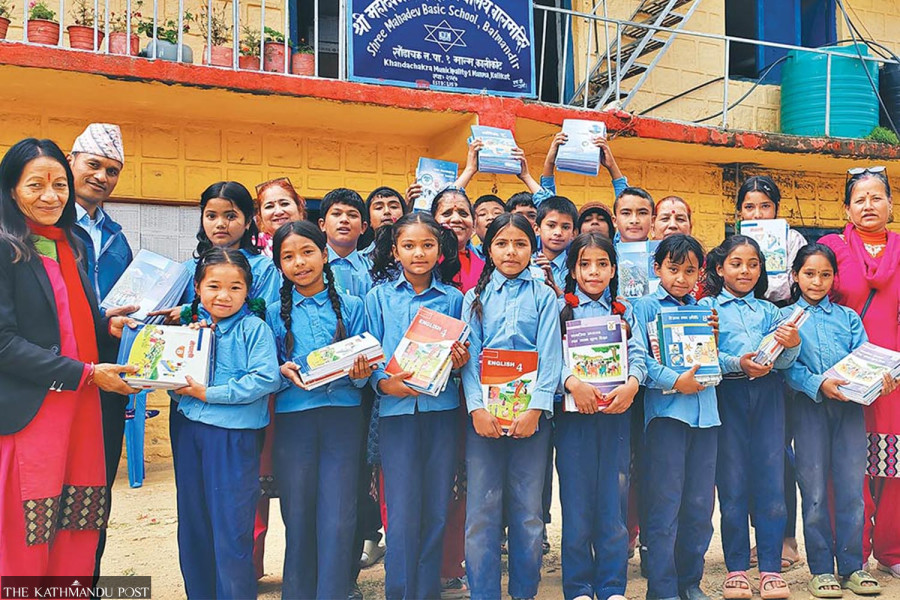
2026 sees a departure from the years-old story of students in remote districts not getting textbooks.Students pose with books for pictures at Mahadev Basic School in Manma Bazar, Kalikot. Tularam Pandey/TKP
For Jayanti Baral, a sixth grader at Badimalika Secondary School in Raskot Municipality, Kalikot, the start of the new academic session used to be a period of worry rather than excitement.
In previous years, the arrival of spring in the high hills of Karnali, the country’s remotest province, rarely coincided with the arrival of new textbooks. Instead, Jayanti and her peers would spend the first few months of the academic year sharing tattered volumes or waiting for shipments that often stalled in the lower places.
This year, however, the narrative has shifted. As she stood in the school courtyard holding a complete set of textbooks, Jayanti could hardly contain her joy. “Last year, I finished the fifth grade using old, damaged books provided by the school,” she said, flipping through the fresh pages of her new book.
“This is the first time I have received a brand-new set right at the time of enrolment. It makes me feel much more motivated to start my studies.”
Hikmat Shahi, a ninth grader in the same school, echoed a similar sentiment of relief. He recalled how past delays had hampered the quality of learning in the classroom. “In the past, we never got a full set at once. Trying to follow the teacher’s lecture while looking at a friend’s book was difficult, and often we simply couldn’t understand the lessons,” he shared his ordeal. “Having my own books on the first day has filled me with a new sense of enthusiasm for the year ahead.”
The timely distribution of textbooks is not only a source of joy for students; it has also lifted a big burden off the shoulders of educators and guardians. Pushpa Raj Baral, principal of Badimalika Secondary School, said this is the first time the school has been able to provide every student with a full set of books, fully paid for by the federal government, in the enrolment phase. In previous years, transport contractors would frequently delay deliveries, forcing the school to rely on old, tattered books to keep classes running.
Currently, Badimalika Secondary School has enrolled 312 students, with a notably higher representation of girls—197 compared to 115 boys. All of them started their first day with a set of new textbooks.
This scene is being replicated across the province. At Janajiban Secondary School, another community school in Kalikot, all 470 enrolled students have already received their textbooks. “The joy they feel is palpable,” said Principal Tej Bahadur Shahi. “For the first time, our students are free from the compulsion of studying from worn-out, outdated copies.”
Karnali, the largest province in area but with the least population density, has a total of 3,026 community schools. The province recorded an enrolment of 595,599 students in the last academic year. The Education Development Directorate, under the provincial ministry of social development, expects similar numbers this session as well.
Deepa Hamal, the acting chief of the directorate, confirmed that teaching has already commenced in most schools. “In many areas, the enrolment campaign and regular classes are happening simultaneously. The system we established to ensure that textbooks reach the hands of students immediately upon enrolment is finally yielding results,” she claimed.
Data from the Janak Education Materials Centre (JEMC), the state-owned body responsible for textbook production, supports this story of progress. Jamuna Dhakal, the centre’s provincial chief in Karnali, revealed that while the province requires approximately 120,000 sets of books, over 80,868 sets have already reached the schools. “About 80 percent of the total requirement has already been delivered,” said Dhakal.
The current efficiency stands in stark contrast to the historical neglect. A huge number of students in the mountain districts of Karnali were forced to study without textbooks in the past.
JEMC officials stated that additional books will be dispatched based on specific demands from schools. This year’s figures represent the highest volume of books sent to the region before the start of an enrolment campaign in over a decade.
During the enrolment period last year, only 40 percent of textbooks reached the 10 mountain and hill districts of Karnali. Historical data shows distribution rates of 49 percent during enrolment campaign in 2024-25, 48 percent in 2023-24, 45 percent in 2022-23, and 40 percent in 2021-22. In the years prior to that, the rate typically hovered between 30 and 40 percent.
The federal government decided to launch the nationwide enrolment campaign on April 28, with teaching starting from May 3 this year. The campaign started two weeks late this year compared with previous academic sessions.
Dhakal attributed this success to a longer preparation gap after the annual examinations and the fact that the curriculum remained unchanged this year, allowing for an early printing and distribution schedule.
The JEMC reported that it has already recorded textbook sales worth Rs76.9 million. Under the current arrangement, JEMC is responsible for the distribution of books for grade 3 and grades 5 to 10. The printing and distribution for grades 1, 2, and 4 have been assigned to the private sector. To ensure the materials reach students across the province, the centre has enlisted 89 registered bookstores to manage the local supply chain.
This year’s success, however, is not unqualified. In Jajarkot, the enrolment campaign continues to face the challenge of seasonal migration. Yagyashwor Khattri, head of the Education Development and Coordination Unit in Jajarkot, said that many parents travel to India for manual labour, often taking their children with them during the transition between academic years.
“We also see students heading into the highlands to collect medicinal herbs like Yarsagumba,” said Khattri. According to him, roughly 80 percent of students have enrolled, the remaining 20 percent are expected to return only after the harvesting season or when their parents return from seasonal work.
Financial and administrative paralysis also haunts some educational institutions of the province. In Soru Rural Municipality of Mugu, which manages 39 community schools for nearly 5,500 students, the local government failed to release the Rs2 million needed for textbook procurement. Gobinda Shahi, a teacher at Sorukot Basic School, revealed that schools had to take books on credit to ensure students didn’t go empty-handed.
This crisis was triggered by the absence of the chief administrative officer Kushal Baral and the suspension of the municipal accountant following a corruption case filed by the Commission for Investigation of Abuse of Authority. Birendra Malla, the head of the local education branch, admitted the difficulty. “Despite the credit, we ensured the children got their books. Classes are underway, but the financial settlement remains a headache.”
Geography remains the ultimate adversary in Karnali. Senior Education Officer Balbir Sunar at the ministry pointed out that while road connectivity reached Humla only this year, many remote local units still rely on the ancient method of mule-back transport once the books reach the district headquarters.
“In the past, contractors would use the lack of roads as an excuse for months of delay. The shift in management, ensuring that local stations have stocks ready before the session starts, has removed some of these traditional bottlenecks,” said Sunar.
The pedagogical importance of timely book delivery cannot be overstated. Jaya Bahadur Bam, principal of Saraswati Secondary School in Humla, emphasised that books provide a psychological anchor for students.
“When a child has a book, he or she learns faster and participates more actively in homework and classroom activities. Without books, it is a struggle for both the teacher to teach and the students to maintain morale,” he said.
In previous years, Bam’s students would wait until July or August to see textbooks. This year, all 390 students have gotten their books at enrolment.




 17.84°C Kathmandu