Speed limits set for Narayanghat-Butwal stretch as road upgrade nears completion
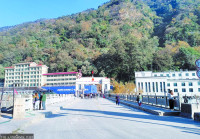
Motorists can travel at up to 80 km per hour on straight stretches and 40 km in the Daunne hill section. The highway varies in width, with six lanes in major market areas, four lanes in most stretches, and three lanes along the Daunne section Narayan Sharma/TKP
Authorities have fixed speed limits for the upgraded Narayanghat-Butwal stretch of the East-West Highway, with vehicles allowed to travel between 40 to 80 kilometres per hour depending on terrain and settlement zones.
The much-anticipated road expansion project, one of the country's largest highway upgrades, is now in its final phase, with 81 percent of construction completed as of last week. Officials say the new speed regulations will come into force in a bid to reduce traffic accidents in sections where work has been finished.
According to Chuda Raj Dhakal, project director at the Asian Development Bank (ADB) Project Directorate, vehicles can travel at up to 80 km per hour on straight stretches of the highway. “In market areas and crossing points, vehicles will need to maintain a reduced speed, roughly equivalent to covering one kilometre in one minute,” he said, indicating a limit of around 60 km per hour in such zones.
A stricter speed limit applies along the Daunne hill section, a 14-kilometre uphill stretch between Dumkibas and Bardaghat, where vehicles will not be allowed to exceed 40 km per hour due to sharp gradients and safety concerns.
Road markings and traffic signs indicating speed limits of 80, 60 and 40 km per hour are being installed across the highway. Yellow lines are being painted along the edges and white lane dividers in the middle to enforce lane discipline, which officials say will be critical on the expanded carriageway. “We expect these markings to guide drivers and reduce accidents by ensuring lane discipline,” said Dhakal.
According to the traffic police, speed limit enforcement will be stepped up once signage installation is complete. Traffic police officers equipped with speed guns will monitor vehicles and impose on-the-spot fines for violations.
“After the signs are in place, we will intensify monitoring using speed guns. Ensuring lane discipline on a highway that stretches up to six lanes in some sections will be a challenge, but we are preparing accordingly,” said Kushal Bartaula, chief of the district traffic police in Nawalparasi East.
The highway varies in width, with six lanes in major market areas, four lanes in most stretches, and three lanes along the Daunne section. Work on concrete paving in water seepage-prone areas and steep inclines is nearing completion.
The project aims to ease traffic congestion and reduce travel time along one of the country’s busiest corridors, which connects central and western Nepal. Once fully operational, the 114-kilometre journey between Narayanghat and Butwal is expected to take around two hours under the new speed limits.
Construction work on the eastern section from Gaindakot to Dumkibas, spanning 61 kilometres, is almost complete. In the Daunne stretch, blacktopping and concrete works are still under way. Most of the western section from Bardaghat to Butwal has also been completed, with workers currently installing road dividers along both sides.
Officials say additional safety measures are being introduced alongside speed regulations. Automatic number plate recognition cameras will be installed in eight major market areas and in the Thumsi section of Gaindakot. “We are also preparing to place cameras at wildlife crossing points,” said Dhakal, citing concerns about road safety and environmental impact.
The project was awarded to China State Engineering Corporation at a cost of Rs17 billion. Delays have plagued the road-widening project since its inception. The road, meant to be completed in 44 months, has remained unfinished for seven years. Construction began in April 2019, with an initial completion deadline of August 2022. The deadline has since been extended four times, most recently to August 2026. Funded by a loan from the Asian Development Bank, the total cost of the projects stands at Rs16.99 billion.
Authorities now say the final phase is progressing steadily, raising hopes that the improved highway will soon deliver safer and faster travel for thousands of daily commuters.




 24.07°C Kathmandu
.jpg)