Nepal sets up recovery mechanism for troubled cooperatives
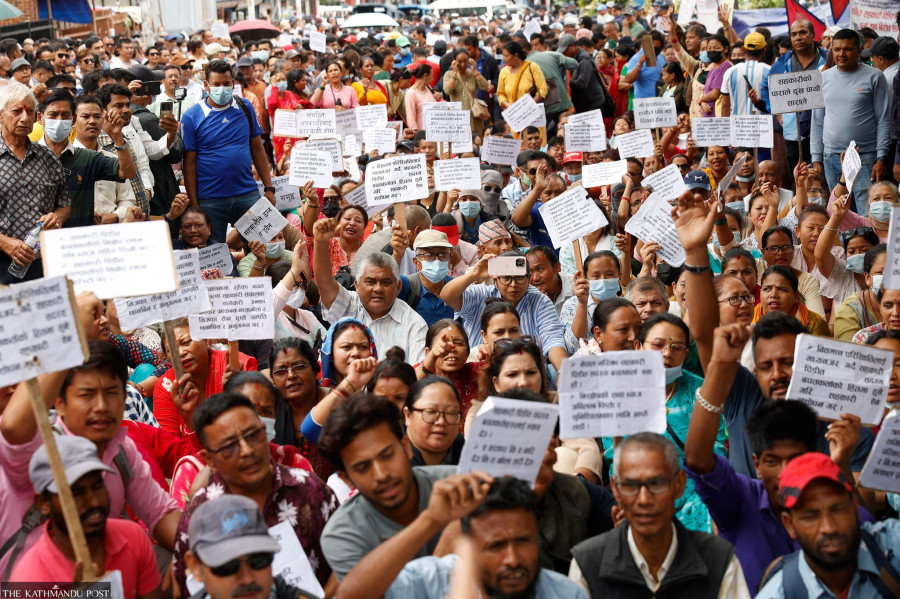
A revolving fund will be used to return small depositors’ savings. Victims take to the streets demanding a return of their savings in this undated photo. Post file photo
The government is preparing to set up a ‘Revolving Fund’ to return deposits of savers trapped in troubled cooperative institutions. With the publication of the Procedures for the Establishment and Operation of the Revolving Fund for Returning Savings of Members of Troubled Cooperative Institutions 2026 in the Nepal Gazette on Thursday, the legal and administrative framework for establishing the fund has been completed.
The government brought the procedures to implement point 99 of the hundred-point agenda approved by the Council of Ministers meeting on March 27, 2026. The agenda aims to ensure immediate repayment of savings to members of troubled cooperatives. The fund will be operated under the Problematic Cooperative Management Committee, which will be responsible for its management and distribution process.
Policy framework and legal basis
Point 23 of the government’s policies and programmes for fiscal year 2025-26 and point 61 of the budget statement for the same year state that savings of up to Rs500,000 in troubled cooperatives will be returned through a revolving fund mechanism. The repayment is expected to be covered through recovery from cooperative savings, loans, fixed assets, and personal assets of board members.
In addition, a Supreme Court order issued on January 25, 2026, directed the state to return funds belonging to small depositors, defined as those with savings below Rs500,000, in cooperatives facing financial distress.
Based on these provisions, the government has decided to proceed with the establishment of the revolving fund aimed at returning deposits of small savers. Although the procedures do not specify the total size of the fund, the current fiscal year’s budget has allocated Rs250 million under recurrent expenditure for returning cooperative deposits.
Officials at the Ministry of Finance said the government will initially deposit the Rs250 million into the fund. The allocation for the next fiscal year will be decided after assessing the total requirement for repayments.
Sources of the fund
Apart from government allocation, the revolving fund will also include money recovered from the auction of assets belonging to directors, account committees, managers, loan sub-committees, and other responsible or authorised persons involved in misappropriation or embezzlement of cooperative funds, savings, loans, or shares.
Recovered amounts from cooperative institutions and other sources will also be deposited into the fund.
The procedures state that the Problematic Cooperative Management Committee must keep the funds in a separate account at a commercial bank and maintain individual records of transactions.
It further states that if asset sales of cooperatives are insufficient to repay depositors, and if any family member of a director has transferred property or invested in a company through division of property, divorce, or other means, the committee may freeze and auction such property.
Process for returning savings
Before repayment, the committee will collect data from depositors. Following a public notice, depositors must submit citizenship certificates, share certificates or proof of membership, Permanent Account Number (PAN), and National ID.
They will also be required to provide details of total savings, applicable interest rates, amounts already withdrawn, and bank account information. Depositors must also disclose whether they hold accounts in more than one cooperative institution.
After verification of records, the committee will distribute funds based on applications in line with the Cooperative Act 2017. The revolving fund will later be reimbursed by the concerned cooperative institutions. All payments will be made through bank transfers only.
Restrictions and priority groups
The procedures state that the balance recorded in cooperative records as of the day before being declared ‘troubled’ will be used as the basis for repayment calculations.
Depositors with outstanding loans will not receive repayment until their dues are cleared. Similarly, savings held by directors, managers, their immediate family members, and individuals involved in financial irregularities will not be returned until all other legal claims are settled.
If a case is under litigation, repayment will be withheld until a final court verdict. In cases where a depositor has died, the amount will be released to legal heirs.
The committee may prioritise repayment for certain groups. These include small depositors, single women, senior citizens above 60 years, Dalit and indigenous communities, and persons with disabilities.
Monitoring and recovery mechanism
The Ministry of Land Management, Cooperatives and Poverty Alleviation will oversee monitoring of the fund and repayment process.
For depositors with savings in more than one federal-level troubled cooperative, repayment will be processed through a single institution. If available funds are insufficient, the committee may distribute payments on a pro-rata basis.
The procedures also state that amounts disbursed from the revolving fund will be recorded as a loan to the cooperative institution concerned.
Before any repayment, the assets and bank accounts of responsible officials and their immediate family members will be frozen. The committee is also required to carry out audits in accordance with existing laws.
Finally, the committee must repay the government using recovered funds from cooperative loan recoveries and asset sales. If recovery from the institution is not possible, the committee will be authorised to recover dues from directors and responsible individuals in the same manner as government arrears.




 14.69°C Kathmandu