Leasehold forestry revives barren hills, boosts incomes in Chitwan
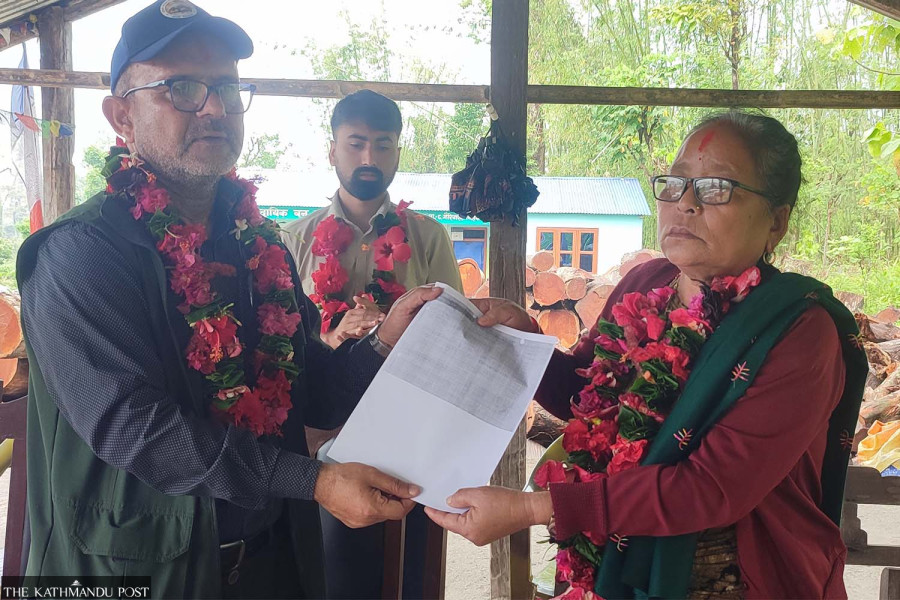
The programme has allowed communities to manage and reap benefits from nearby degraded forest land. Larimaya Gurung, chairperson of Chuwad Tandi Kabuliyati Forest, receiving a voucher from district forest officer Bishnu Prasad Acharya (left) for the proceeds from the sale of fallen and dried timber collected from the leasehold forest. Ramesh Kumar Paudel/TKP
A once barren hillside in ward 8 of Kalika Municipality, Chitwan, has been transformed into a thriving green forest, bringing both ecological recovery and steady income to local residents.
Above the home of Larimaya Gurung, aged 60, in Gairibari, a hill that stood dry and degraded 25 years ago is now covered in dense greenery. Local residents say the change is the result of collective effort under leasehold forestry programme, which allows communities to manage and benefit from nearby degraded forest land.
“We used to cut grass and sell bamboo that grew here,” Gurung said. “This year, we earned Rs756,000 just from selling sal timber.”
Gurung is among 12 local residents who took responsibility for protecting the forest under a 40-year lease in 2000. Their group, Chuwad Tandi Kabuliyati Forest, now manages 5.19 hectares of land. While some sal trees existed earlier, the area had been deteriorating due to neglect and overuse.
According to Bishnu Prasad Acharya, divisional forest officer at the Division Forest Office in Bharatpur, such leasehold forestry arrangements are designed to restore degraded national forests near settlements while improving livelihoods. “Communities are allowed to plant, grow and sell crops, fruits and forest products,” he said.
The group’s journey has not been without hardship. Gurung recalled that during the armed conflict period (1996-2006), shortly after the 2006 Comprehensive Peace Agreement, Maoist combatants set up a temporary camp near the village and felled around 40 to 42 young trees.
“We tried to stop them by hugging the trees, but they did not listen,” Gurung said.
Despite lodging complaints with the district and central authorities, no action was taken. At the time, strict rules prevented local users from harvesting even fallen or dried timber from leasehold forests.
“Communities could only use what they planted, like grass or bamboo. Existing trees were off-limits,” said Acharya. A policy revision in 2022 changed that. Communities are now allowed to collect and auction fallen or dried trees. Under the revised rules, 50 percent of the revenue goes to the government and the remaining half to the user group.
“The change came after repeated complaints that timber was rotting or being lost to forest fires without being utilised,” Acharya said. “Now, proper use of forest resources has begun.”
According to Usha Kunwar, division supervisor for leasehold forestry, Chitwan has a total of 443 such forest groups managing around 1,417 hectares. Most groups have traditionally focused on grass, broom grass (locally called amriso) and bamboo cultivation, but timber income has only recently begun.
This year, six groups, including Chuwad Tandi, received permission to harvest timber. Five have already completed the process and sold their produce. In nearby Kalika-11, the Jaladevi Kabuliati Forest Group, dominated by Chepang households, is also preparing to collect timber. Secretary Guthilal Chepang said their ancestors once grew indigenous banana varieties in the forest and bartered them for rice in nearby Tharu villages. “Those bananas disappeared about seven or eight years ago,” he said, noting changes in forest use over time.
Kunwar said that leasehold forestry groups in Chitwan are largely made up of marginalised communities, including Chepang, Gurung, Tamang and Dalit households, many of whom lack formal land ownership.
There are six groups of Gyamedung Leasehold Forest in the upper Kalika region that collectively earn around Rs2 million annually from broom grass products alone, Kunwar added. There are 30 households as the users of the leasehold forest.
In Gairibari Leasehold Forest, bamboo and grass remain key sources of income. Nearby vegetable farmers in Shaktikhor depend on bamboo supplied by these forests. “Our group sells bamboo worth around Rs400,000 annually,” said Sangita Pariyar, chairperson of the Thulo Bigata Leasehold Forest Group.
The leasehold forestry also helps to expand livestock farming in the area. After planting fodder species, locals began raising cows, buffaloes and goats. “Those who rear goats sell ground grass while cattle owners sell tree fodder,” said Manmaya Gurung, chair of the Ichchhakamana Kabuliati Forest Group.
Gurung herself sells up to 26 litres of milk a day. A milk collection centre established three years ago has helped farmers access the market.
With the addition of timber income, communities say leasehold forestry is finally delivering both environmental and economic returns.
“We protected this forest land from encroachment,” Gurung said. “Earlier, nothing grew except nettles. Now it is green and supports our livelihoods.”




 25.92°C Kathmandu
1.jpg)