Maoist insurgency victims urge PM Shah for credible transitional justice
Stating that truth, justice and reparations are sidelined, victim groups call for legal reforms, transparent commissions and immediate government action. Post Illustration
A coalition of conflict victims’ organisations has urged Prime Minister Balendra Shah to take “credible and concrete” steps to ensure truth, justice and reparations for victims of Nepal’s decade-long armed conflict.
In an open letter addressed to the prime minister on Thursday, the victims congratulated the prime minister on assuming office with strong parliamentary backing but raised concern over the lack of priority given to transitional justice in the government’s agenda, including its commitment paper and 100-point programme.
Victims say the issue remains marginal even in the Rastriya Swatantra Party’s election manifesto, calling the government’s silence “disturbing and painful” for those awaiting justice.
Nearly two decades after the conflict ended, hundreds of serious human rights violations remain uninvestigated, with neither the truth established nor adequate reparations provided, the letter says.
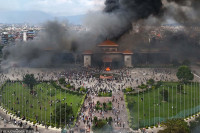
The groups accuse successive governments of politicising the process, deepening frustration among victims. They warn that failure to act has contributed to rising public discontent, including recent youth-led protests.
They criticise repeated appointments to the Truth and Reconciliation Commission and the Commission of Investigation on Enforced Disappeared Persons through non-transparent, politically influenced processes, saying these have borne no meaningful results in 11 years.
The victims’ group recalled that the current commissioners have been rejected by victims, with 334 individuals filing a petition at the Supreme Court demanding transparent, merit-based appointments.
The letter also flags legal provisions that could institutionalise impunity, including limits on prosecution timelines and reduced penalties for serious violations, which it says contradict constitutional and international standards.
Victims call for immediate legal reforms, new independent commissions and meaningful participation in the process, warning that continued inaction risks further unrest.




 23.25°C Kathmandu