Mountain students to suffer more as off Sundays pile on learning holidays
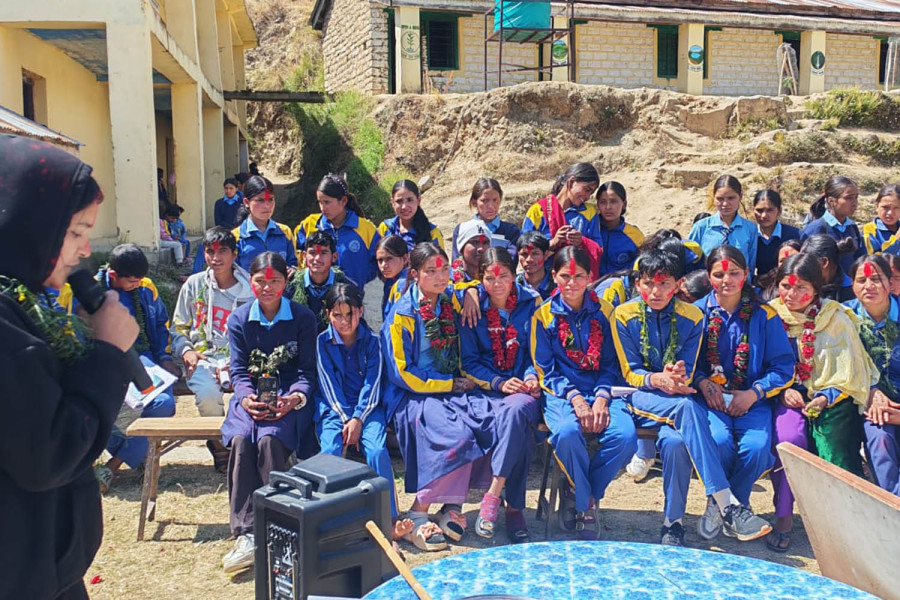
Federal directives on enrolment and teaching schedules clash with climatic, social and structural realities across Karnali and Madhesh, causing worries about incomplete courses and worse learning outcomes. SEE-appearing students attend a farewell function at Panchadeval Secondary School in Kalikot recently. Tularam Pandey/TKP
The federal government’s attempt to enforce a uniform academic calendar nationwide is likely to face resistance from local governments, as different climatic, social and infrastructural realities in the mountainous and Tarai regions disrupt schooling and threaten course completion.
Chhundup Tamang of ward 6 in Mugum Karmarong Rural Municipality of Mugu travels to alpine meadows, locally known as patan, every year with his wife, Sangmu, and their three sons to collect Yarsagumba, a high-value medicinal fungus. During this period, his children miss at least a month and a half of schooling, a disturbance that has become routine for families in the highlands.
Keeping in view the biting cold that grips the region for several months, the rural municipality provides a month-long winter break in January. Schools are often forced to close during the rainy season as well due to access problems and safety concerns.
“In total, all the village children attend school for about six months,” Tamang said. “Children cannot study regularly due to the weather and family compulsions.”
His sons—Karma, Sanduk and Shashank—recently passed grades 9, 8 and 6, respectively. Despite their progress, Tamang said he remains concerned about their studies, particularly as the Yarsagumba harvesting season coincides with this year’s enrolment campaign, once again pulling children away from classrooms.
Yarsagumba is found in nearly a dozen meadows in Mugum Karmarong, including Koiki, Rimar and Tanke. Children join their parents from the second week of May to the second week of July, staying in temporary camps in high-altitude pastures. For many households, the income from Yarsagumba collection is of great importance, leaving little room to prioritise schooling during the harvesting period.
Jagat Budha, a teacher at Kimri Basic School, said this seasonal migration severely disrupts the academic cycle. “When students do not even show up, what is the point of opening the school?” he asked. “An academic session starting in April is impractical in mountainous districts where livelihoods depend on seasonal movement.”
Due to the lack of regular classes and sustained attendance, student numbers in community schools have steadily declined. “Not a single one of the 50 students enrolled at the basic school is present; parents are increasingly drawn towards Buddhist education, so almost all schools have become empty,” said Subas Chandra Rawal, chief administrative officer of the rural municipality.
“On top of that, with irregular attendance from both teachers and students, there is not even six months of effective teaching.”
According to Rawal, there are 16 schools in the municipality, including secondary schools, with nearly 1,000 students enrolled on paper. However, the attendance remains inconsistent. In the municipality inhabited largely by the Tamang and Lama communities, nearly 80 percent of parents send their children to Kathmandu or India to pursue Buddhist education in monasteries, further reducing enrolment in formal schools.
The federal government has announced that the nationwide enrolment campaign will begin on April 28, with teaching set to start from May 3. However, local authorities in Karnali say the centrally determined schedule fails to reflect ground realities.
Tsiring Kyapne Lama, chairman of Mugum Karmarong Rural Municipality, said the decision was made without adequate consultation. “Authority up to the secondary level was given to local governments, but the federal government has begun issuing and imposing decisions every year,” he said. “For mountainous districts, the academic session should ideally start in March, not April.”
Before the Covid-19 pandemic, Mugu used to run its academic session from March to October, taking into account heavy snowfall and extreme cold from November to February. Lama said the earlier schedule was more aligned with local conditions. He added that completing the syllabus remains difficult due to multiple disruptions, including the Yarsagumba season, religious and cultural festivals, and the prolonged absence of teachers who come from outside the district and often take extended leave.
Similar challenges are reported in other highland municipalities. Namkha in Humla, and Shey Phoksundo, Chharka Tangsong and Dolpo Buddha in Dolpa face freezing temperatures from November to February, sometimes extending into March. During this period, many residents migrate to lower valleys to escape the cold, taking school-going children with them.
“There is a problem in teaching once children leave with their parents,” said Bikal Tamang, a teacher at Sunkhani Basic School in Limi, ward 6 of Namkha Rural Municipality in Humla. “The municipality provides a one-month winter break, but in practice, students do not return to school for nearly three to four months.”
Prem Bahadur Lama, chairman of Namkha Rural Municipality, said the federal government’s decision to introduce a Sunday weekly holiday is impractical in Karnali’s context. “In cities, students may commute by vehicle, and there may be concerns about fuel use,” he said. “Here, all students walk long distances to school; a Sunday holiday does not serve the same purpose. Where completing the syllabus is already a challenge, this risks leaving even half the course untaught.”
Data from the Ministry of Social Development in Karnali Province highlights the structural constraints. There are 3,026 schools in the province with around 595,000 students enrolled. According to Balbir Sunar, an official at the ministry’s education division, only about 10,000 students use transport to reach school. In contrast, nearly 80,000 students stay in rented rooms away from home due to the lack of secondary schools in their villages.
Devakala Acharya, headteacher at Nigasaini Secondary School in Dashala, Kalikot, said completing the syllabus is difficult due to overlapping disruptions, including winter and summer breaks, Dashain–Tihar holidays, agricultural seasons and the practice of students accompanying their parents to collect herbs.
Deepa Hamal, acting director of the Education Development Directorate of Karnali Province, said that while a unified national academic calendar has simplified administrative tasks such as textbook distribution and teacher training, it has overlooked the diversity of local conditions.
“Until a few years ago, the calendar differed for Himalayan and hilly districts,” Hamal said. “Now, a single nationwide calendar has improved administrative coordination but ignored local needs.”
Education regulations require schools to remain open for 220 days a year, with at least 180 days of teaching. However, a 2022 study conducted by the directorate in 100 schools across Karnali found that schools in Himalayan districts remained open for only 180 to 200 days, with actual teaching limited to 140 to 160 days.
“When schools open for fewer days, finishing the course becomes unrealistic, and educational quality has declined,” said Sunar. “Declared holidays alone account for nearly three months, and additional local holidays, seasonal migration and irregular attendance mean another three months of disruption.”
Kamal Lamsal, an associate professor at Mid-Western University involved in educational research, said schools in mountainous districts effectively shut down for two months annually—one month during peak winter and another during peak summer or monsoon conditions.
In addition to these breaks, there is nearly a month-long closure during Dashain–Tihar, around 15 days for the enrolment campaign, and another 15 days after annual examinations. Local governments can grant up to five additional days of leave, while the provincial government grants about a week.
“On top of that, students and teachers often do not attend school for a week before and after major festivals,” said Bijay Lama, a civil rights activist in Humla. “Teachers whose homes are far away take one to two weeks to arrive back. In highland settlements, teaching effectively takes place for only four to five months in a year.”
In districts such as Mugu, Dolpa, Jumla, Rukum West and Jajarkot, where Yarsagumba collection is widespread, summer breaks begin just as the harvesting season ends. Lamsal said this sequencing creates a learning gap early in the academic year.
“Educational quality has declined because the initial months, which are critical for building concepts, are disrupted,” he said. Teaching is further interrupted by teacher recruitment exams, union programmes and national campaigns. In the previous academic session, classes were halted for nearly half a month during the Gen Z protests in September and again during the House of Representatives elections in March.
Declining Secondary Education Examination (SEE) results in Karnali reflect these systemic issues. According to the directorate, the pass rate dropped to 56.78 percent in 2025, down from 64 percent in 2024 and 64.8 percent in earlier years.
Shortage of subject teachers
The Karnali provincial Ministry of Social Development reports 3,109 sanctioned secondary-level teaching posts across 3,034 community schools. However, there are vacancies for 1,749 teachers. At present, only 1,360 teachers are working under permanent, temporary and relief quotas.
Sunar said the shortage is particularly severe in core subjects. “There is a shortfall of 654 teachers in English, Maths and Science alone, which is directly affecting SEE results each year,” he said.
Remote schools continue to struggle to attract qualified applicants despite repeated vacancy announcements. Saraswati Secondary School in Jaira, ward 1 of Sarkegad Rural Municipality in Humla, failed to recruit Science and Maths teachers even by the end of the last academic session.
Jaya Bahadur Bam, the head teacher, said the school first advertised vacancies on August 21, 2025, and issued a ninth call for applications on March 17, 2026. “We simply could not find secondary-level teachers for Science and Maths; students had to prepare for their SEE on their own,” he said.
Similarly, Rupadevi Secondary School in ward 7 of Narharinath Rural Municipality in Kalikot found a math teacher only after issuing its 19th vacancy notice on November 16, 2025.
“More than half the academic session was spent searching for a teacher,” said head teacher Dan Bahadur Budha. “Starting teaching from mid-November made it difficult to complete the course, and students were forced to rely on private tuition.”
The school, established in 1978, has 375 students but operates with only three permanent posts at the primary level, supplemented by 13 teachers funded by the municipality or private sources.
Chairman Lama said teachers are often unwilling to serve in remote areas due to difficult living conditions, lack of infrastructure and limited incentives. Even those who are posted frequently remain irregular. “How can students learn without teachers? How can the courses be completed?” he asked.
Worries in the Tarai over course completion
Concerns are not limited to mountainous regions. Educationists in the Tarai also say the federal government’s decision to introduce a two-day weekend—Saturday and Sunday—will further reduce teaching days and strain an already tight academic calendar.
In addition to cold waves in winter and heatwaves in summer, which often force emergency school closures in the Tarai-Madhesh region, the delayed enrolment schedule is expected to shrink the period for effective teaching-learning.
With schools now limited to five days a week, educationists say student learning outcomes may suffer. Professor Yogendra Prasad Yadav said the policy, aimed at reducing fuel consumption and administrative costs, could have unintended consequences.
Ram Kripal Yadav, former president of the Nepal Teachers’ Association, said that with 104 weekend days in a year, along with public holidays and seasonal closures, the number of school days could fall below the required 180.
Madhesh Province’s Education Minister Rin Kumari Tiwari said completing the syllabus under such constraints will be difficult. “In Madhesh, we already have separate emergency breaks for cold waves and heatwaves,” she said. “Teachers may complete the syllabus under pressure, but students may not fully understand lessons delivered in haste. The challenge is to balance course completion with actual learning.”
She identified a shortage of teachers, weak monitoring mechanisms and political interference in school management committees as additional challenges affecting the quality of education in the province.
Professor Yadav said that unless schools are allowed to adjust their academic calendars scientifically based on local conditions, the impact will be felt in examination results. He suggested reducing the duration of long holidays or introducing alternative learning methods, such as online classes and assignments, during weekends.
“Efforts to save administrative costs may end up weakening the country’s educational foundation,” he warned.
There are more than 3,000 community schools and around 2,000 private schools across the eight districts of Madhesh Province. Ram Kripal Yadav said that teaching only five days a week would result in a shortfall of around 40 teaching days annually, increasing the academic burden on students during working days.
Teachers say that unless the 45-day combined summer and winter breaks, particularly in June and July, are reduced, there will not be enough time to complete the syllabus.
Nakul Gurung, a teacher, said the study habits of students, already affected by the Covid-19 pandemic, could deteriorate further. “If we give two days of weekly off, subjects like math and science, which require regular practice, will not be properly taught, directly affecting student performance,” Gurung said.
In addition to the federal government’s directives, the Madhesh provincial government has announced six additional public holidays linked to cultural and religious festivals observed in the region. Stakeholders say this will further tighten the academic calendar, leaving schools with even less time to meet curriculum requirements.




 14.69°C Kathmandu