Government moves to probe assets. Questions linger over panel’s mandate and impact
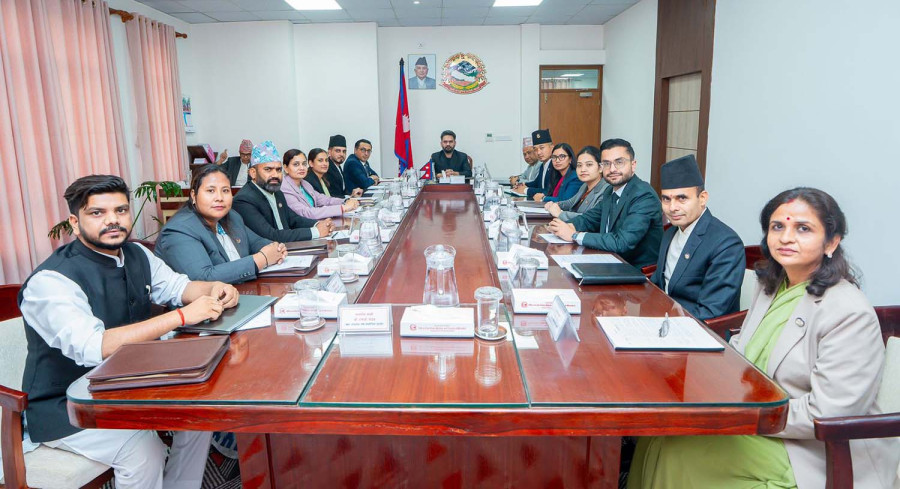
Ex-justice-led panel will examine wealth of public office holders between 2006 and 2026. The Cabinet meeting on Wednesday decided to form a commission. Courtesy of prime minister’s office
The government, on April 15, formed a high-level inquiry commission led by former Supreme Court justice Rajendra Kumar Bhandari to investigate the assets of high-ranking officials and employees who have held public office over the past two decades.
The move has revived questions over whether yet another inquiry panel will lead to tangible action, given the long history of commissions whose recommendations were never implemented.
The five-member panel includes former justices Purushottam Parajuli and Chandiraj Dhakal, former deputy inspector general of Nepal Police Ganesh KC, and chartered accountant Prakash Lamsal. The commission has been tasked with examining wealth accumulated between 2006 and 2026, a period marked by frequent political transitions and allegations of corruption, unlawful accumulation and misappropriation across state institutions.
The formation of the commission follows commitments made by major political parties during the March 5 elections to investigate assets acquired through the abuse of public office. The ruling Rastriya Swatantra Party, which secured a near two-thirds majority and formed a government under Prime Minister Balendra Shah on March 27, had pledged in its manifesto to probe the wealth of public officials, including the political leaders who held public posts. Government officials say a second phase of investigation may later extend to the period between 1989 and 2005.
Despite the announcement, key aspects of the Bhandari Commission remain unclear. The government has said it was formed under the Inquiry Commission Act, 1969, but the terms of reference have yet to be finalised. Questions remain over the commission’s jurisdiction, tenure, scope of authority and procedures. It is also unclear which categories of officials will be covered and whether the commission will have authority to summon individuals, record statements, or recommend arrests.
Even so, the decision has brought renewed attention to long-standing demands for systematic scrutiny of the assets of public officials.
Nepal has seen multiple governments and hundreds of office holders across federal, provincial and local levels since 2006. During this period, at least 16 individuals have served as prime minister, some multiple times, including Girija Prasad Koirala, Pushpa Kamal Dahal, Madhav Kumar Nepal, Jhalanath Khanal, Baburam Bhattarai, Khil Raj Regmi, Sushil Koirala, KP Sharma Oli and Sher Bahadur Deuba, followed by subsequent administrations leading up to the current government under Shah. Under these administrations, dozens of ministers, lawmakers, constitutional office holders and senior bureaucrats have exercised authority over public resources.
At the same time, the questions over unexplained wealth and abuse of office have been raised for a long time. However, official data suggest that enforcement has been limited. The Commission for the Investigation of Abuse of Authority (CIAA) filed only 61 cases related to disproportionate assets in the 20 years since 2006. Between 1990-91 and 2024-25, a total of 128 such cases were filed in court, with none recorded between 1989-90 and 2001-02, according to the CIAA’s 35th annual report.
In the years that followed, only a handful of high-profile cases involving former ministers and senior officials reached the Special Court. Critics have repeatedly alleged that investigative bodies have been subject to political pressure, undermining their ability to conduct impartial inquiries.
Concerns over weak enforcement are not new. A similar effort was undertaken through the Bhairav Lamsal Commission, formed on March 4, 2002, to investigate assets accumulated between 1990 and 2001.
The commission was constituted following a Cabinet recommendation and appointed by King Gyanendra Shah in consultation with the Judicial Council. It was led by then sitting Supreme Court justice Bhairav Prasad Lamsal, with former justices Udaya Raj Upadhyaya and Gyaindra Bahadur Shrestha as members.
Although the Constitution of the Kingdom of Nepal 1990 generally restricted sitting judges from holding other positions, it allowed exceptions for assignments related to legal research, reform and matters of public interest, enabling Lamsal’s appointment.
The Lamsal Commission was given a broad and ambitious mandate. It was authorised to investigate assets of a wide range of individuals, including the prime minister, ministers, members of Parliament, the chief justice, constitutional office holders, senior bureaucrats, employees of state-owned enterprises, political appointees and even their family members. Its jurisdiction extended from section officers to the highest offices of the state.
During its tenure, the commission sent inquiry notices to more than 40,000 individuals and collected asset details from over 30,000. It conducted extensive investigations and submitted its report to the government on March 18, 2003, a year after its formation.
However, the report was never made public and was not fully implemented.
Journalist Hari Bahadur Thapa, who reported on the commission at the time, said that while some cases were later pursued, the broader recommendations were largely ignored. “The commission was formed with a clear objective and carried out extensive investigations, but the report was not made public,” he said. “Cases were filed against some individuals, but further investigation was not conducted as recommended.”
Thapa said that even subsequent efforts based on the findings did not last. “The Royal Commission for Corruption Control, formed by then King Gyanendra, later took statements from individuals identified by the Lamsal Commission. However, the royal commission itself was declared illegal by the Supreme Court,” he said. “If the Lamsal report had been fully implemented and made public, the situation today might have been different.”
The experience of the Lamsal Commission has shaped current debates over the Bhandari Commission’s mandate and effectiveness.
While the government has invoked the Inquiry Commission Act, 1969, the legal framework within which the commission will operate is complex. The Constitution of Nepal 2015 lays down specific provisions governing investigation and action against holders of senior offices in the constitutional bodies.
Article 101 of the Constitution requires that an impeachment process be completed before initiating any criminal investigation or inquiry against the President, Vice President, Chief Justice, justices of the Supreme Court, members of the Judicial Council and heads of constitutional bodies.
Under this provision, at least one-fourth of the total members of the House of Representatives must register a motion of impeachment. The motion must then be endorsed by a two-thirds majority of the total membership of the federal parliament. Only after such officials are removed from office can further legal proceedings be initiated in accordance with federal law.
Similarly, one-fourth of the members of the House of Representatives may move an impeachment motion against the Chief Justice, Supreme Court justices, members of the Judicial Council and constitutional office holders on grounds including violation of the Constitution or law, incompetence, misconduct or failure to perform duties honestly. If passed by a two-thirds majority, the office holder is relieved of their position. The Constitution further clarifies that such removal does not prevent subsequent legal action for offences committed while in office.
For other categories of officials, including civil servants and political appointees, investigations can proceed through existing legal mechanisms, particularly the CIAA under the Prevention of Corruption Act and related laws. However, the CIAA’s jurisdiction has also been an issue of debate, particularly regarding its authority over members of the judiciary, the military and certain “policy decisions” taken by the Council of Ministers.
In recent years, the CIAA has attempted to pursue some cases by categorising decisions as administrative irregularities rather than policy matters, but critics say it has struggled to bring senior figures within the scope of asset investigations.
Against this legal backdrop, experts say the effectiveness of the Bhandari Commission will depend on how its mandate is defined and implemented.
Former Supreme Court justice Ishwar Prasad Khatiwada said the government has the authority to determine the scope and timeframe of such inquiries, but emphasised that commissions of this nature are limited to fact-finding roles.
“Such commissions are formed to establish facts. They can investigate and recommend, but they do not have the authority to punish or deliver judgments,” he said. “If discrepancies are found and they amount to corruption, the matter must proceed through authorised bodies such as the CIAA.”
Khatiwada said the impact of the commission would ultimately depend on whether its findings are acted upon. Referring to the previous Lamsal Commission, he said, “The report was prepared after serious investigation, but it was not even made public. That was not the fault of the commission, but of the government.”
He added that the scope of the Bhandari Commission, including which officials it can investigate, will become clearer only after its terms of reference are formally issued.
Constitutional expert Bhimarjun Acharya also said that the government is within its rights to initiate such an inquiry. However, he stressed that the credibility of the exercise would depend on the integrity of the process.
Acharya noted that past experience has not been encouraging. “Commissions have been formed in the past, but their reports were either not implemented or became controversial,” he said. “That raises questions about intent and effectiveness.”
He pointed to recent debates surrounding the Gauri Bahadur Karki Commission as an example of how public trust can be affected when the process is perceived as lacking neutrality.
The Bhandari Commission thus begins its work amid high expectations and scepticism. While it represents a renewed attempt to address long-standing concerns over corruption and illicit wealth, its ultimate impact will depend on the clarity of its mandate, the robustness of its investigation and, crucially, the government’s willingness to act on its findings.




 14.69°C Kathmandu