Water crisis worsens for Jajarkot earthquake survivors
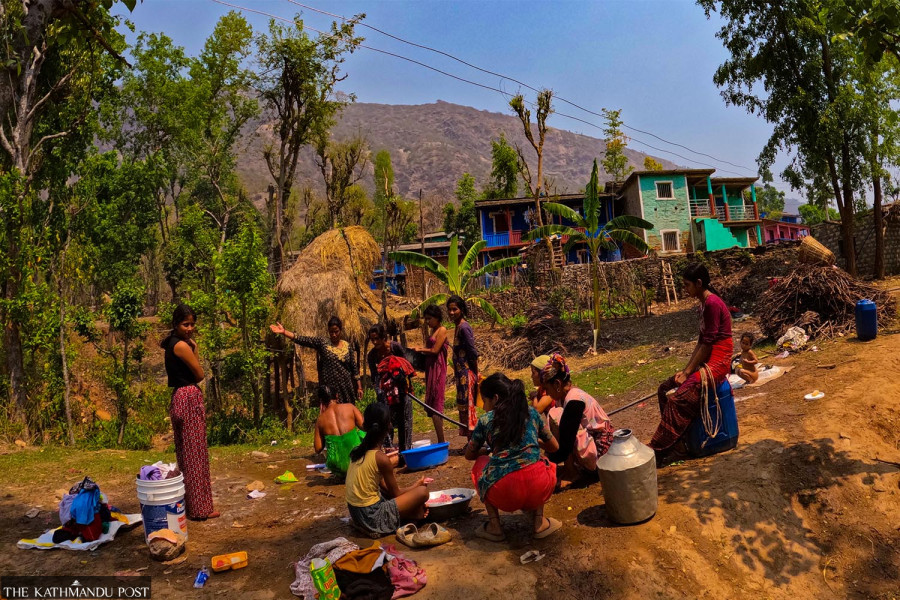
The earthquake in 2023 damaged 480 water projects across three districts of Karnali province. In Jajarkot alone, 145 drinking water projects were destroyed and 106 damaged.Women wash clothes, bathe, and wait for water at a borewell in Rokayatole, Bheri Municipality in Jajarkot district, in this recent photo. Krishna Prasad Gautam/TKP
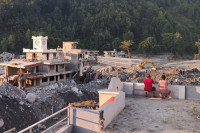
Two years after the devastating 2023 earthquake, with its epicentre in Barekot of Jajarkot district, thousands of survivors are trapped in a dual nightmare. While the government’s promise of permanent housing stays unfulfilled, a severe water crisis has emerged as the most pressing threat to the quake-affected people in Jajarkot and neighbouring districts.
Data from the Karnali Provincial Ministry of Water Resources and Energy reveal that the earthquake damaged a total of 480 water supply projects across Jajarkot, Salyan and Rukum West, causing losses estimated at Rs3 billion.
In Airari and Labisa settlements in ward 5 of Nalgad Municipality of Jajarkot, springs that once fed nearly 80 households vanished overnight when the magnitude 6.4 earthquake shook the area on November 3, 2023. For residents like Dil Bahadur Oli, the daily routine has devolved into a desperate walk in managing drinking water.
"We are forced to roam surrounding villages just to fill a gagri (a traditional water pot with tapered neck and broad belly) of water. Even then, we must wait in long queues," said Oli. "Fetching water has become the main job for women and children. There is no alternative to walking at least half an hour for a single pot."
The crisis is equally dire at Bayala village in ward 1 of Barekot Rural Municipality in the district. After quake-triggered landslides buried their primary water source, 200 families now rely on the Lahare, Jamun and Derpani streams.
"A single pot of water fetched in the morning isn't even enough to cook a meal. In the dry season, even the seasonal springs dry up. We spend our entire day carrying water, ignoring hunger and thirst, and are forced to ration every drop,” lamented Saraswati Gharti, a local.
According to the Jajarkot District Disaster Management Committee, the earthquake caused water sources of 143 drinking water projects to dry up entirely across the district. Furthermore, 106 projects suffered damage to tanks and pipelines. This structural devastation, combined with geological shifts, has left temporary shelters of displaced residents under acute shortage of drinking water.
Purnakala Rana, a resident of Rimna in ward 1 of Bheri Municipality, described the misery of living without basic sanitation. "The source of the Budbudi drinking water project above our village disappeared underground after the quake. Now, the taps are dry," said Rana. "Nearly 150 households are struggling for water for both drinking and livestock. We now walk thirty minutes to the Bheri river for water."
According to the villagers, water shortage has also forced residents to return to open defecation. "The government ignored our need for permanent homes, and now they have failed to provide even basic water," Rana lamented.
Public health consequences are mounting. In Nalgad Municipality, the area hardest hit by the earthquake, which completely destroyed 23 drinking water projects and left 26 partially damaged, Mayor Dambar Bahadur Rawat warned of a brewing epidemic. "Residents along the Bheri river are drinking contaminated water. We are seeing a spike in diarrhoea and dysentery," said Rawat.
Dr Bishal Upreti, head of the Nalgad City Hospital, confirmed that the health facility treats up to 150 patients on a daily basis for water-borne diseases including typhoid, diarrhoea and high fever.
The current crisis mirrors how the 2023 earthquake disproportionately affected impoverished hilltop communities, where infrastructure was already fragile. Similar to the aftermath of the 2015 Gorkha earthquake, geological shifts have permanently altered the hydrogeology of the mid-hills, making traditional ‘spring-fed’ drinking water projects obsolete.
Budgetary constraints remain the primary hurdle to reconstruction. Birendra Chand, chief of the Water Supply, Irrigation, and Energy Development Office in Jajarkot, said there is a massive funding gap. "This year, seven local levels requested Rs1.06 billion for reconstruction, but we were only allocated approximately Rs80 million," said Chand.
Last year, a modest budget of Rs90 million allowed for the repair of three dozen schemes, but the scale of the damage remains overwhelming. "In many places, we have simply distributed pipes for temporary fixes through community labour. At this rate, it will take at least five years to fully restore the damaged water projects,” Chand added.
Despite these hurdles, local leaders like Barekot Rural Municipality Chair Bir Bahadur Giri insist that water remains a priority. "The earthquake devastated public infrastructure in every ward. We completed 20 small-scale projects last year and continue to prioritise water projects in this year’s planning,” said Giri.
The water scarcity, which was already an issue in Jajarkot, has significantly worsened following the earthquake. As the dry season intensifies, the parched settlements of Jajarkot have a hard time managing water.




 25.92°C Kathmandu