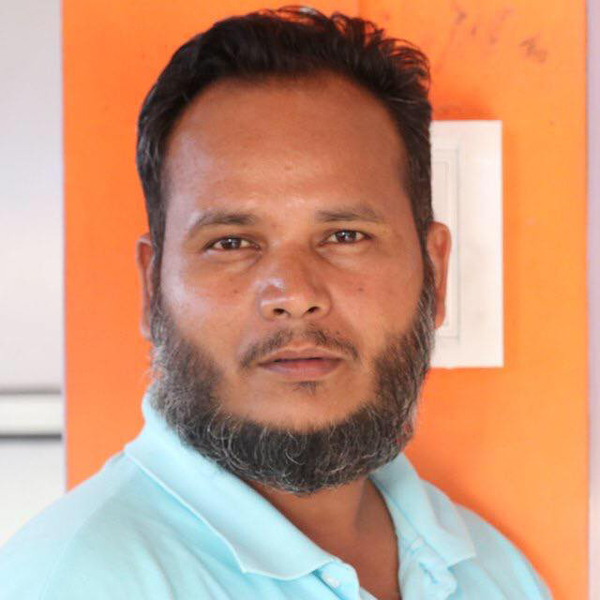
The Tharu village of Bataraitola is home to around 1,100 people, but over 50 including old and young suffer from severe mobility issues. Bataraitola of Gramthan Rural Municipality-2, Morang. Parbat Portel/TKP
Gramthan Rural Municipality, located a short distance from Biratnagar, the capital of Koshi province, is home to a settlement facing a growing public health crisis. In ward 2 of this Tharu-dominated locality, lies the Sardar settlement—locally known as Bataraitola—where paralysis linked to high blood pressure has affected a large number of residents.
Home to around 300 households and a population of roughly 1,100, the Sardar settlement appears orderly at first glance. Paved roads and a concrete temple suggest a degree of development. But a closer look reveals a starkly different reality. Inside the rows of thatched homes, many residents are bedridden, while elderly people move slowly with the support of sticks. A significant number of households are dealing with paralysis, largely linked to high blood pressure and related complications.
Local estimates suggest that around five percent of the population—over 50 individuals—are living with paralysis or severe mobility issues. Neither the ward office nor the municipal health department maintains precise records of those affected, leaving officials in the dark about the true scale of the problem.
Some residents’ experiences show the impact of the disease.
Jurilal Sardar, 58, once a busy carpenter, now walks with difficulty using a stick. About five years ago, while working, he suddenly felt intense pressure on the left side of his chest and collapsed. He was rushed to a nearby pharmacy and then referred to a hospital. The timely intervention saved his life, but a stroke caused by high blood pressure left the right side of his body paralysed.
Similarly, Nepanlal Sardar, 64, has lived with hypertension-induced paralysis for nearly two decades. The Dalit allowance of Rs8,000 that he receives every three months, is barely enough to cover the cost of his treatment, let alone other family needs.
High blood pressure has also claimed the lives of residents like Rasilal Sardar, who died three months ago, and former chair of the rural municipality Narendra Sardar. Narendra’s son Umesh Kumar, experienced a similar condition but survived after treatment.
Another case is Menulal Sardar, 53, a former mason, who collapsed while working at a construction site in Kathmandu three years ago. He was rushed to hospital, but the left side of his body became completely immobile. His family spent around Rs1.2 million on treatment, pushing them into debt. “We still have not been able to repay the loan,” said his wife, Parodevi, who is also a member of the Dalit women’s ward committee. She added that her husband lost his ability to speak for some time but regained it after undergoing Ayurvedic treatment. “He can speak now, but he still needs support to walk,” she said.
Menulal admits that his past habits contributed to his condition. “I used to drink four to five bottles of beer a day and eat a lot of meat,” he said.
Women are also affected. Pudanidevi Sardar, 70, has been bedridden for the past 10 years due to paralysis.
Despite the scale of the problem, Gramthan Rural Municipality lacks well-equipped health facilities. Residents often have no choice but to travel to Biratnagar for diagnosis and treatment, increasing both cost and delays.
The local unit’s vice-chair Gunawati Devi Tharu said the absence of food quality monitoring has contributed to rising health problems. “There is no effective system to check food quality. People are consuming food with pesticides, inedible substances and adulterated materials,” she said.
While older residents form a large share of those affected, the risk is increasingly visible among younger people as well. Cases of high blood pressure and related complications are also reported among individuals in their 30s and 40s.
Young men such as Mailu, Suresh, Jaguwa and Ram Prasad Sardar have recently developed similar conditions, raising concern among health workers.
Ram Kumar Sardar, 46, suffered a stroke at the age of 28. At the time, he earned a living repairing bicycles. He now moves around on a tricycle provided by a donor agency and continues repairing bicycles to sustain himself. “I earn Rs200-Rs300 a day, which I use for food and medicine,” he said.
Local elder Mohanlal Sardar, who served as a local unit chief during the Panchayat era, attributes his relatively good health to a disciplined lifestyle.Though eighty, he is still active. “I avoid food and habits that harm health,” he said. “Those who consume alcohol and cigarettes heavily are the most affected.”
Health worker Badri Chaudhary, who runs a clinic in Jhorahat market, pointed to similar factors. He said unhealthy diets, excessive consumption of meat and irregular lifestyles are contributing to the problem. “Lack of awareness is the main issue. People seek treatment only after the disease has progressed,” he said.
Assistant health worker Bimal Sardar said many patients fail to take medicines regularly even after diagnosis, which worsens their condition. “They neglect the disease in its early stages, and by the time they seek care, it becomes serious,” he said.
According to a 2021 census by the Nepal Sardar/Batar Welfare Committee, the Sardar community numbers around 250,000 across the country, primarily from Jhapa to Makwanpur. Many live in poverty, depend on manual labour and have limited access to education and healthcare.
Seeking treatment across the border
In the absence of accessible and affordable healthcare, many residents travel across the border to seek treatment in India. The “Rajendra Prasad Yadav Free Treatment Centre” in Kharaiya, located in Bihar’s Araria district, has become a common destination for patients from the region.
The centre, which operates without formal medical infrastructure, provides treatment primarily through injections, often without diagnostic tests or proper evaluation. Despite the risks, many residents continue to visit the facility due to its low cost and widespread local belief in its effectiveness.
“There are no proper check-ups or laboratory tests there,” said Rajkumar Jha, health coordinator for Gramthan Rural Municipality. “But people go because they believe it works.”
Health officials warn that such practices can worsen conditions. Jha said there have been cases where patients returned with complications, and some deaths have been linked to inappropriate treatment or overdoses of medication.
The treatment centre in India, was established in 1995 by Rajendra Prasad Yadav, who was not a trained doctor. Following his death four years ago, it is now run by his family members. Treatment is based on experience rather than medical diagnosis.
Health workers say patients are often given strong antibiotics or other drugs that may provide temporary relief but can cause long-term harm.
Parul Chhetri, a resident of Biratnagar, said two of her neighbours died after returning from treatment in Kharaiya. “They felt better for a short time, but once the effect wore off, their condition worsened,” Chhetri said.
The centre attracts patients not only from Morang but also from Jhapa, Sunsari and parts of Madhesh Province. Its location, about a two-hour journey from Biratnagar, makes it accessible to border communities.
What specialists say
Health experts say the crisis is largely driven by untreated or poorly managed high blood pressure, compounded by lifestyle factors and weak health systems.
Gramthan Rural Municipality has been conducting health camps for non-communicable diseases such as hypertension, diabetes and kidney disorders for the past three years. In a recent camp, many residents of the Sardar settlement were found to have high blood pressure.
Neurologist Dr Sunanda Paudel said ignoring high blood pressure is a major risk factor. “Unhealthy diet, stress and lack of physical activity increase blood pressure. If not controlled, it can lead to strokes and paralysis,” she said.
According to Paudel, up to 90 percent of such risks can be reduced through preventive measures, including a balanced diet, regular exercise and adherence to prescribed medication.
Health coordinator Jha said 502 people were screened during the previous year’s health camps. Those with severe conditions were referred to hospitals in Biratnagar for further treatment.
However, many residents do not regularly visit local health facilities, even though basic services and medicines are available. The municipality operates five health posts, two basic health centres, one primary health centre and several other units.
A health facility exists in ward 2, but utilisation remains low. Many residents are unaware that medicines for conditions such as high blood pressure, diabetes and tuberculosis are available free of cost.
“We did not know that medicines are available for free,” said local resident Buduni Sardar. “If we had known, we would have gone to get them.”
Health officials say irregular use of prescribed medicines, combined with alcohol consumption and poor dietary habits, has worsened the situation.
“The problem would have been less severe if people had taken their medicines regularly,” Jha said. “Diet, hygiene and lack of exercise are also contributing factors.”
He added that excessive use of pesticides in agriculture has further complicated health outcomes. “Heavy pesticide use is found in vegetables, wheat and rice. This is adding to health problems,” he said.
The provincial Ministry of Health reports a significant burden of non-communicable diseases among people aged 15 to 49 in Koshi Province. Deaths due to heart disease, liver disease and chronic respiratory illnesses are on the rise.
According to the ministry, the death rate in this age group stands at 9.3 percent. Strokes account for 2.5 percent of deaths, chronic kidney disease 2.3 percent, diabetes 1.6 percent and chronic respiratory diseases 1.9 percent. High blood pressure affects 24.5 percent of adults, raising serious concern among health authorities.
The situation in the Sardar settlement reflects a broader public health challenge, where preventable conditions are leading to long-term disability due to gaps in awareness, early detection and sustained treatment.




 19.35°C Kathmandu