Democracy in the shadow of supermajority: Strong government, weak opposition
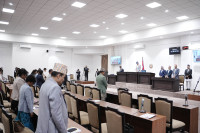
RSP’s historic mandate promises stability but analysts doubt a weak opposition can hold it accountable. This picture shows some members of the House of Representatives elected from the March 5 polls taking oath in Singha Durbar on Thursday. Angad Dhakal/TKP
In the general elections held on March 5, the Rastriya Swatantra Party (RSP) bagged a staggering 182 seats in the 275-member House of Representatives. The RSP’s landslide victory is reminiscent of the two-thirds majority achieved by the Nepali Congress in 1959, when it won 74 out of 109 seats in the first parliamentary elections in Nepal.
Since the restoration of democracy in 1990, across seven subsequent electoral cycles, no single political force had ever managed to garner such an overwhelming number of seats in the legislature. Consequently, a new government has been formed under the leadership of RSP senior leader Balendra Shah, notably without the need of support from any political party.
While the RSP celebrates this historic endorsement, the parliamentary opposition has been decimated. The Congress has been reduced to a mere 38 seats. The CPN-UML holds 25, the Nepali Communist Party 17, the Shram Sanskriti Party seven, and the Rastriya Prajatantra Party just five. Apart from the Congress, no other party managed to get even 10 percent of the total seats. This creates a procedural crisis—under parliamentary rules, parties other than the Congress have lost the standing to even challenge a voice vote by demanding a formal division. This raises a fundamental question for the republic—how can a weak opposition hold a powerful executive accountable?
Opportunity and litmus test of majority
Whether in local tea shops, media debates, boardrooms, or the halls of the federal parliament, a singular narrative had dominated Nepali discourse for decades: the lack of a strong, stable government was the root of the nation's malaise. Stability felt like a mirage, perpetually out of reach for the Nepali populace.
The statistics supported this frustration. In the 34 years since the restoration of democracy in 1990, Nepal saw 30 different governments. Despite these transitions, stability, political accountability, and the rule of law remained elusive.
In recent years, the triumvirate of leaders from the Congress, UML and Maoist engaged in a continuous game of musical chairs, swapping the prime ministership through shifting alliances. This triggered chronic policy instability. Furthermore, major constitutional appointments and diplomatic postings were routinely treated as political spoils. At one point, the “sharing” of power even extended to the judiciary, with a seat at the Cabinet table effectively reserved for the Chief Justice of the Supreme Court.
When Pushpa Kamal Dahal became Prime Minister with UML support in 2022, the NC, the largest party in the House of Representatives, also voted in his favour during the vote of confidence, creating a “House without an opposition.” Even when the two largest parties, NC and UML, eventually joined hands to form a government, the parliamentary opposition remained powerless.
Meanwhile, the cycle of perceived corruption, rising unemployment, and the controversial ban on social media platforms eventually broke the public’s patience. In the second week of last September, a youth-led movement erupted. The resulting two-day crackdown saw 76 deaths, leading to the collapse of the KP Sharma Oli-led government. An interim government, headed by former Chief Justice Sushila Karki, was formed to oversee the transition.
While neighbouring South Asian nations and other countries facing similar unrest often struggled to hold elections, Nepal successfully conducted polls on schedule. It was an overwhelming mandate for the RSP. Now, that very majority, nearly two-thirds, has sparked a new debate—who will check such a formidable executive?
Political scientist Bhaskar Gautam says that while the government is numerically strong, its true strength will be judged by its actions. “The first test of this government will come from within the party itself. Historically, governments with near two-thirds majorities in Nepal have collapsed not due to external pressure, but because they failed to manage internal dissent and maintain accountability within the party,” said Gautam.
Constitutional expert Bipin Adhikari adds that numbers alone do not automatically ensure a government will be stable and last its full term. “Stability only comes when democratic values are institutionalised. If our systems are robust, they can withstand the failings of a few individuals. A large number in parliament does not automatically translate into a lasting legacy.”
In a democracy, an absolute majority does not grant absolute power. The core tenets of the separation of powers and checks and balances are designed to ensure that even the most powerful government remains accountable. Analysts thus argue that democracy is not merely a game of number; it is the responsibility of the government to listen to and address dissenting voices. The primary concern now is whether Prime Minister Shah is prepared to embrace this duty.
Those who closely monitored Shah’s tenure as Kathmandu's mayor are concerned about his decision-making style, which they describe as often impulsive and individualistic rather than institutional. Critics recall instances where the municipal police used excessive force against street vendors, an issue many felt the mayor ignored. There is a fear that this ‘lone wolf’ approach might carry over into his premiership.
“If he continues to avoid dialogue and walks alone as he did during his mayorship, problems will invariably rise,” says Sangken Rai of the Indigenous Gen Z Movement Alliance. “A leader with a majority in parliament must show a democratic character. That is their ultimate responsibility,” she says.
Chandra Kishore, a political analyst, argues that the government arrived on a ‘wave of populism,’ which often risks bypassing the process in the pursuit of immediate results. “In a democracy, the method and process are as important as the outcome,” he warns. He notes that globally, strong majorities often lead to the erosion of democratic institutions. “Majoritarian regimes tend to view themselves as the only true representatives of the people, effectively silencing minorities and the opposition. They begin to believe that their perspective is the only truth.”
With the opposition currently weak in both quality and quantity, Chandra Kishore suggests that Nepal may face a real risk of democratic decay. This is a phenomenon noted by Harvard University political scientists Steven Levitsky and Daniel Ziblatt in their work, How Democracies Die. They argue that modern democracies rarely perish through military coups; instead, they are slowly dismantled by elected leaders. They write that the constitution remains, elections are held, but the institutions are hollowed out.
Similarly, a recent study by the International Institute for Democracy and Electoral Assistance (International IDEA) on Asian democracies found that governments with two-thirds majorities often implement structural changes that are nearly impossible to reverse, entrenching their power for the long term.
Political scientists refer to this as 'democratic backsliding'. Democracy does not vanish all at once; it erodes gradually. This process often begins where the parliamentary opposition is extremely weak. Beyond the legislature, the media, civil society, and universities also start to soften their stance towards the government.
Chandra Kishore argues that in order to protect democracy, the judiciary must not succumb to a psychology of fear. Citing neighbouring countries where the judiciary has been intimidated by powerful governments, he warns, “They must not live under invisible fear. If judges do not follow their conscience, the court becomes a mere tool for those in power, acting as a government puppet.”
Congress President Gagan Kumar Thapa asserts that the opposition’s role in a democracy is just as vital as that of the government. Addressing the party’s central committee on March 24, Thapa said, “The opposition’s responsibility is even greater when a government holds immense power. We want immediate results, but not by compromising democratic fundamentals. Civil liberties, equality, and the independence of the press and the judiciary are non-negotiable; they must be expanded, not curtailed. We must remain vigilant to ensure no compromises are made."
RPP lawmaker Khusbu Oli echoes this sentiment. “The public voted for the RSP because they were tired of the problems caused by instability. However, with such a weak opposition, there is a real worry that the government might dodge accountability or lean towards authoritarianism,” she says.
Global mirror: India, Hungary, the US and El Salvador
The question of what happens to a democracy with a strong government and a weak opposition is no longer a theoretical exercise. The experiences of Hungary, India, the United States, and El Salvador offer a sobering preview.
In Hungary, Viktor Orban’s Fidesz party won a two-thirds majority with more than 50 percent popular votes in 2010. Within a week, they passed 88 laws, turning parliament into a rubber stamp for the executive. Orban subsequently rewrote the constitution, replaced judges, pressured independent media through state advertising, and gerrymandered electoral districts. By 2022, the European Parliament declared Hungary an ‘electoral autocracy.’
In neighbouring India, the decade following Narendra Modi’s 2014 victory saw a significant decline in democratic indices. India dropped to 161st out of 180 countries in the World Press Freedom Index. The Enforcement Directorate (ED), a financial watchdog, became a tool for political pressure. According to an Indian Express report, out of 121 politicians investigated by the ED over nine years, 115 were from the opposition.
Many who switched to the ruling Bharatiya Janata Party saw their cases mysteriously stall or disappear. As the 2024 elections approached, the accounts of the Indian National Congress party were frozen, and the Chief Minister of Delhi, Arvind Kejriwal, was arrested. Even the BBC faced raids after releasing a documentary critical of Modi’s past.
The second term of Donald Trump in the US is instructive, too. In 2025, the US was listed among countries where civil liberties are rapidly declining. Trump has bypassed congressional budgetary authority and dismantled federal agencies at an unprecedented pace. Threats against judges have become commonplace, and journalists have faced arrest while reporting on public protests.
In El Salvador, President Nayib Bukele’s party secured a two-thirds majority in 2021. Soon after, Bukele’s supporters removed all five judges of the Supreme Court and the Attorney General, replacing them with loyalists. While Bukele remains immensely popular due to his crackdown on crime, El Salvador has plummeted 61 places in the Press Freedom Index since 2019.
Despite these global trends, some Nepali analysts remain cautiously optimistic. “I am not yet convinced that our institutions will collapse,” says political scientist Uddhab Pyakurel. “Nepal has a vibrant democratic society. Any attempt to encroach upon civil rights will face stiff resistance.”
Constitutional expert Bipin Adhikari also remains optimistic that Nepal will not reach such a dire state. “Neither this nor any other government can infringe on the rights of the media and citizens,” he said. “Our history shows that those in power cannot withstand the public backlash that such actions would inevitably trigger.”
Constitutional vulnerability
Nepal’s Constitution 2015 has some provisions that a two-thirds majority can exploit. Under Article 101(2), the chief justice and justices of the Supreme Court, members of the Judicial Council, and heads of constitutional bodies can be impeached by a two-thirds majority of the House of Representatives. With 182 seats, the RSP is just two votes shy of the power to remove any constitutional official at will.
This ‘sword of Damocles’ hanging over the judiciary raises concerns about its ability to act as a neutral arbiter. History provides a grim precedent. Even without a two-thirds majority, the Congress and Maoists previously moved to impeach then Chief Justice Sushila Karki. Later, an impeachment motion against Cholendra Shumsher Rana was left in limbo until his retirement, effectively suspending him without a trial. Such manoeuvres have long been viewed as weapons to intimidate the judiciary.
Furthermore, parliamentary committees, which are supposed to ensure executive accountability, are composed based on the party’s numerical strength. This means the RSP will command a majority in most committees, including the Impeachment Recommendation Committee. This creates a feedback loop where the executive controls the very mechanisms meant to oversee it.
While a two-thirds majority in both Houses is required for constitutional amendments or the impeachment of the President, the RSP’s dominance in the lower house is sufficient to exert immense pressure on the autonomy of constitutional bodies.
The media landscape is equally precarious. Nepal dropped 16 places in the 2025 World Press Freedom Index, ranking 90th. Regarding journalist safety, it sits at a dismal 120th. With the government owning major outlets like Radio Nepal, Nepal TV, RSS, and Gorkhapatra, and controlling the lion’s share of advertising through state agencies, the independence of the private press is under constant financial and political strain.
However, political scientist Gautam offers a different perspective on the ‘weak opposition’ narrative. “I don't necessarily agree that the opposition is just now becoming weak,” he says. “Since 2008, the politics of ‘consensus’ and coalitions have systematically hollowed out the role of the opposition. If anything, the current situation forces parties to stand on their own merits. We are moving away from the ‘all-party’ government model to a period where every party's true standing will be tested."
New chapter or risky accident?
The rise of the RSP was fuelled by a young electorate demanding transparency, an end to corruption, and effective governance. Pyakurel reminds the new leadership that democracy is not just about numbers—it is about the visibility of all faces in the decision-making process. “The RSP rose by challenging the old guard on values. Now, they must apply those values to themselves.”
Constitutional expert Adhikari advises the government to focus on the rule of law and justice rather than getting bogged down in controversial structural changes that could alienate their base. “The opposition exists not only in parliament. When the ruling party is large, the force of external opposition—in the streets, in the media, and in civil society—grows proportionally. Let us not forget that BP Koirala was not removed by parliamentary numbers, nor were the previous giants like the NC-UML coalition immune to public pressure,” he warns.
Nepal finally has a strong government. The world is watching to see if the mechanisms of power will be used to strengthen the state or merely to consolidate the party.




 19.73°C Kathmandu