Money laundering probe into Deuba, Dahal, Oli intensifies, former minister Khadka arrested
Department of Money Laundering Investigation pursues case after six months of preliminary enquiries, with CIB support, as probe covers top political leaders and past corruption cases.
A detailed investigation has been launched against three former prime ministers and two former ministers over alleged money laundering offences, with authorities intensifying scrutiny following months of preliminary enquiries that uncovered discrepancies in financial and asset records.
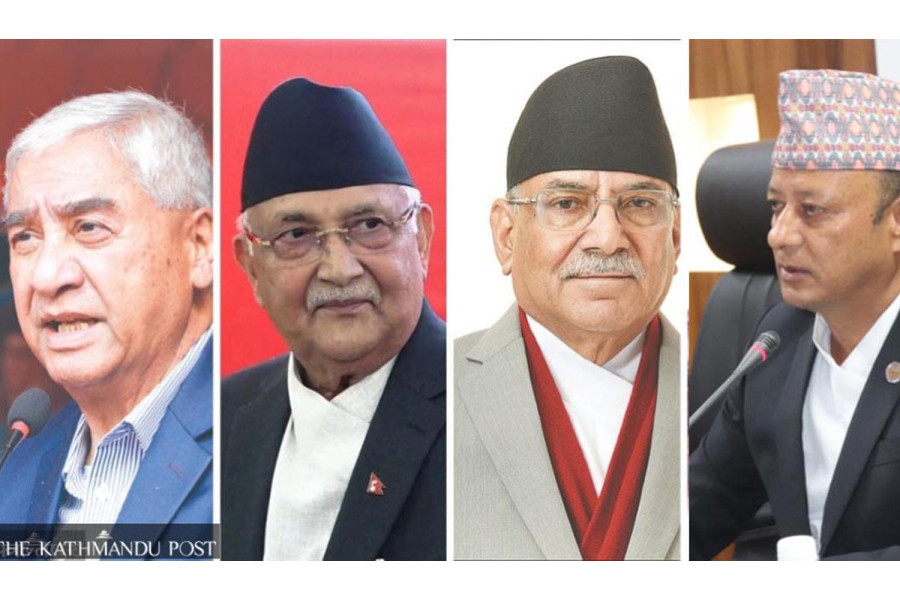
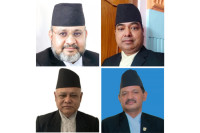
The Department of Money Laundering Investigation (DMLI), with the assistance of the Central Investigation Bureau (CIB) of Nepal Police, has initiated an in-depth probe against former prime ministers Sher Bahadur Deuba, KP Sharma Oli and Pushpa Kamal Dahal, as well as former ministers Arzu Rana Deuba and Deepak Khadka.
Last week, the department dispatched a letter to the Police Headquarters seeking support with investigation. Acting on that request, former minister and Nepali Congress leader Khadka was arrested from his Budhanilkantha residence on Sunday.
Prior to upgrading the case to a detailed investigation, the department had conducted preliminary enquiries for nearly six months. The investigation was formally intensified after discrepancies were identified during that period, prompting authorities to widen the scope of scrutiny.
The probe was triggered by the recovery of fragments of burnt banknotes from the residences of several leaders following vandalism, arson and destruction on September 9, 2025—the day after the Gen Z-led protests of September 8. Photos and videos that surfaced in the aftermath showed burnt notes at the homes of Deuba, Khadka and Dahal. Subsequent laboratory tests confirmed that the recovered fragments were genuine currency.
Following site inspections and the collection of preliminary details regarding movable and immovable assets, the department initiated a full-fledged investigation through CIB officers.
“Following discrepancies identified during preliminary enquiries, the case has been moved to a detailed investigation,” a department official told the Post. “To facilitate this, we are proceeding with the investigation with the support of CIB personnel.”
Additional Inspector General Manoj KC, chief of the CIB, said the bureau assisted in the arrest and is supporting the investigation after receiving a request from the department.
“The request for CIB assistance came through the Police Headquarters; we have provided the necessary cooperation accordingly,” KC said, adding that Khadka was taken into custody for questioning following the department’s directive.
Immediately after the arrest, Minister for Home Affairs Sudhan Gurung shared what he described as a “CIB urgent warrant of arrest” on social media, stating that former energy minister Khadka had been detained in connection with the investigation into funds recovered from his residence during the September 9 incidents. Authorities, however, have not disclosed further details regarding the ongoing investigations into the other accused.
According to investigative sources, the probe is proceeding simultaneously against Khadka and other individuals under scrutiny.
Former DIG Hemanta Malla, who previously headed the CIB, said this marks the first instance in Nepal where former prime ministers have been subjected to a money laundering investigation. He said involving the CIB would make the investigation more effective and help reach the depth of the alleged offences.
“In the past, the department has utilised the CIB for complex and special investigations; continuing that practice is a positive step,” Malla told the Post. “Investigating individuals who have led the state and hold significant power is not easy—there are often attempts to suppress or influence such cases. However, the department taking the lead through the CIB is a positive sign that will help uncover the truth.”
Deuba has held public office continuously since 1991 and has won elections from Dadeldhura in all parliamentary and Constituent Assembly polls since then. However, he did not contest the House of Representatives elections held on March 5. A week before the election, on February 25, he travelled to Singapore for medical treatment.
His wife, Arzu Rana Deuba, who served as foreign minister until the September protests, travelled to New Delhi on January 5 and has not returned. Sources involved in the investigation say she has since reached Singapore from Delhi. The current whereabouts of the Deuba couple remain unconfirmed.
Sources also indicate that Deuba’s son, Jaiveer Singh Deuba, and his brother-in-law, Bhushan Rana, are currently outside the country. On September 28, 2025, the department raided Rana’s residence in Jawalakhel, seizing electronic devices and documents. Days later, further raids were conducted at the homes of his relatives.
Prakash Deuba, a nephew of the former prime minister and member of the Sudurpashchim Provincial Assembly, has also been out of contact since the investigation began. Sources claim he has travelled to the United States via India.
Deuba has served as prime minister five times—in 1995, 2001, 2004, 2017 and 2021—and previously held the home minister’s portfolio in 1991 under the government led by Girija Prasad Koirala. His wife, Arzu Rana Deuba, has served as a proportional representation lawmaker in multiple terms and was foreign minister in the government led by Oli until the September protests.
On September 9, protesters reportedly assaulted the Deuba couple at their residence. After receiving hospital treatment, they travelled to Singapore on October 26 for further care, returning to Nepal 18 days later. The money laundering investigation was initiated while both remained abroad following their subsequent departures.
Oli has served as prime minister multiple times and held key portfolios including home minister in 1994 and foreign minister in 2006. Since 1991, he has remained a prominent political figure, winning multiple parliamentary elections. He lost in the 2008 Constituent Assembly elections and again in the March 5 general elections.
Following the findings of the Gauri Bahadur Karki-led Commission of Inquiry, which held him responsible for the suppression of the September 8 protests, Oli was arrested on murder charges shortly after Balendra Shah assumed office as prime minister. He is currently in police custody.
Dahal entered parliamentary politics following the 2006 political transition and has served as prime minister three times. His party, now part of a broader communist formation under the name of Nepali Communist Party, has remained in government for much of the period since 2008 through shifting alliances.
Dahal has faced longstanding allegations of embezzling state funds allocated for the subsistence of former Maoist combatants during the peace process. He had been residing in a Khumaltar property owned by businessman Sharada Adhikari but relocated after the house was set on fire by protesters on September 9.
As part of the ongoing investigation, Khadka, who previously served as minister for energy, water resources and irrigation, has been remanded in custody for seven days following court approval.
Under the legal process, the CIB will conduct field investigations and submit its findings to the Department of Money Laundering Investigation. Based on the investigation report and legal opinion from the Government Attorney’s Office, the department may file a case at the Special Court or, if no charges are warranted, forward its decision to the Office of the Attorney General.
If a case is filed, the department can seek penalties including imprisonment, fines and recovery of embezzled amounts.
The investigation has gained renewed momentum following the appointment of Prime Minister Balendra Shah. Sources say preliminary assessments of the assets of the former prime ministers, ministers and their family members have already been completed.
Authorities have sought financial and corporate records from Nepal Rastra Bank, the Securities Board of Nepal and the Office of the Company Registrar to obtain details on bank accounts, investments and company transactions. The Department of Land Management and Archive has also provided property records following requests made in October 2025.
Officials said the probe accelerated after forensic reports confirmed that the burnt debris recovered from the residences of Deuba, Dahal and Khadka on September 9 was indeed genuine currency.
The developments come against the backdrop of several major corruption scandals in Nepal, many of which have long been criticised for weak or incomplete investigations.
These include the wide-body aircraft procurement case, the Sudan scam, irregularities in Maoist combatant camps, controversies surrounding tax settlements, and the misappropriation of public land such as Lalita Niwas, Patanjali land, Giribandhu Tea Estate, Tikapur land, Lychee Garden land, Bal Mandir and Bansbari land.
Other high-profile cases include the fake Bhutanese refugee scam and the visit visa racket. Many of these cases, observers say, were influenced by political interests and pressure, with investigations either obstructed or diluted. Even when agencies such as the Nepal Police and the Commission for Investigation of Abuse of Authority completed investigations and cases reached the courts, attempts were often made to influence judicial outcomes.
During the Covid-19 pandemic, further allegations of embezzlement surfaced in cases such as the Omni Group procurement deal involving medical supplies, irregularities in Nepal Trust land, gold smuggling cases, cooperative fraud, the security press procurement controversy, TERAMOCS, excise sticker printing, and the Melamchi project.
Political leaders were implicated in many of these cases. However, several cases reached the courts only after allegedly “cleansing” political figures of involvement, while others remain under investigation.
More recently, although the CIAA filed a case against over 50 individuals—including five former ministers and nine former secretaries—over the construction of Pokhara International Airport, a comprehensive and conclusive investigation has yet to be completed.
In this context, the arrest of former minister Khadka and the inclusion of three former prime ministers within the ambit of a money laundering probe mark a significant development.
Malla said that if the investigation reaches a logical and independent conclusion, it could serve as a deterrent to those in positions of power.
“If this investigation involving high-level leaders is taken to its conclusion, it could discourage decision-makers from amassing wealth through the misuse of state power and in violation of the law,” he said.




 16.46°C Kathmandu