The government on Saturday arrested former Prime Minister and CPN-UML chair KP Sharma Oli based on recommendations from the Gauri Bahadur Karki Commission’s report, which has been accused of bias.
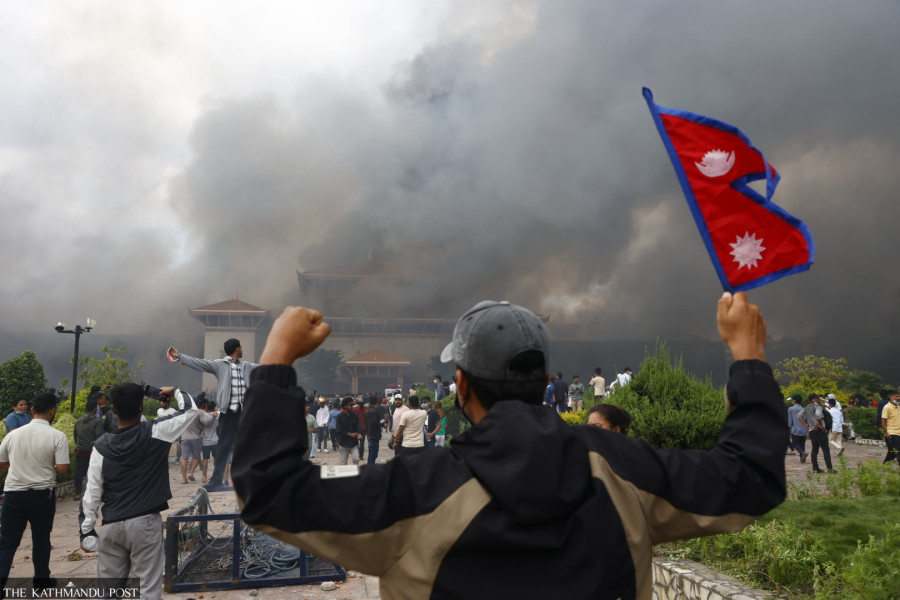
While the then-interim government constituted the Karki-led inquiry panel, the National Human Rights Commission also simultaneously investigated state atrocities on September 8 and the arson and destruction of public and private properties the next day.
The leaked report that recommended criminal investigation against Oli, Lekhak and former Nepal Police chief Chandra Kuber Khapung—for their alleged negligence and recklessness that led to the death of 19 on September 8—paid little attention to tracing the culprits from the second day.
But officials from the human rights commission involved in their study say they have held people accountable on both days, unlike the Karki-led panel.
“Our report is different to that of the Karki panel,” an official involved in the study told the Post. “The human rights commission must release the report without any delay. It has revealed different aspects of the two-day protest that the Karki panel has chosen to stay silent on.”
The human rights watchdog’s report not only implicates Oli, Lekhak, and the leadership of the security agencies but also holds those involved in the vandalism and the instigators of the violence accountable, the official said. Even as several statements the government inquiry panel recorded gave clues about the inciters of arson and vandalism, it didn’t recommend prosecuting anyone, which calls its intent into question.
Satya Raj Joshi, then jailor at Nakkhu prison, has gone on record saying that he was intimidated into signing a document allowing the release of Rabi Lamichhane, the Rastriya Swatantra Party chair. Similarly, the report accounts for the pattern of sluggish response of the Nepali Army from the very first day. In some places, it was found that the indifference of the national defense force led mobs to destroy national property. Yet, other than recommending actions against four officials under the military laws, it doesn’t hold the leadership accountable, unlike for the other security agencies.
“I believe the human rights commission report has addressed the issues that the Karki commission report has been accused of omitting,” said senior advocate Surya Dhungel.
Dhungel, who is also a former member of the human rights commission, said both reports should be in the public domain, and the government should take reference from both for prosecution.
The Lily Thapa-led probe team of the human rights commission submitted its report to chairperson Top Bahadur Magar on March 20. Magar, along with other members of the commission, is studying it.
“The report can be made public only after the commission adopts it,” said Manoj Duwady, a member of the commission. “It is under study now.”
Speaking to the Post after submitting the report, Thapa had said that during its investigation the commission recorded statements from 90 individuals, including Oli, then-home minister Lekhak, members of the National Security Council, the Central Security Committee, and the Kathmandu District Security Committee.
Statements were also recorded from then Kathmandu Metropolitan City mayor Balendra Shah and Rastriya Swatantra Party chair Rabi Lamichhane, among others. Even as it had asked the Chief of the Army Staff to be present for a statement, he sent a major general to respond on behalf of the national defence force.
In addition, the NHRC probe committee held discussions with 586 others, including protesters and victims. The commission has also analysed the forensic and ballistic reports before drawing a conclusion, which the Karki panel hasn’t.
The commission has studied in detail whether the Kathmandu metropolis was reluctant to mobilise the fire brigades to douse fires, and has also analysed whether Lamichhane’s decision to flee from prison instigated the protesters.
Constitutional experts say that, being a statutory body, the human rights commission’s report is expected to be comparatively fair and neutral.
“Karki-panel’s report is not just incomplete but also full of biases,” said senior advocate Dinesh Tripathi. “It is vital that the human rights commission’s report be unveiled without delay.”
Tripathi also questioned the government move to arrest Oli and Lekhak. “This government resorted to arrests in haste,” he said. “It should have first studied both the reports and then proceeded accordingly.”
Binod Ghimire covers parliamentary affairs and human rights for The Kathmandu Post. Since joining the Post in 2010, he has reported primarily on social issues, focusing on education and transitional justice.




 15.34°C Kathmandu