As government arrests Oli, UML vows nationwide protests
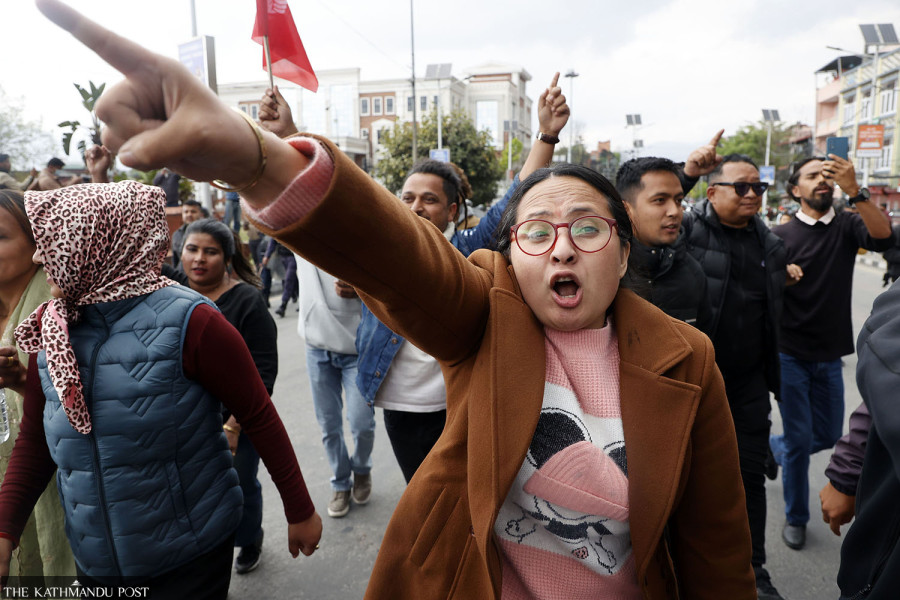
After the former prime minister, and ex-home minister Lekhak, were caught early Saturday morning, party cadres hit the streets. UML supporters demonstrate against Oli’s arrest in Kathmandu on Saturday. Hemanta Shrestha/TKP
The CPN-UML has condemned the arrest on Saturday of its chair and former prime minister KP Sharma Oli and staged demonstrations, while also deciding to hit the streets nationwide from Sunday, calling for his immediate release.
Concluding that the move of the newly formed Balendra Shah government vindictive, biased, and unlawful, a Secretariat meeting of the party on Saturday also decided to fight its battle in Parliament and in court.
Speaking to the media after the meeting, General Secretary Shankar Pokharel said that party-affiliated organisations would begin demonstrations starting Saturday. All district committees would submit memoranda to the government through the respective district administration offices, demanding Oli’s release, on Sunday.
“This morning, even before sunrise, the arrest of our party chair and former prime minister KP Sharma Oli, along with Nepali Congress leader Ramesh Lekhak, is entirely vindictive, prejudiced, and against the spirit of the rule of law. This meeting has decided to demand their immediate release.”
After taking the oath of office and secrecy from President Ramchandra Paudel on Friday, the first Cabinet meeting chaired by Shah decided to implement the recommendations of the judicial commission formed to investigate the Gen Z protests that shook Nepal in September last year.
Based on that decision and the paperwork done through night, police on Saturday morning arrested Oli, who was prime minister at the time of the Gen Z protests, along with Lekhak, a Congress leader who served as home minister in his Cabinet. Both were taken into custody from their respective residences in Bhaktapur.
The “urgent warrants of arrest” issued by the police to apprehend both Oli and Lekhak stated that the duo needed to be taken into custody immediately for an ongoing investigation into a homicide-related case.
The judicial commission's report prepared under the special court's former chair, Gauri Bahadur Karki, has been criticised as biased. Though the report has recommended investigating more officials as well, the Cabinet meeting of Friday decided to immediately implement the probe findings. What followed is the arrest of Oli and Lekhak.
The Cabinet meeting decided to implement the commission’s report but it has not yet been formally made public, apart from unauthorised publications in the media. Nor has the government tabled it in the parliamentary library, as decided by the interim Sushila Karki government. These have led some to say that the arrests were made in haste and with bias.
Gokul Baskota, a leader of the UML, calls the arrests of Oli and Lekhak problematic prima facie. Baskota warned that Nepal could be moving towards a “Pakistani-style” political model, which, he says, could further destabilise society.
He also criticised the appointment of Gauri Bahadur Karki as head of the judicial commission in the first place, arguing that his report effectively endorsed his stance on the Oli government and its leaders seen during the Gen Z protests. Baskota noted that while the commission produced a detailed report on the events of September 8, it offered little substance on the events of September 9. Taking action solely on the basis of the commission’s recommendations was therefore inappropriate, Baskota said.
“It is objectionable that the government has arrested the party chair on the basis of political vendetta, instead of first forming another investigative committee based on the recommendations of the judicial commission and, if necessary, taking anyone into custody in consultation with that committee,” Baskota said.
Yagyamani Neupane, lawmaker from the Rastriya Swatantra Party, defended the arrests, saying that an arrest warrant is not a political tool but a sensitive instrument of the rule of law. He argued that if there is a serious risk of the accused committing further offences, destroying evidence, fleeing, or obstructing the investigation, immediate arrest is justified.
Neupane further argued that not only Nepali law but also the legal systems of almost all countries in the world recognise such emergency powers. He emphasised that the law does not operate based on who a person is, but rather on the circumstances and the evidence.
“Whether it is KP Sharma Oli, Ramesh Lekhak, or an ordinary citizen, this principle—that everyone is equal before the law—is what is being tested here,” he argued.
The police arrested both individuals by issuing urgent warrants. Oli, however, was later admitted to the Tribhuvan University Teaching Hospital, in Maharajgunj while Lekhak is being held at the nearby police office.
Demonstrations organised by various UML-affiliated groups saw clashes with police. The Police Headquarters has issued a directive to its subordinate offices not to grant leave to personnel.
The Administration Branch of the Police Headquarters issued a circular that no police officers across the country should be granted leave. According to the letter issued by Deputy Superintendent Santosh Niraula, all types of leave—except maternity and bereavement leave—are to be withheld.
“Considering the present situation and the need to mobilise police forces for security management, all concerned are requested not to grant, recommend, or approve any leave other than maternity and bereavement leave until further notice,” reads the letter.
Additionally, the police headquarters has instructed police officers who are currently on leave to report back to duty immediately. “Arrangements are to be made for police officers who are on leave, including those holding office chief responsibilities, to return and report to their offices without delay,” the notice reads.




 14.69°C Kathmandu