Sobita Gautam looks to tackle piling legal backlog
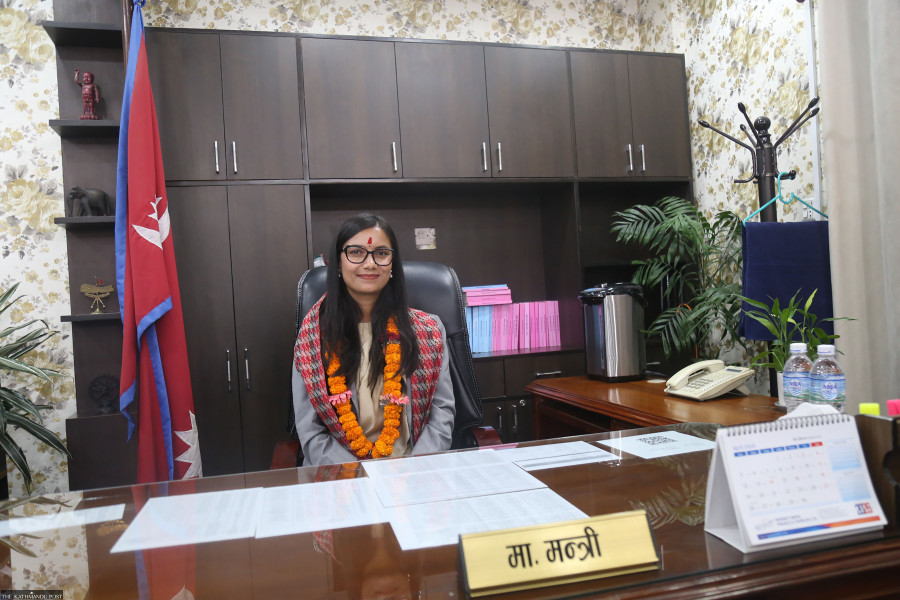
As the new minister for law, justice and parliamentary affairs, Gautam faces a formidable task: reforming a legal system bogged down by contradictions, delays and long-standing political disputes. Sobita Gautam, law minister Post photo
Born in June 1995, Gautam holds a bachelor’s degree in law and is a licensed advocate. She entered national politics with the rise of the Rastriya Swatantra Party (RSP), winning the Kathmandu 2 constituency in her first parliamentary election after the party’s formation. Although she did not previously hold an executive position, she quickly built a reputation in Parliament as an assertive and outspoken lawmaker.
Her legal background and parliamentary experience appear to have played a role in her appointment by Prime Minister Balendra Shah to lead the Ministry of Law, Justice and Parliamentary Affairs.
The ministry is responsible for drafting laws, overseeing constitutional amendments and playing a role in judicial appointments—functions that place Gautam at the heart of Nepal’s governance reforms. The position presents both major challenges and real opportunities.
One of her biggest tasks will be to harmonise Nepal’s legal framework. Over the years, overlapping laws, regulations, directives and ordinances have created confusion and administrative bottlenecks. Even the ministry itself struggles to determine exactly how many laws are currently in force.
Although the government introduced the new Civil Code in 2017—repealing many outdated laws—numerous sector-specific regulations remain inconsistent with one another. In practice, these contradictions often obstruct government work.
Officials within the law ministry acknowledge that legal inconsistency has become a structural problem and requires urgent reform. Past governments struggled to address these issues, largely because coalition politics made it difficult to secure parliamentary consensus on legal changes. With the RSP-led government holding nearly a two-thirds majority in the lower house, ministry officials believe there may now be a greater opportunity to advance reforms.
Another major challenge is completing the legislation required to effectively implement the 2015 federal constitution. Nearly a decade later, several laws mandated by the constitution have yet to be enacted.
Many constitutional clauses state that certain rights or institutional arrangements will function “as provided by federal law.” But without those laws being enacted, the provisions remain largely symbolic. Gautam’s ministry must identify these gaps and expedite the legislative process.
Closely linked to this is the need to enact laws that guarantee fundamental rights. Nepal’s constitution lists 31 fundamental rights under Part III (Articles 16–46). However, legislation has been enacted for only 16 of them so far.
Some laws related to consumer protection, housing, employment rights, food security, health services, education and social security have already been passed. Yet nearly half of the rights guaranteed by the Constitution still lack enabling legislation.
Gautam also faces a politically complex issue: the review of several constitutional commissions. Article 265 of the constitution requires that commissions formed during the political transition—from 1996 to 2006—be reviewed after ten years. Since that deadline has now passed, the government must decide whether to retain, restructure or dissolve them.
These bodies include the National Women Commission, National Dalit Commission, National Inclusion Commission, Indigenous Nationalities Commission, Madhesi Commission, Tharu Commission and Muslim Commission. Any major restructuring would likely require a constitutional amendment.
Even as the RSP holds strong support in the lower house, it lacks the two-thirds majority required for constitutional changes and has no representation in the upper house. This means Gautam will need to build consensus with other political parties—an inherently difficult task.
The RSP’s election manifesto also proposes broader constitutional reforms, including discussions on a directly elected executive system, a fully proportional parliament, a separation between lawmakers and ministers, non-partisan local governments and a restructured provincial system. Coordinating such reforms and initiating national dialogue will likely fall within Gautam’s responsibilities.
Judicial reform is another critical area. As a member of the Judicial Council, the law minister plays a role in recommending judicial appointments. Ensuring transparency in the selection of judges and ending the long-criticised practice of political bargaining in judicial appointments will be a major test of her leadership.
Equally pressing is Nepal’s unresolved transitional justice process. Nearly two decades after the end of the country’s decade-long armed conflict, cases involving human rights violations remain unresolved.
Institutions such as the Truth and Reconciliation Commission and the Commission of Investigation on Enforced Disappeared Persons were established to address these issues. Yet critics say the bodies have been plagued by political interference and ineffective leadership. The victims of the conflict have challenged the decision to select the office bearers for both commissions before the Supreme Court of Nepal, while the international community has expressed concern about the credibility of the process.
Resolving transitional justice in a victim-centred and internationally credible manner will be one of the toughest assignments for Gautam.
Gautam’s legal training and parliamentary experience may give her an advantage in navigating these challenges. If she succeeds in pushing through judicial reforms, harmonising Nepal’s fragmented legal system and advancing the long-delayed transitional justice process, it could mark a defining achievement in her political career.




 24.79°C Kathmandu