Legal steps ahead following arrest of Oli and Lekhak
Police detained the two leaders from Bhaktapur on Saturday morning over deaths during the September Gen Z protests. Court to decide on arrest warrant on Sunday.
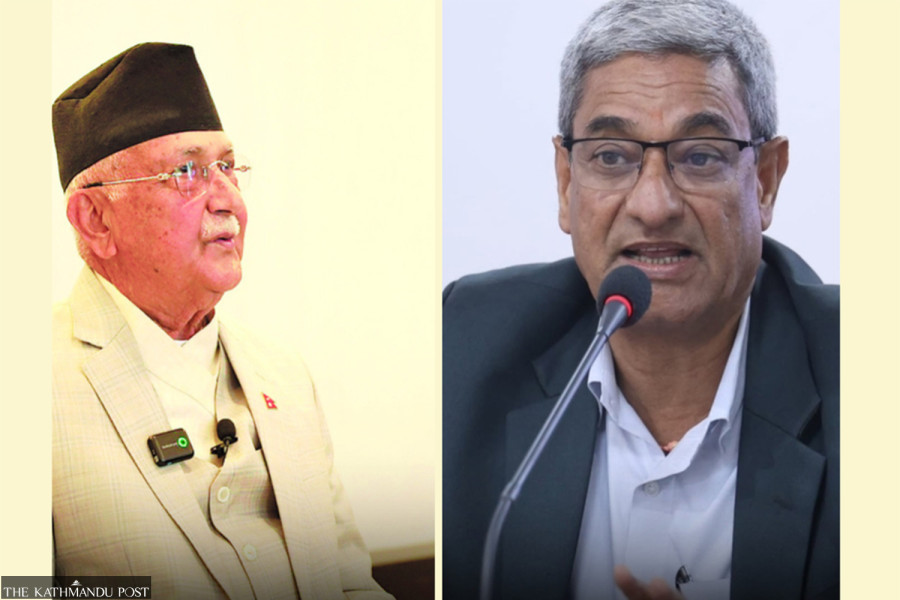
Government prosecutors are set to seek judicial endorsement on Sunday for the urgent arrest warrants issued by the police in detaining former Prime Minister KP Sharma Oli and former Home Minister Ramesh Lekhak for investigation.
Police held Oli and Lekhak from Bhaktapur on Saturday morning in connection with deaths during the September Gen Z protests.
According to an official at the Office of the Attorney General, government prosecutors must seek judicial endorsement on Sunday for the urgent arrest warrants initially issued by the police. Under the law, police may issue such warrants when there is a risk that a suspect could abscond or destroy evidence if not arrested immediately. In other cases, an arrest requires a court order.
“We will first seek validation of the urgent warrants issued by the police today. The District Government Attorney’s Office has prepared for that,” the official said.
Defence lawyers representing Oli and Lekhak, however, have questioned the legality of the urgent warrants. “An urgent arrest warrant is issued only when there is a risk that the person may flee and cannot be re-arrested,” senior advocate Tikaram Bhattarai, who advised Oli prior to his arrest, told the Post. “As there were no chances for the accused to leave the country or abscond, such a warrant was unnecessary. Its necessity will be questioned.”
Police acted on the report of a commission formed to investigate the Gen Z movement, led by former judge Gauri Bahadur Karki. The commission recommended investigating and prosecuting Oli, Lekhak and then Inspector General of Police Chandra Kuber Khapung for alleged negligence leading to protest-related deaths.
It also recommended investigating then home secretary Gokarna Mani Duwadi, Inspector General of Armed Police Force Raju Aryal, then chief of the National Investigation Department Hutaraj Thapa, and then chief district officer of Kathmandu Chhabi Lal Rijal for criminal negligence.
A Cabinet meeting on Friday decided to form a task force to study the commission’s recommendations related to security agencies and to immediately implement the remaining recommendations. Following the decision, police issued urgent arrest warrants and detained Oli and Lekhak on Saturday morning.
If the court does not endorse the urgent warrants, both of them will be released on Sunday, though the investigation will continue. If the warrants are endorsed, prosecutors will seek custody remand for further investigation. Ramhari Kafle, chief of the Kathmandu District Government Attorney’s Office, said remand would be sought.
Under existing law, suspects may be held in custody for up to 25 days for investigation in such cases. With court approval, police may question and record statements while keeping the suspects in custody. The court may also refuse to extend remand, in which case the suspects must be released, although the investigation will continue.
Courts do not grant the full 25-day custody period at once. Prosecutors typically seek shorter initial remand periods and must return to court for extensions if needed. At each stage, the court may either grant or refuse further remand. Police may also release suspects on their own recognisance, requiring them to appear when summoned.
Even if remand is repeatedly extended, a suspect cannot be held in custody for more than 25 days. If the investigation remains incomplete after that period, police may release the suspects and continue the investigation without custody.
At every stage of the remand process, legal counsel for Oli and Lekhak has the right to challenge the detention in court.
Police said they are investigating a homicide case based on evidence, including the Karki Commission report, the Cabinet decision to implement its recommendations, a First Information Report filed by the Ministry of Home Affairs, post-mortem reports, crime scene records and CCTV footage.
Investigators and prosecutors are expected to rely on this material to justify the need for a custodial investigation. Defence lawyers, however, may argue that the commission report itself does not constitute evidence, that there is no proof of direct involvement by Oli and Lekhak, and that no orders to use lethal force were issued through Cabinet decisions or other channels.
Khamma Bahadur Khati, a former attorney general who advised Lekhak prior to his arrest, said: “A report is merely a recommendation; it is not evidence. Unless an investigation establishes personal negligence or recklessness, arrest and prosecution are unwarranted.”
Upon completion of the investigation, police will submit a report with findings and legal opinion to the District Government Attorney’s Office. The office may also issue directives to police during the investigation regarding evidence collection, which the police are required to follow.
The Government Attorney’s Office will then decide whether to prosecute. If it opts not to file a case, the decision must be endorsed by higher authorities, including the Office of the Attorney General. These bodies may overturn the decision and direct prosecution.
If charges are filed, the District Government Attorney’s Office will determine the applicable legal provisions and the severity of penalties sought. The Karki Commission has recommended action under Sections 181 and 182 of the National Penal Code, 2017, which deal with causing death through negligent or reckless acts. Conviction under these provisions carries a sentence of three to 10 years’ imprisonment and a fine ranging from Rs30,000 to Rs100,000.




 14.69°C Kathmandu