Leaking roofs and dry taps make life miserable for Chepangs
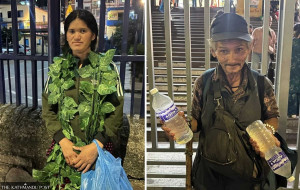
In a village at the foot of Kaminchuli, one of Chitwan’s highest peaks, at least six households face a severe drinking water crisis as soon as winter sets in. An elderly Chepang couple in Kanda, Lothar—a remote hilly settlement in ward 13 of Rapti Municipality in Chitwan. Ramesh Kumar Paudel/TKP
The roof over their heads exists, yet it fails to keep out the rain; a tap stands in the village, but no water flows from it. An elderly couple in Kanda, Lothar—a remote hilly settlement in ward 13 of Rapti Municipality in Chitwan—have somehow managed to arrange drinking water for now. But as for re-thatching their roof, they say they have no means to do so.
In this village at the foot of Kaminchuli, one of Chitwan’s highest peaks, at least six households face a severe drinking water crisis as soon as winter sets in.
Dhansingh Chepang is 70 years old. His wife, Thulimaya, is of a similar age. The palm of Dhansingh’s left hand is shrivelled, and his fingers do not function properly, making it difficult for him to grip or hold objects. Thulimaya, who had gone to the forest to graze cattle, returned carrying water in plastic bottles.
“There are farmhands coming to sow maize tomorrow. We certainly need this much water. I made sure to collect it while I was in the forest,” she told the Post on Saturday.
She notes that it is not always possible to go to the forest. As a result, she often has to walk down to the lower village to fill her vessels. For drinking and cooking water, she must endure a round trip of at least half an hour. Like Dhansingh and Thulimaya, their neighbours—Gopiram Chepang, Nir Bahadur Chepang, Ram Bahadur Chepang, Resham Chepang, and Buddhi Kumar Chepang—must arrange water in the same arduous manner.
The thatched roof over the small area at the front of Dhansingh’s house is almost bare. On the left side of the porch, he has stored peas harvested from his fields. The maize sown at this time on the hillside will ripen only in August. There was a time when, after March, the Chepang community had to survive by foraging for wild tubers, air potatoes and forest roots. While the threat of absolute famine is no longer as severe, Dhansingh says they still have to gather wild tubers to supplement their diet.
“This place lies right at the foot of the mountain. Winds strong enough to blow houses away sweep through here. There is very little rainfall. Until mid-winter, we managed to drink spring water brought through pipes. But after January, it starts drying up, and from February onwards, not a single drop flows from the tap. We have to wander around carrying bottles in search of water,” Buddhi said.
The area falls under ward 13 of Rapti Municipality. Despite being part of a municipality, neither roads nor electricity have reached the village, and the struggle for drinking water remains acute.
“I have no idea when a road will reach the village; I cannot imagine one arriving while we are still alive. I’ve heard that electricity poles have reached the lower areas, but I don’t think power will come here anytime soon. Roads and electricity are distant dreams; here, we cannot even quench our thirst with ease,” Dhansingh said.
After their children grew up, they left the area to settle elsewhere. Dhansingh and Thulimaya, however, could not bring themselves to abandon their ancestral land.
“Where would we go? And if we stay, this is our plight,” Dhansingh said. The sloping land does not yield good harvests. He has not been able to rear goats or poultry for sale, and there is no income to arrange corrugated zinc sheets. Even if he cuts hay to thatch the roof, he said, strong winds and monsoon rains do not allow it to last long.
Located northeast of Bharatpur, the district headquarters of Chitwan, Dhansingh’s village sits on the edge of forests and hills bordering Dhading.
From Bhandara on the East-West Highway, after a nearly three-hour drive north along hilly tracks, one must walk for at least another three hours to reach the village. No political leaders visit this settlement, which is accessible only via narrow, winding paths that climb and descend steeply.
“No one comes here to ask about our welfare. Nor have we gone to anyone to complain about our problems. It is what it is, and we just get by,” Dhansingh said.




 26.87°C Kathmandu
1.jpg)