Jumla is drawing medical students from India and beyond
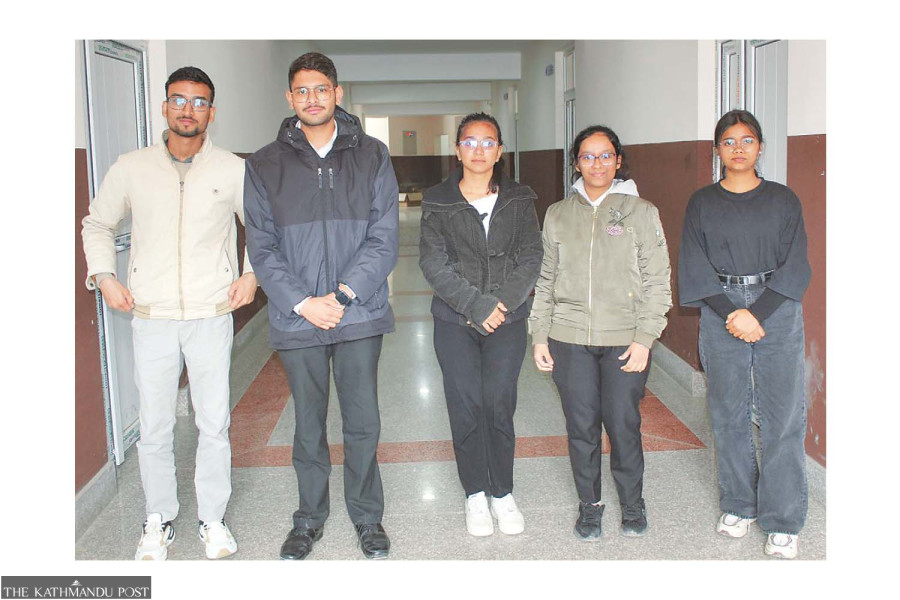
Students praise Karnali Academy of Health Sciences for quality education and rural healthcare experience. Foreign medical students at Karnali Academy of Health Sciences, in this recent photo. DB Budha/TKP
Sakshi Gupta, from Jammu and Kashmir, India, is a third-year MBBS student at the Karnali Academy of Health Sciences (KAHS) Teaching Hospital in Jumla. She says she is excited about the opportunity to pursue her medical degree in this remote mountain district. Having met all the criteria set by the Medical Education Commission, Gupta notes that she is gaining invaluable insight into the healthcare challenges of rural Nepal.
“We once heard that Karnali was a place that had to send its patients elsewhere for treatment,” she said. “Now, it is producing doctors who are contributing to solving health problems in urban areas as well.”
Joining her in Jumla are two more Indian students—Kasturi Singh from Madhya Pradesh and Kartikeya Mishra from Prayagraj, Uttar Pradesh. They say they were pleasantly surprised by the environment, academic standards and the hospitable nature of the local people.
“We had the option to study at city-based universities in Nepal,” Gupta said. “However, we chose the Karnali Academy not just for the MBBS programme, but to contribute to healthcare, education and research in a remote region. I had heard that medical education in Nepal is excellent; the quality here is high, and the regularity of both classes and faculty is impressive.”
The number of Indian students is steadily growing. Following the first batch of three, five more have joined the second batch, bringing the total to eight. KAHS Rector Dr Dabal Bahadur Dhami said Indian students are increasingly drawn to Karnali’s medical curriculum.
According to Dhami, this academic session has welcomed Angel Singh from New Delhi, Abdul Ahmed from Nanpara (Bahraich), and Ridhyma Chauhan, Shreya Tripathi, and Digvijay Singh, who come from Uttarakhand and Mathura areas.
“Indian students could have chosen any university across Nepal,” Dhami said. “They have come to Jumla because this is a government institution established as an academic hub, known for the discipline of its staff and the unique appeal of getting exposure to rural healthcare challenges.” He added that their presence has helped to boost the region’s health education sector.
The academy’s growing reputation is reflected in its results, with 100 percent of graduates in Pharmacy, Nursing and Public Health passing their respective licensing examinations. The 300-bed teaching hospital provides a strong environment for practical training.
Historically, Karnali was synonymous with poverty and unemployment, with many residents migrating to Indian cities such as Nainital and Uttarakhand for manual labour. Today, that trend is partially reversing, as Indian students are arriving in the same region to pursue professional medical degrees. Dhami said the institution is also preparing to launch PhD programmes in Rural Health, Public Health and Pharmacy.
Currently, KAHS operates several schools: the School of Medicine (MBBS, MD, MS), the School of Pharmacy (BPharm, MPharm), the School of Nursing (BSc Nursing, BN, Bachelor of Midwifery), and the School of Public Health (BPH, MPH). Across these disciplines, there are 130 students, 120 faculty members and staff.
While students from Karnali once travelled to India, Pakistan, the Philippines and Egypt for medical studies, the academy is now hosting students from the Maldives, Sri Lanka and India. Mishra, a third-year student from Prayagraj praises the academic standards at KAHS.
“The teaching is going well, and we are gaining excellent experience. The quality here is on par with what you find in India,” he said.
The academy has effectively silenced critics who once doubted the viability of a medical college in Jumla. It now offers 13 undergraduate and postgraduate programmes. “We are achieving better results than the national average in several disciplines,” Dhami added.
Raj Bahadur Mahat, chairperson of Civil Society Jumla, said Karnali was long defined by hardship and state neglect, but the situation is changing.
“Roads are finally connecting our villages to markets, and the academy has ensured specialist-level healthcare and medical education,” he said.
The institution has also helped reduce deaths from outbreaks of diseases such as cholera and influenza.
For the 2026 academic session, 130 students have been enrolled across various programmes, including 50 in MBBS and 20 each in Nursing, BNS, BPH, BSc Nursing and BPharm—an increase from 104 students last year.
Established on October 20, 2011, the KAHS serves 10 districts of Karnali province and three districts of neigbouring Sudurpashchim province. In addition to its academic mission, the academy regularly conducts health camps in remote areas such as Humla, Mugu, Dolpa and Kalikot, bringing specialist care directly to local communities.




 12.97°C Kathmandu