High-tech surveillance helps nab notorious poachers in Chitwan
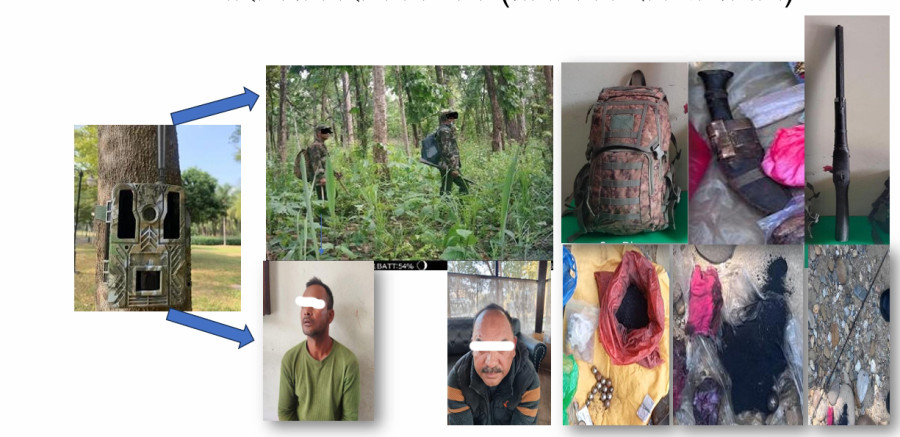
Chitwan National Park currently employs 25 spy cameras alongside seven drones to monitor its 952 sq km territory and buffer zone areas. The combination photo shows spy cameras mounted on a tree, Nepali Army soldiers patrolling the forest, arrested poachers, and their weapons and logistics. Photo: Courtesy of Chitwan National Park
The dense undergrowth of Chitwan National Park (CNP), the country’s first protected area, usually offers perfect cover for those seeking to harm its rare inhabitants. However, a discreet network of spy cameras has proven to be a game-changer for conservationists. Authorities recently announced the capture of a notorious poacher, Ram Sharan BK, whose illicit activities were brought to light by high-tech digital surveillance.
The breakthrough occurred on July 13 last year, when a sensor-activated camera positioned in a sensitive zone transmitted a startling image to the park’s command centre. The photograph depicted two individuals dressed in fatigues, carrying muskets and heavy bags. This visual evidence immediately alerted the park’s security agency, leading to a coordinated pursuit by the Nepali Army and park rangers.
"While regular patrols continue, we have increasingly integrated technology into our strategy," said Ganesh Pant, chief conservation officer at the CNP. "These spy cameras have provided us with critical leads and significant successes in our recent operations. The ability to monitor remote areas without a physical presence is a major deterrent against poaching."
While Akkal Bahadur BK, a permanent resident of Parsagadhi Municipality in Parsa district, was apprehended shortly after the initial sighting, the primary suspect, Ram Sharan BK—also known as Rakesh Lamgade—managed to evade capture for five months. It was only on December 1, 2024 that a joint team from the CNP office, the Nepali Army's Naya Gorakh Battalion, and the Central Investigation Bureau (CIB) finally detained him in the Purano Parsa Bazar area of Khairahani.
Ram Sharan, a permanent resident of ward 3 of Hetauda Sub-Metropolitan City in Makawanpur district, is no stranger to the conservation history. In 2010, he was sentenced to 15 years for the conviction of rhino poaching, a term later reduced to 10 years by the Supreme Court. Having completed that sentence, authorities believe he returned to the park again with the specific intent to kill rhinos for their horns.
"We have filed cases against BK for attempted rhino poaching and the illegal possession of firearms," said Abinash Thapa Magar, the park’s information officer. Magar noted that while a court set bail at 200,000 rupees for the poaching charge, Ram Sharan remains in custody for possessing the arms.
However, the victory is bittersweet. Akkal Bahadur BK, who was initially caught, is among 17 wildlife criminals who escaped from Bharatpur Prison during the Gen Z unrest on September 10, 2024. "Search operations for these fugitives have been intensified, as they represent a persistent threat to our conservation goals," said Magar.
The use of technology marks a shift in Nepal’s conservation efforts. Poaching and smuggling of body parts remain the greatest threat to conserve one-horned rhinos. Following the repeated poaching of rhinos in the park area, the national park planned for more sophisticated surveillance to curb the illegal activities.
CNP currently employs 25 spy cameras alongside seven drones to monitor its 952-square-kilometre territory and buffer zone areas. These tools augment the efforts of approximately 800 Nepali Army personnel stationed within the park. The cameras use motion sensors to capture and transmit images instantly, though Pant admitted that the vast distances often make immediate physical interception challenging.
The park is a vital habitat for rhinos and tigers. Under existing legal provisions, those convicted of killing rare wildlife or trading in their parts face fines of up to one million rupees, a 15-year prison sentence, or both.
Chitwan National Park is the major habitat of tigers, rhinos and several other endangered species in Nepal. There has been a rise in the population of both tigers and rhinos in the national park and its vicinity.
One-horned rhino, which is native to Nepal and India, is an endangered animal. Nepal is home to 752 one-horned rhinos and Chitwan National Park alone has 694, according to the national rhino census conducted in 2021. The 2015 count had found 605 rhinos in the park.
According to the latest tiger census held in 2021, the tiger population in Nepal has reached 355, with the country nearly tripling the number in 12 years. Chitwan is a major habitat for big cats, hosting as many as 128 big cats in its forests and surrounding areas. In 2018, the park was home to 93 tigers.




 25.92°C Kathmandu
1.jpg)