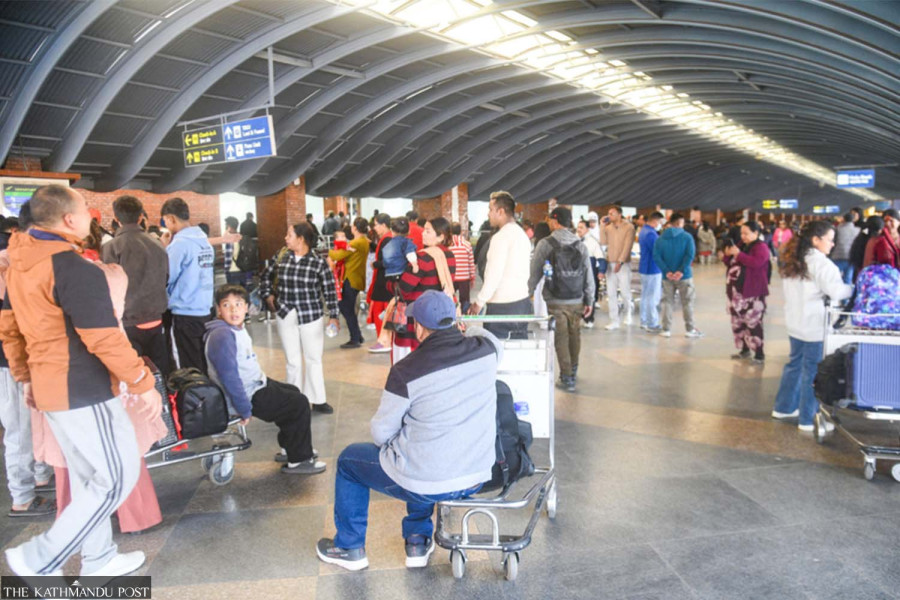
Rising tensions in West Asia have severely affected Nepali migrant workers in the region, as well as those seeking jobs there. As a result, more than 2,000 Nepali nationals who have already been granted work visas are denied labour permits by the government of Nepal on a daily basis, citing rising tensions in the Gulf.
Not only new workers but also those who have returned home on leave have been denied labour permit renewals, preventing them from returning to work.
The Department of Immigration has barred Nepali migrant workers without labour permits from air travel. A meeting of the “Emergency Response Team”, chaired by Foreign Secretary Amrit Bahadur Rai, recommended to the Ministry of Labour, Employment and Social Security that new and existing workers going to West Asian countries should not be granted work permits.
Based on this recommendation, the Department of Foreign Employment halted both new and existing labour permits for 12 countries—Kuwait, Bahrain, Iraq, Lebanon, Israel, Saudi Arabia, the UAE, Qatar, Oman, Yemen, Jordan and Turkey from March 1, 2026. However, permits resumed for seven countries- Saudi Arabia, the UAE, Qatar, Oman, Yemen, Jordan and Turkey—starting Tuesday, although permits for new workers remain suspended.
According to the department, 70,503 people, including new and returning workers, had been issued labour permits for employment by February 12, 2026. Of them, 48,226 had obtained permits to go to 12 West Asian countries. Among the five main destinations for Nepali workers, four are in the Gulf region—Kuwait, the UAE, Saudi Arabia and Qatar.
On February 28, the US and Israel launched joint attacks on Iran. Shortly afterwards, Iran began retaliatory attacks targeting US bases in Gulf countries, heightening insecurity in the region.
In the one-month period from February 13 to March 14, the department issued labour permits to 52,000 people in total, including new and returning workers. However, most of the 14,536 people, who had already obtained new visas for 10 West Asian countries by February 28, have been unable to travel due to the conflicts.
Ujjwal Thapa of Sindhuli, who had already spent Rs 200,000 for employment in the UAE, said his employment opportunity was now at risk. He had planned to fly after the March 5 parliamentary elections, following the completion of medical checks, and visa and documentation procedures.
“I fear I may lose the money spent on the employment process if I am not allowed to fly now,” he said. “Everyone at home is hopeful. What should I tell them?”
He said he needs to go to the UAE to fund treatment for his sick wife. “I have to pay for my wife’s treatment and also secure my children’s future. I have loans to repay. If I cannot go now, what should I do?” he said. “There is fear of insecurity in the Gulf region on one hand. On the other hand, there are family responsibilities. I am afraid to go, but I am left with no options as I have to manage money to operate households.”
Baikuntha Paudel, general secretary of the Nepal Association of Foreign Employment Agencies, said approximately 20,500 workers who had already received visas for Gulf countries are waiting for labour permits. Of them, 10,000 were supposed to go to the UAE, 5,500 to Saudi Arabia and 5,000 to Qatar. “Their procedures were already completed. However, their departure is uncertain,” he said.
He added that tensions in West Asia have negatively affected the Nepali job market. “Seventy-three workers had come to Kathmandu to go to Bahrain. I arranged bus fares for all of them and sent them back home,” he said. “It is uncertain when they will be able to travel.”
Director General of the Department, Mira Acharya, said the decision to resume labour permits for seven countries was made on Tuesday, allowing Nepalis who were on leave to return to their destination countries.
“No decision has been made yet to renew permits for Nepalis working in Iran, Israel, Bahrain, Kuwait, Iraq and Lebanon,” she said. “Airports in these countries are not yet operational. Further decisions will be taken based on the developing situation. For new workers, conditions have not yet become favourable.”
Some workers forced into camps, others returning
As Iran continues attacks in Gulf countries, Nepali workers in those areas have been forced into camps. Some companies have started sending workers back to Nepal.
Iran has carried out drone attacks on the Shah gas field in the UAE, the Fujairah oil port, the Ras Tanura oil refinery in Saudi Arabia, the Majnoon oil field in Iraq, and the Salalah port in Oman. It has also attacked projects in Qatar’s Mesaieed.
Attacks have also targeted Dubai International Airport, Kuwait International Airport and Erbil International Airport in Iraq, where thousands of Nepali workers are employed in these areas.
Ram Paswan of Sarlahi, who works at Kuwait Airport, said he has been staying in the camp for the past two weeks.
Nepalis whose contracts have expired in the UAE and those granted leave are returning home. Workers from Qatar, Kuwait and Bahrain are returning via Saudi Arabia. The Ministry of Foreign Affairs is facilitating the return of those who are unsafe or have urgent needs through Saudi Arabia. Qatar, Kuwait, Bahrain and the UAE share land borders with Saudi Arabia.
Air services across much of the Gulf are irregular, affecting the movement of Nepalis returning home. From the UAE, Flydubai and Air Arabia are operating limited flights. After a temporary disruption, operations at Dubai Airport have resumed. However, due to limited flights, tickets are extremely difficult to obtain.
International human rights organisations have urged governments, employers and international bodies to take immediate steps to protect migrant workers.
“To ensure the protection of migrant workers, including Nepalis, the governments of destination countries must strengthen early warning systems and provide equal access to safe shelters and humanitarian assistance without discrimination,” said Rameshwar Nepal, South Asia Director of Equidem, a global human rights organisation.
“Employers should not withhold workers’ documents or wages if they wish to return home. During this crisis, employers who withhold wages or dismiss workers must face strict action,” he added.
Hom Karki is a reporter with two decades experience covering migrant workers issues and the Nepali diaspora. He was previously based in the Gulf for Kantipur Daily.




 23.3°C Kathmandu