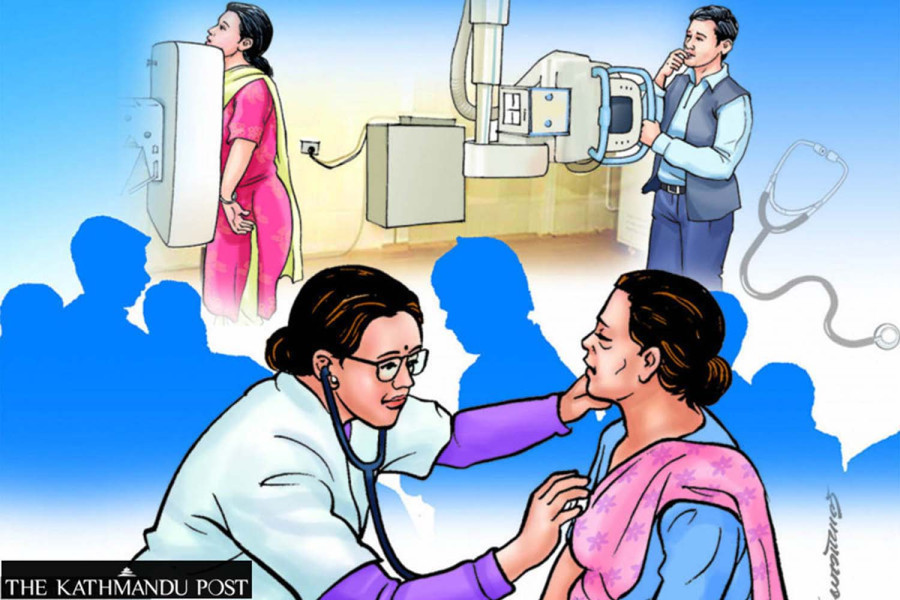
Kathmandu Metropolitan City (KMC) failed to carry out its annual month-long screening of non-communicable diseases this fiscal year, mainly due to the March 5 snap parliamentary elections, which coincided with the campaign.
Each year, local units across the country screen residents for major non communicable diseases, including hypertension and diabetes, and also conduct tests to check kidney function, blood sugar, and body mass index.
Officials at the KMC, the most populous city in the country with over a million residents, blamed the deployment of health workers in the elections for the disruption.
Although around three months remain in the fiscal year, officials say it is unlikely that the screening will be completed this time. “This year, we couldn’t carry out screening of four major non-communicable diseases [hypertension, diabetes, renal function-related, and obesity],” said Deepak Kumar KC, chief of the Health Department of the city office. “We are still planning to conduct the screening, but it seems we won’t be able to do it this time.”
Several other local units, and in some cases even entire districts, have not carried out screening of non-communicable diseases this fiscal year. Deployment of health workers in election work is the chief reason many health offices cite, while local officials in mountain districts blamed the harsh winter.
“Only around 300,000 people underwent screening for non-communicable diseases,” said Dr Pomawati Thapa, chief of the Non-communicable Disease and Mental Health Section at the Epidemiology and Disease Control Division under the Ministry of Health. “The programme targeted people over 30, but indeed the number is too low.”
Though the programme was originally scheduled for February 13 to March 14, the Ministry of Health and Population had this time directed all health agencies to complete the screening well ahead of the elections.
The federal government allocated Rs100,000 to each district, and local units were provided up to Rs520,000 based on the population size to conduct the screening.
According to health officials, 188,794 women (63.3 percent) and 109,268 men (36.7 percent) underwent screening during the campaign. Only 11,245 people underwent health screening in the Karnali province.
Of those screened, 53,800 checked their blood pressure, 48,000 their weight, 22,900 their blood sugar levels, and 8,000 examined their renal function.
Health workers referred over 30,000 people for further treatment at other health facilities, and 30,600 received treatment at local health facilities.
Officials say the screening programme is designed mainly to raise awareness, and low public participation undermined that purpose.
The burden of non-communicable diseases has risen alarmingly in recent years. The Nepal Burden of Disease 2017 report attributed two-thirds (66 percent) of total deaths to non-communicable diseases, while the figure jumped to 71.1 percent in 2019. The Global Burden of Disease 2021 shows 73 percent of deaths are caused by non-communicable diseases.
Hypertension, diabetes, renal disease, liver problems, heart problems, and cervical cancer, among others, are major contributors to morbidity and mortality in the country, according to public health experts.
They say that the month-long screening programme helps raise awareness of risk factors, diagnose ailments at an early stage, and initiate treatment, thereby preventing conditions from worsening.
Many people in Nepal do not even get their blood pressure checked and often learn about their condition when complications become severe.
A study conducted by the Health Department of Kathmandu Metropolitan City last year uncovered a growing health crisis among residents. According to the findings, 39 percent of the population aged 30 and above in the city suffers from high blood pressure or hypertension, a condition in which an individual’s blood pressure remains elevated over time.
High blood pressure is an established risk factor for ischemic heart disease (also known as coronary heart disease), stroke, and kidney disease.
Of those suffering from high blood pressure, 13 percent were unaware of their condition, and around three percent were not taking medications despite knowing their health problems. Those who are not taking any medications despite knowing were mostly young people who believed they could manage the problem through diet and exercise, and were concerned about high treatment costs.
Likewise, five percent of people in the metropolis were newly diagnosed with diabetes, while 14.5 percent of those tested said that they already had the disease. Another 2.4 percent were not taking medications despite knowing that they have high blood sugar levels, for the same reasons— diet and exercise management and concerns about medical expenses. Altogether, 22 percent of KMC residents above 30 are diabetic, according to the report.
Doctors say changes in dietary patterns, such as increased consumption of processed foods, sedentary lifestyles, and rising stress levels, are among the culprits for the rise in the burden of non-communicable diseases. Most patients seek treatment when problems worsen, and in many cases, it is already too late.




 27.61°C Kathmandu