Air in Kathmandu Valley has already turned toxic and the peak forest fire season is nearing.
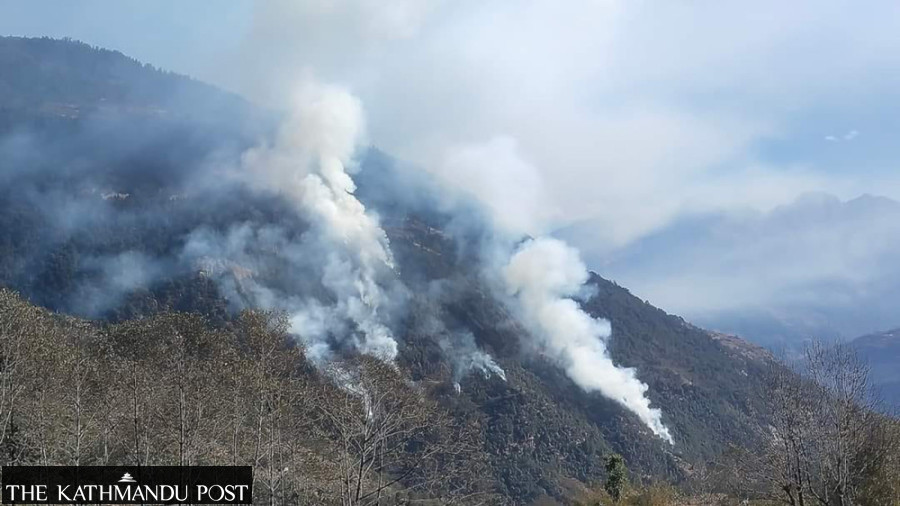
Environmentalists, as well as air quality experts, say that the worst air pollution is yet to come, as no measures have been taken to prevent fires, which engulf almost all forests throughout the country in the dry season every year.
What is concerning is that the problem has not been recognised as such by any agency in the country. The National Disaster Risk Reduction and Management Authority, which is responsible for coordinating efforts of risk reduction with provincial and local authorities, lacks a focal person to oversee forest fire management for over six months.
“An expert on forest fires serving under our ministry retired years ago and another officer tasked to oversee forest fire management efforts has been transferred to another ministry,” said Shanti Mahat, information officer at the authority. “The public must remain cautious, as forest fires do not stop simply because there is no designated focal person to oversee the incidents.”
Environmentalists and air quality experts warn that complacency towards the serious issue will be too costly for the country and the people. They say that incidents of forest fire are likely to increase this year, as the prolonged drought and accumulation of biomass in the wild for a long time provide ample fuel.
“Incidents of wild fire have already started rising and the peak of the forest fire season reaches in April-May,” said Bhola Bhattarai, an environmentalist and forest fire expert. “We talked about the problem only when it started. By then it would always be late to take preventive measures.”
With the decline in the use of forest products—firewood, dry leaves and others–by the people residing in villages, biomass accumulation has risen manyfold in the forests, which fuels wildfires. In Nepal over 90 percent of the forest fires are started intentionally.
The wildfires have not only threatened years of progress made by the country in forest conservation, but also risked lives and livelihoods, ecology, and environment, according to experts.
“Quality of the air has already deteriorated and looming forest fire incidents will worsen air quality further,” said Bhattarai. “The effects of polluted air on public health will be far more than what people anticipate. The entire country, excepting mountainous regions, will be like a gas chamber during the peak forest fire season.”
Wildfires are common in Nepal during the dry season. Human activities and negligence are the main culprit for most of the forest fire incidents, officials say. Farmers set fire to dried vegetation to clear their farmland while grazers and staffers burn national park areas deliberately.
“Last year a passenger discarded a glowing cigarette butt before boarding a public bus in Sankharapur Municipality in Kathmandu. It caused a massive forest fire,” said Bhattarai. “Youths roaming in forest areas to smoke marijuana, as well as villagers trying to encourage new fodder growth or dealing with wild animals, sometimes intentionally light fires.”
Experts say that incidents of forest fires are likely to increase in the coming days due to ongoing dry conditions and a low chance of heavy precipitation in the next few days.
Nepal’s valuable forests, which took more than six decades to restore, face a worsening wildfire reality with scarce resources and nearly zero strategies to prevent or fight it. The country has increased forest coverage by 45 percent from around 41 percent in 2019. However, growing incidents of forest fires threaten progress, according to experts.
They ask the authorities to launch an awareness drive about the risk of forest fires, and urge people not to go to forests if there is an out-of-control blaze and the wind blows from all directions.
“Strengthening local governments, imparting training to local residents, providing them with necessary kits to deal with fire incidents, and building artificial ponds are among the ways to deal with fires,” said Bhusan Tuladhar, an environmentalist. “Raising awareness of the consequences of deliberately causing forest fires, and penalising those responsible could significantly reduce such incidents. We should also make people aware of the dangers of putting out fires.”
These days the quality of air has reached a very unhealthy and hazardous level. Since last Thursday, haze mixed with polluted air blanketed most parts of the country. Kathmandu was ranked the world's second most polluted city with PM2.5 soaring to very unhealthy and hazardous levels. Experts say air quality in Kathmandu has worsened due to the Valley’s bowl-shaped geography.
PM2.5 refers to particulate matter (solid or liquid droplets) in the air less than 2.5 micrometres in diameter. It is among the most dangerous pollutants that can get past the nose and throat to penetrate the lungs and even the bloodstream. PM2.5 particles are small and likely to remain suspended in the air for a long time, increasing the likelihood of people inhaling them.
The worsening air quality has aggravated respiratory illness among the general public. Major hospitals in the Valley have reported a sharp rise in cases of flu, viral fever, cough, and respiratory disease. The Ministry of Health and Population has urged the general public to remain indoors to avoid the adverse effects of deteriorating air quality.
Air pollution has emerged as the number one risk factor for death and disability in Nepal, surpassing malnutrition and tobacco use, according to the World Bank report.
The report titled, ‘Towards Clean Air in Nepal: Benefits, Pollution Sources, and Solutions,’ unveiled last year, stated that polluted air cuts life expectancy by 3.4 years for the average Nepali and causes approximately 26,000 premature deaths annually.
Air pollution heavily contributes to various diseases: 75 percent of chronic obstructive pulmonary disease cases, 46 percent of strokes, 44 percent of ischemic heart disease, 41 percent of lower respiratory infections, 38 percent of lung cancer, 30 percent of neonatal issues like low birth weight and preterm birth, and 20 percent of diabetes, the report stated.
Economically, the consequences are severe. “It affects labour productivity due to increased health-related absences and impaired cognition. The negative impact on the tourism industry and the aviation sector is also significant. The economic cost of poor air quality is estimated to exceed six percent of Nepal’s GDP each year,” the report says.
Without intervention, the economic burden is also expected to grow proportionally, the report warns, while calling for multi-sectoral and multi-regional actions.




 25.92°C Kathmandu