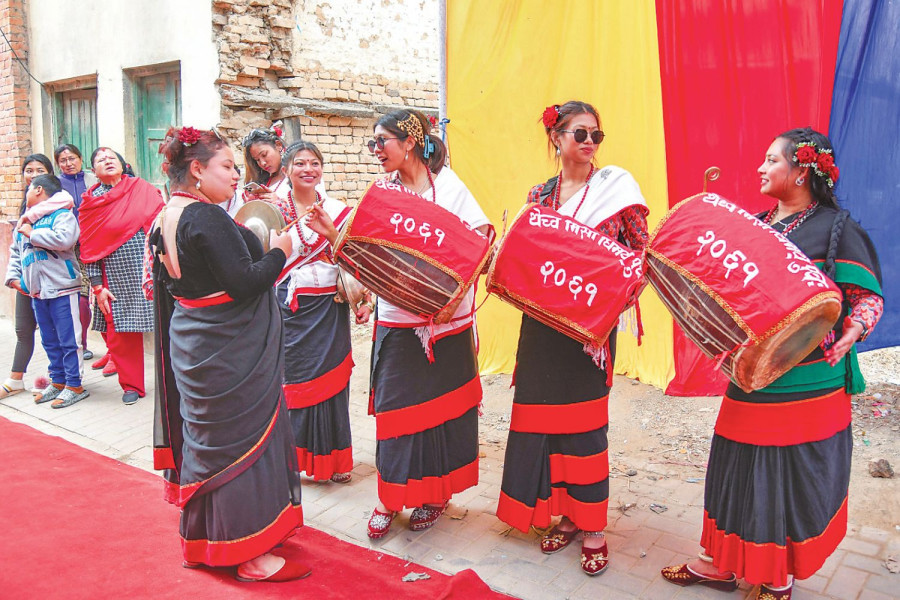
Women now serve on committees, assist in rituals, and play instruments, but they still cannot assume hereditary leadership duties. Women of the Mali community play music during the Navadurga Nach festival in Thecho, Lalitpur in 2024. PHOTOS: Courtesy of Prashant Mali
When Sanju Maharjan married into the Mali community two decades ago, she quickly learned that women’s voices were limited.
“If I said anything, I was told, ‘You’re a woman, so please stay quiet,’” she recalls. Leadership roles in the Guthi, the socio-religious institution of the Newar community that manages festivals, feasts, funerals, and communal responsibilities, were reserved for men.
Women prayed, fasted, plastered floors with mud, and supported rituals from home. Committee discussions and leadership roles were male-dominated.
Today, Sanju is the secretary of the Navadurga Bhawani Devi Guthi Preservation Committee. She first joined as a volunteer and gradually assumed a formal role after the community began including women in line with the constitutional provisions requiring at least 33 percent female representation. ‘‘There is a need for at least three women in the group,’’ she explains, adding that meeting the requirement allows the committee to receive certain government funds.
The Guthi system, integral to Newar life since the Lichchhavi era (5th to 8th century common era), has historically been male-dominated, with women confined to supportive, backstage roles in festivals, feasts and funeral rites. Yet voices from within the Mali community suggest the institution is at a point of adjustment. Like the broader Guthi network, whose practices are being discussed in the context of modernisation and cultural preservation, women’s participation is being reassessed. While some traditional boundaries remain, inclusion in committees and minor adjustments indicate gradual change shaped by both internal considerations and wider social transformations.
In Thecho, the Mali community’s ritual life revolves around multiple Guthis. Three Guthis—Kona Guthi, Mu Guthi, and Nehas Guthi—operate under the Brahmayani Raj Guthi. Similarly, Tho Guthi, Pune Guthi, Chare Guthi, and Paru Guthi function under the Balkumari Raj Guthi.
Each Guthi has defined ritual obligations, hereditary roles, and administrative responsibilities. The Kona Guthi functions as Malami Guthi, managing funeral rites and processions.
Historically, only males could serve as committee members. Women’s participation was devotional and informal, supporting rituals, preparing offerings, or maintaining cleanliness.
“In the past, women were not allowed into the feast or near the gate,” recalls Gyanu Maharjan of the Mali community. Access to kitchen spaces and the Guthighar was restricted.
Gopal Mali, a priest at Navadurga for nearly a decade, explains that these practices continue in some areas. “Internal work hasn’t been given to them since the beginning. Currently, they do all the outside work. This Guthi is for the main deity, and women shouldn’t see it,’’ he said. Even family members cannot enter the Thakali ghar (the kitchen and ritual preparation area) during cooking or ceremonies; they can enter only after work is complete, to clean.
In the past, women were even barred from receiving the black tika of Nathguru, due to fears it could drive them mad. “We later realised it was just a superstition,” he said.
Over time, adjustments expanded women’s roles. Ichchha Bhakta Maharjan, the Naike (head) for nearly 40 years, initiated changes, including reducing the duration of ‘Yama Punhe Jatra’ from 13 days to about a week. ‘‘In this Jatra, it is women who have to wake up early and go to temples to perform puja regularly throughout the festival,’’ he said. Women can now stay in the Guthighar during the feast. Its timing has also been fixed to morning and evening rather than throughout the day.
Krishna Lal Mali, Naiike at the Kona Guthi, notes that women can now freely play the flute and Dhime drums. The committee encourages the women to learn such instruments at the Natyeshwar shrine. ‘‘They actually play better than us now,” he says, referring to women who have begun performing in ritual spaces.
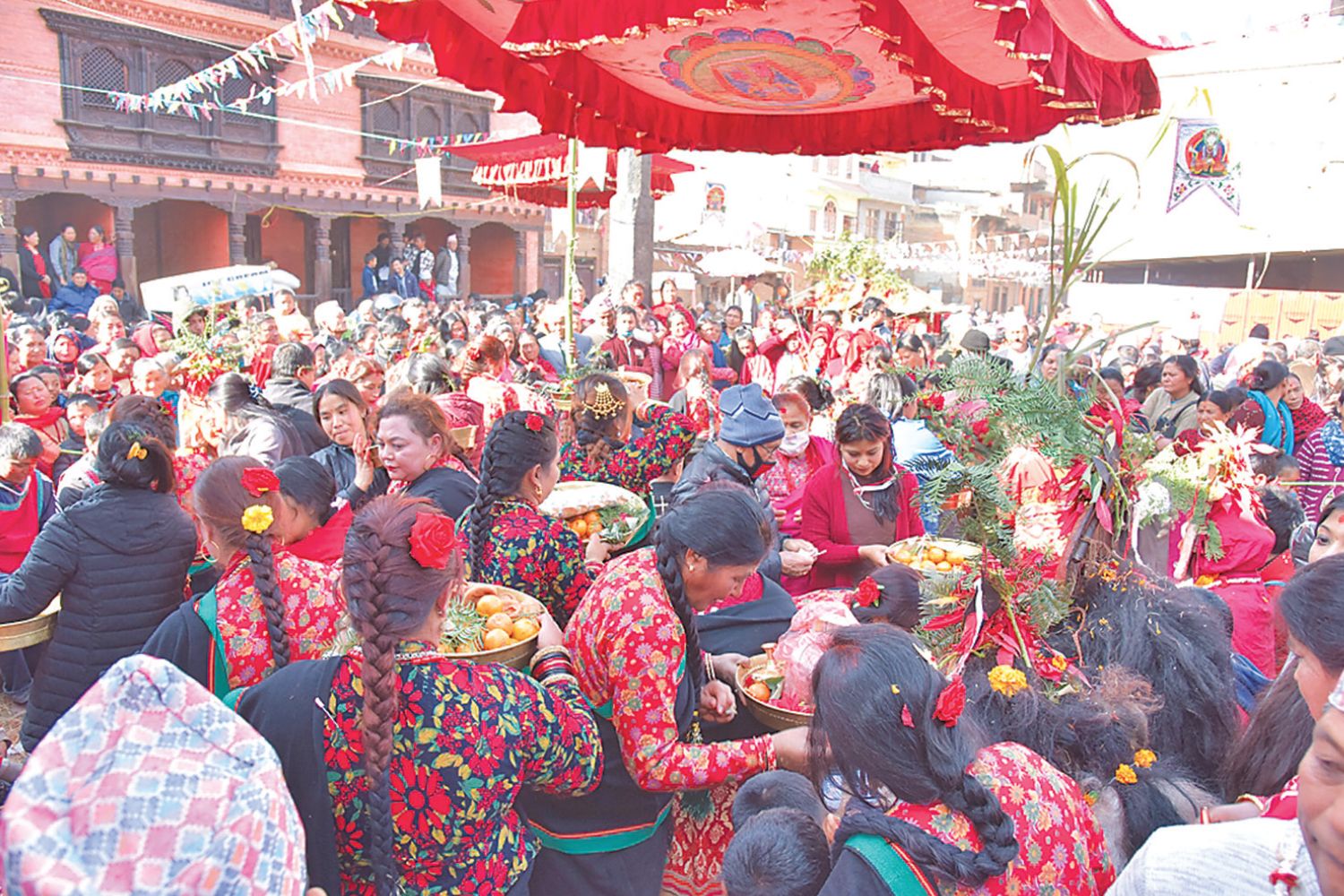
Men and women waiting with offerings to worship the Navadurga, nine forms of the Goddess Durga.
Young participants like Nikita Mali speak from experience. She began learning the Dhime drum at the age of 20 in the Micha Dhime Khala (group), as part of the third batch. “It’s been only four years since this started,” she said. There are separate classes for girls and boys, and twelve baja khala in total, where participants are taught to play ritual instruments.
However, in the Navadurga Dhimay Khala Baja, women are still not allowed to enter. They can play the Dhimay outside, but cannot practice it inside.
Formal committee membership has also provided women with a platform to influence decisions. Sanju, Sanu Devi Mali, and Hira Mali serve on the Navadurga Bhawani Devi Guthi Preservation Committee.
Sanu Devi, an executive member for more than four years, remembers learning women could officially join: “I felt very happy. Involvement was there from home, but to work officially meant a lot.”
Her involvement has enabled her to propose changes, such as honouring retired deities (boys who have completed their term in ritual roles) and forming a nine-member Volunteers Committee to assist during Dashain, Tihar, and support processions.
Even minor adjustments are meaningful. Gyanu Maharjanof the Mali Guthinotes that women can now carry out tasks such as cleaning bowls inside the Guthighar, rather than doing so outside as in the past. Food for Samyabaji (a Newari ceremonial food assortment offered to deities), previously prepared at home for festivals at Patan Durbar, can now be prepared within the Guthi premises while maintaining ritual standards.
Although these changes relate largely to supportive and preparatory roles, some members see scope for border shifts.
Gyan Bhakta Maharjan, head chef of the Mu Guthi, sees potential evolution. “Slowly, in the coming days, they should be accepted. If I had a daughter, I would allow her to inherit the role.’’
Ichchha Bhakta Maharjan, however, maintains that Guthiyar and deity roles remain within male succession, citing physical demands and tradition as the reasons. The secretary also accepts that women may not assume these positions, pointing to practical constraints such as menstruation that can coincide with rituals.
Resistance persists, though it is shrinking. “If we’re a total of 30 people, there are still four who don’t like our involvement,” Sanju notes. Decision-making power is not yet equal, and women’s suggestions are sometimes taken lightly. She adds, ‘‘The opposition is not entirely male; internalised hierarchies can also limit participation.’’
Sanu Devi adds that criticism often comes from outsiders claiming women’s involvement is “not traditional.” Within the Guthi, she says, support has grown.
The inclusion of women has coincided with gradual shifts in social norms and caste practices. Gyan Bhakta Maharjan notes, ‘‘Even where rituals were strict before, some boundaries are slowly changing. Restrictions based on caste are not as rigid as they used to be.’’ The overall pattern of reform reflects negotiation rather than confrontation.
The Mali community’s experience shows how traditional institutions adjust over time. Women now serve on executive committees, assist in ritual work, and contribute to decision-making, while hereditary and internal ritual roles remain male-dominated.
‘‘In societies where ritual authority is inherited, incremental changes in participation can have a significant impact on women’s social agency,’’ notes Neera Shrestha, gender studies scholar at Tribhuvan University. ‘‘Even if they do not assume all leadership roles like of Nayike and Guthiyar, being part of committees alters visibility, voice, and influence.’’
She adds that flexibility is already seen in practice. ‘‘In families without adult sons, women sometimes take on the roles that are usually reserved for men. This can happen if the sons are abroad, if the husband has passed away, or if an older woman is no longer menstruating.’’
While women’s full access to ritual leadership remains uncertain, their participation in committees and volunteer groups reflects a gradual shift.
As Sanju puts it, ‘‘Even though some roles remain restricted, being part of the committee means our voices are being heard. Participation is expanding and over time, more people will accept it.’’
Aarya Chand is a reporter at The Kathmandu Post covering social issues. Before moving to the social beat, Chand was an intern covering culture and lifestyle for the Post.




 14.81°C Kathmandu