West Asia tensions raise alarm for 1.9 million Nepali workers
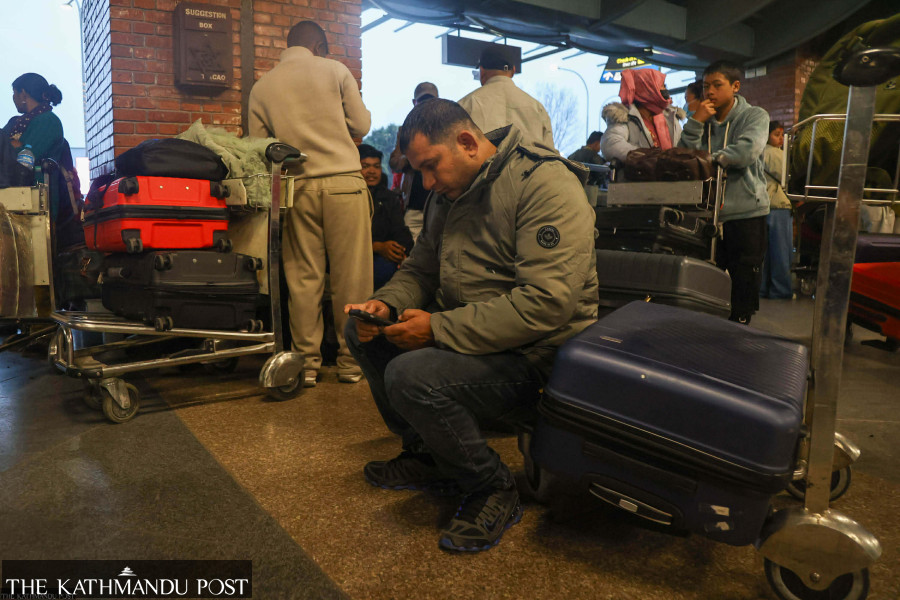
Drone and missile strikes across the region have disrupted workplaces, leaving Nepali migrant workers in Kuwait, Saudi Arabia, the UAE, Qatar, and Lebanon facing heightened risks and uncertainty. Passengers wait in the departure hall at the Tribhuvan International Airport in Kathmandu on Saturday after a Qatar Airways flight was delayed following tensions in West Asia.
Fighting between the United States, Israel and Iran erupted on Saturday, sending shockwaves across the Gulf and stoking fears of a wider regional conflict in West Asia.
The conflict is no longer limited to these countries. Tehran has launched retaliatory strikes on countries hosting US military bases. In Saudi Arabia, Qatar, Kuwait, the United Arab Emirates, Bahrain, Oman and Iraq, Iranian missiles and drones have hit not just US installations but also airports, hotels, residential buildings, ports and oil facilities. As the war escalates, roughly 1.9 million Nepalis working across the Gulf face immediate danger.
On Saturday, Ranjit Kumar Yadav of Sarlahi was inside Kuwait International Airport when it came under attack. “Iran carried out a drone attack on Terminal One. We were about two minutes away, getting ready to leave after duty,” Yadav told the Post by phone. “There was panic, and some people were injured.”
According to Kuwait’s health ministry, 32 migrant workers were injured in the airport attack. Yadav has not been assigned duty since. About 35 Nepalis were at the site at the time.
“There was a huge fear that another drone or missile might strike. We felt it could hit us,” he said. “We left immediately in the company vehicle and have been staying in our rooms since.”
Sirens sounded intermittently across Kuwait. “There is very little movement on the streets; it looks deserted. The company has told us not to go outside, and public buses are scarce,” said Yadav, who has worked in Kuwait for four years.
On Monday, Iran launched a drone strike on the Ras Tanura refinery, operated by Saudi Arabia’s state company Aramco. Situated in the country’s eastern region, it is the largest oil refinery in West Asia.
“We had just arrived at the office. Two drone strikes hit at 7 and 7:10am,” said Shyam Kumar Thakuri, who works in the refinery. “Nothing happened to us. Everyone is safe.”
The refinery can process 550,000 barrels of oil per day and employs about 1,000 Nepali workers. After the attack, the company moved all migrant workers, including Nepalis, to safe camps.
“There was a fire inside the plant, and smoke spread. We were scared for a while,” he said. “We are trained not to run in emergencies. We gathered at designated points and later exited in turns.”
They have been taken to a workers’ camp by the company. “We don’t have to go on duty for now and are staying in our rooms,” he said. “We have been told to remain in the camp until further notice.” According to the Nepali embassy in Riyadh, Nepalis working in Ras Tanura are safe. “We are in contact with the workers,” Labour Consular Kabiraj Upreti said. “All Nepalis are safe.”
In the United Arab Emirates, Iranian drone and missile strikes continue. Sita Gaire said her company relocated workers from Abu Dhabi to Sharjah.
“There was a US base camp near our camp. For security reasons, we have been moved to Sharjah,” she said. “The situation seems to be getting more complex. If the war does not stop soon, it could become even harder.”
In Qatar, where Nepalis make up a significant workforce, drone strikes have damaged missile sites and the Ras Laffan energy production centre. Qatar’s defence ministry said two drone attacks damaged an energy facility and a water tank.
“Almost all work sites are closed. Qatar looks deserted. No one is going outside,” said Prem Prasad Bhattarai of Khotang, in Al Khor. “Until Sunday morning, we were not that afraid. By Monday, everyone had grown worried.”
He said he had not left his room. “The Qatari government sends mobile alerts before missiles arrive, warning people to stay inside. But some friends go out to record videos of the strikes. They are putting themselves at risk,” he said.
Around 1,500 Nepalis work in Lebanon. Israeli air strikes have killed 31 people in Beirut and southern Lebanon, and injured 149. Junkiri Alemagar of Ramechhap, who has worked in Beirut for 15 years, said a missile exploded in a building just 10 minutes from her home.
“There were 10 explosions on Monday morning alone,” she said. “The sound shakes the heart. I have not slept for two days.”
Despite rising tensions, Nepalis say evacuation is not yet necessary.
“It does not feel like a full-scale war, but seeing missiles in the sky for the first time has terrified us,” said Padam Sundar Gurung in Bahrain. “There is no need for evacuation yet.”
“He said the situation remains uncertain. ‘There is enough food and drinking water, and all companies are keeping their workers safe in the camps,’ he said.
Iran’s attacks have largely targeted airports. Dhiren Subedi of Pokhara, who works in Kuwait, said he had bought a ticket to return to Nepal on Saturday for the elections.
“It does not look like I will be able to go now,” he said. “The situation is not as it appears on social media. Damage is limited to where missiles fall. There is no need to panic yet.”
Workers whose contracts have expired and were preparing to return home are now stranded. The embassy said it is coordinating with employers to assist them.
“For those whose visas have expired and who had to leave the airport, we have requested employers to provide accommodation and food,” said Labour Counsellor Upreti.
The Foreign Employment Board has pledged funds to support stranded workers. Mahesh Kumar Basnet, general secretary of the Nepal Association of Foreign Employment Agencies, said manpower agencies have been instructed to coordinate continuously with employers to ensure workers’ safety.
“The protection of Nepali citizens’ lives and security is our top priority,” he said. “We have urged manpower companies to stay in contact with employers and provide regular updates on workers’ conditions.”
Krishna Neupane, chair of the National Network for Safe Migration, said the government must prioritise the safety of Nepalis in the Gulf and have a swift rescue and relief plan ready.
“The government should be prepared with an evacuation plan,” he said. “Nepalis returning home are being stranded. Plans must also ensure their protection.”
The Ministry of Foreign Affairs said it is closely monitoring the situation in Gulf countries.
“A committee led by the foreign secretary has been formed to prepare for the possible evacuation of Nepalis if needed. It includes representatives from concerned ministries,” said Foreign Ministry spokesperson Lok Bahadur Paudel Chhetri. “So far, no Nepali workers have approached the embassy requesting evacuation. We are making all necessary preparations, including enhancing capacity, should evacuation become necessary.”
Hom Karki is a reporter with two decades experience covering migrant workers issues and the Nepali diaspora. He was previously based in the Gulf for Kantipur Daily.




 18.82°C Kathmandu