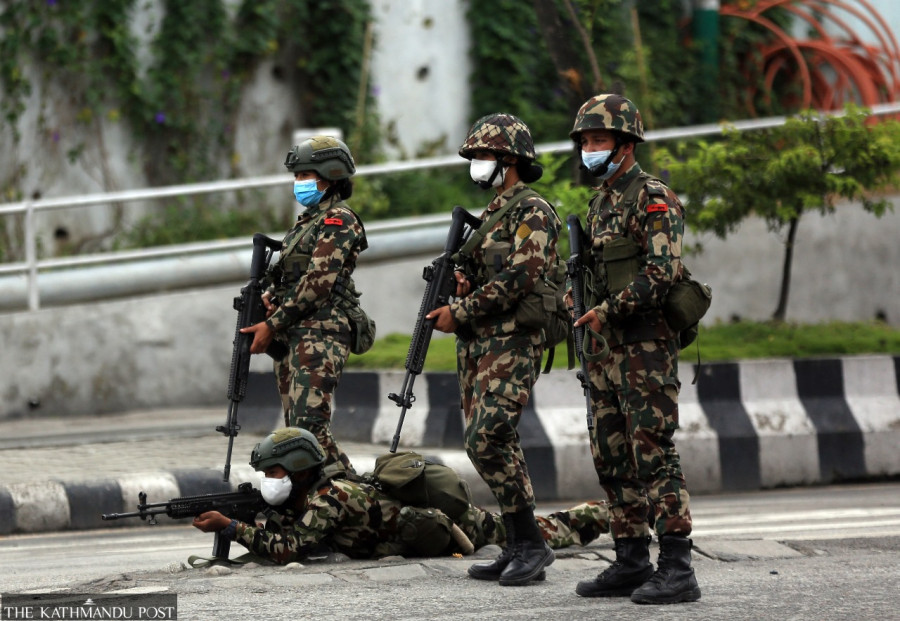
The home ministry and security agencies have gradually started mobilising forces including the Nepali Army for the security of March 5 parliamentary elections.
Some of them have already been deployed for patrolling and other purposes such as securing the facilities where ballot papers are printed.
Relevant ministries, the election commission and security agencies have formed their committees to oversee security-related issues.
At its meeting on November 16, the Central Security Committee decided to initiate the process of deploying the army three months before the elections. The decision was communicated to the National Security Council through the Ministry of Defence.
The letter was forwarded to the Security Council in reference to an earlier communication from the Election Commission. The council has already approved a request to deploy the Nepali Army, which was subsequently endorsed by President Ramchandra Paudel.
Although the interim government, formed after the Gen Z uprising in early September, announced the parliamentary elections for March 5, major political parties still accuse the government of failing to create a conducive environment for the polls.
During the all party meeting called by Prime Minister Sushila Karki on Friday, the parties had concerns about the election environment.
In response, the government decided to deploy the Nepali Army three months ahead of the election in order to help create a favourable environment.
Less than three months remaining until the polls, the question is whether the army has already been mobilised in line with the decision.
“Security arrangements during the election can be categorised in three phases. At present we are focused on the pre-election phase,” said Rajaram Basnet, spokesperson for the Nepali Army.
For the pre-election purpose, army personnel have started patrolling and are deployed for the security of ballot paper printing. Besides that, army personnel will be deployed as per the Integrated Election Security Plan, he added.
“Despite the government decision to deploy the army three months before the election date, the army unilaterally does not mobilise its personnel. It is done according to the directives of the Integrated Election Security Plan prepared by the home ministry,” Basnet said.
A meeting of the Central Security Committee on November 16 endorsed the Integrated Election Security Plan 2025 for the snap parliamentary elections, and forwarded it to all four security agencies.
“In accordance with the Election Security Management Procedure 2021, an integrated security ad hoc committee has been formed,” Basnet told the Post. “This committee prepares the necessary security framework for the election and submits it to the relevant authorities. Subsequently, security personnel will be deployed as per the approved plan.”
The election Security Management Procedure was formulated in accordance with the Election Commission Act 2017. It mandates a six-member high-level election security committee to ensure security during the election period.
An election commissioner serves as the coordinator of the committee in which secretaries of the commission, the home secretary, the defence secretary, an army officer appointed by the force’s chief and the inspector general of Nepal Police remain as members.
However, an official at the home ministry said that following the government’s decision to deploy the army, mobilisation started on the same day.
Joint security patrols, search operations to locate escaped detainees, and efforts to recover weapons currently outside state control are all being conducted in accordance with this plan, said Rabindra Acharya, assistant spokesperson at the home ministry.
Each security agency has clearly defined roles and responsibilities. In line with the decisions of the Central Security Committee, it has been decided to conduct joint security patrols.
The election security has been categorised into three phases—before the vote, the polling day, and after the polling day. With a particular focus on the days surrounding polling day, the government has decided to assign the responsibility for securing highly sensitive locations such as airports and prisons to the Nepali Army, Acharya said.
A central security command post will remain in operation at the federal level, with provincial command posts and district command posts also established at the provincial and district levels. Under this security strategy, the security agencies will collect and analyse the necessary information and, based on that analysis, take any immediate measures required as the situation demands, Acharya said.
“A total of 300,000 security personnel will be deployed including the Nepali Army, Nepal Police, Armed Police Force, National Intelligence Department and the Election Security Police that are recruited just for the purpose of poll security,” Acharya added.
“The army is assigned the security of airports, custody and other vital places.”
The Ministry of Home Affairs has said the number of Election Security Police will be decided while announcing the recruitment process. Earlier the home ministry had said that during the March 5 polls at least 100,000–120,000 Election Security Police will be recruited.
Taking into account the experience of past elections as well as the current security challenges, a comprehensive plan has been drawn up for the mobilisation of all security agencies, including the Nepali Army, according to the ministry.




 14.82°C Kathmandu