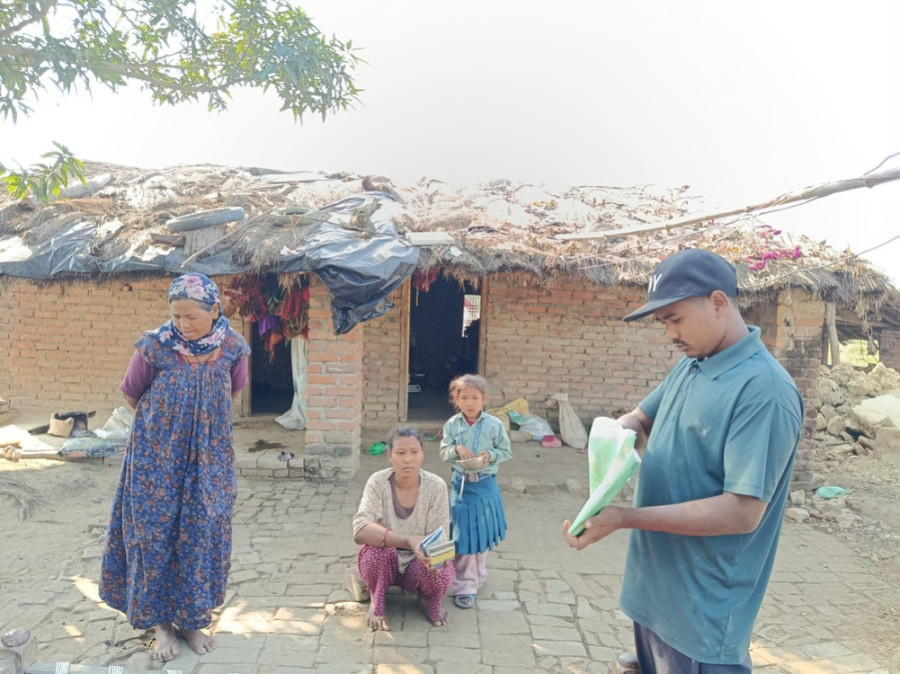
When the Post visited the modest home of Phulani Tharu in Dakshin Bhakari village in ward 4 of Badhaiyatal Rural Municipality early Tuesday morning, the courtyard was heavy with silence. In a single week, the 58-year-old woman had lost both her husband and daughter.
“I don’t know how to describe the pain of losing my daughter and my husband together. Every time I close my eyes, I see them,” said Phulani, her eyes welling with tears.
Her 22-year-old daughter Anju Tharu had died by suicide in the first week of November. Overwhelmed by daughter’s death, Phulani’s husband Kanchha Tharu, aged 61, took the same path a few days later.
Their deaths were not sudden and impulsive acts, family members insist, but the final chapter of a years-long struggle marked by injustice, indifference and systemic failure. It was, in their words, proof of how those on the margins can give up on life after knocking on the doors of the state for long without being heard.
You must go back eight years, when Anju was just 15, to understand what compelled the girl and her father towards such despair. Rumours spread through the village that she was pregnant. After inquiries by locals, the child reportedly belonged to Anil Tharu of a neighbouring village. A meeting of the village's elites (Panchayati) was convened and Anil took the girl home as his wife, even though she was underage. On December 10, 2018, Anju gave birth to a daughter.
The relationship soon soured. Tensions escalated and in December, 2019, Anju returned to her parents’ home. When Anil failed to take responsibility for her or the child, she went to the Bardiya district court in January, 2020, seeking a share of property. Anil contested the claim, denying that the child was his.
However, the court declined to nullify the marriage, noting that no formal complaint had been filed against the underage union and citing provisions of the Civil Code that recognise a marital relationship if a woman becomes pregnant through physical relations and gives birth, even when both parties are under 20.
“Although the law bars marriage before the age of 20, the couple has already given birth to a daughter. No one sought annulment of the marriage, and the court’s earlier mediation order was accepted by both sides. As Anju Tharu and Anil Kumar Tharu have a child together and the plaintiff has no alternative for livelihood, they are entitled to a share of property for survival,” the court stated in its order. As a relationship dispute was evident, the court also ordered statements to be recorded under Section 171 of the Civil Procedure Code and fixed January 13, 2021, as the date for DNA testing.
Anil failed to appear for the test. Later, in November 2022, the court ruled that Anil’s property be divided into three parts, with two parts going to Anju and her daughter Anita.
Even after the court’s ruling, justice remained out of Anju’s reach. She could not claim a share of her husband’s property as she had neither a citizenship certificate nor a marriage, or birth registration of her daughter. Carrying the court order in her hands, she went from office to office.
The ward office refused to initiate the process for her citizenship or for her daughter’s birth registration. “My father and sister went to the ward office at least 10 times. They frequented other government offices as well. They returned every time with nothing but new excuses,” said Arun Tharu, Anju’s elder brother.
Nare Thapa, ward 4 chairman of Badhaiyatal, confirmed that Anju had come with the court order but claimed the verdict only determined property division. “The court decided only on the property. There was no clear instruction about issuing citizenship or a birth certificate for the child. They did not submit a separate written application for recommendation,” Thapa claimed. He further argued that, by law, birth registration requires both parents as well as their citizenship certificates.
In the case involving Anju and Anil, it is the seven-year-old girl who has suffered the biggest injustice. The country’s Act Relating to Children 2018 guarantees every child the right to identity, name and birth registration. The law also states that children born as a result of rape, incest or unlawful relationships must be registered if the mother wishes, even if only her name is included. In cases where parents are absent, guardians are legally permitted to register the child. The ward office, however, disregarded all these legal provisions.
Anju had earlier tried to obtain citizenship through her parents, who are also from the same ward. On January 8, 2025, she had filed an application at the ward office, which was forwarded to the District Administration Office. But the process was halted when officials learned that she was already married. Ward chair Thapa admitted that he withdrew his recommendation after receiving a call from then-assistant chief district officer Roshan Kathayat. Kathayat, now at the Area Administration Office in Pharping of Kathmandu district, however, told the Post that he did not recall making such a call.
Tired of running, for years, between the court, the ward office and the administration, Anju ultimately chose to end her life, leaving behind her seven-year-old daughter. Unable to bear the grief, her father soon ended his life as well. Anil remains absconding, with police searching for him for abetting Anju’s suicide.
Hima Sunar, coordinator of the Civil Society Network in Bardiya, said the tragedy was the result of the state denying a citizen’s fundamental rights. “The constitution guarantees every person an identity after birth. Being deprived of that right pushed Anju to suicide. This is a painful failure of the system,” said Sunar. She demanded a thorough investigation and strict punishment of the guilty.
Following Anju’s death, the family registered a complaint at the Area Police Office in Mainapokhar, accusing Anil Tharu of abetment of suicide. Superintendent of Police Saroj Poudel said a case has been filed and that police are actively searching for the fugitive. “We are closely monitoring the case and the search is on to nab Anil,” he said.
Caught between double mourning and the responsibility of raising a child who is still not recognised by the state, Phulani’s life is now defined by both loss and an uncertain future.
The struggle for justice, she fears, may not end. “While fighting for justice, my daughter lost her life, and in that same pain, my husband left this world too,” she said, demanding justice.




 17.46°C Kathmandu