Siddhartha Highway’s Siddhababa Tunnel work moving at snail’s pace
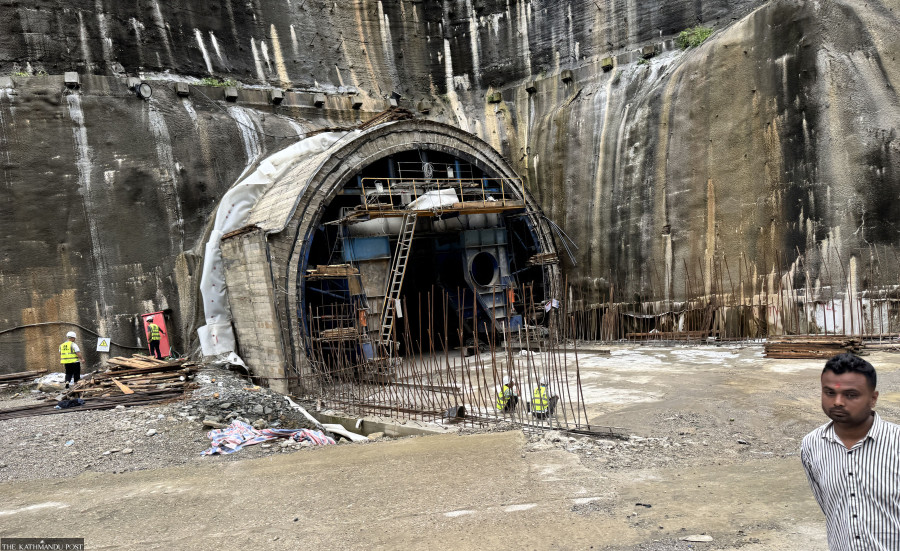
A 1,126-metre long tunnel is under construction in the most perilous stretch of the road section. But work has almost stalled over the past two months. A section of the Siddhababa Tunnel at ward 3 of Tinau Rural Municipality in Palpa district, pictured a few days ago. Post Photo: Madhav Aryal
Work on the Siddhababa Tunnel along the Siddhartha Highway is at a snail’s pace with only 1.69 percent progress recorded over the past two months. Project engineers and residents alike are concerned about the slow work progress.
According to an update from the project office, physical progress stood at 62.75 percent and financial progress at 53.09 percent by mid-November; these figures show only marginal gains since mid-September.
“Over the last eight weeks, work has slowed significantly,” said project information officer Sabita Gyawali. “The contractor, China State Construction Engineering Corporation, has confined its recent activity to culvert and portal construction. While the work of 17 metres of the north portal and 19 metres of the south portal is underway, critical tasks like electrical installation, ventilation, and fire-safety systems remain undone.”
According to Gyawali, rock-shed and rock-fall barrier designs—essential for slope protection in this landslide-prone zone—remain under discussion and are yet to be approved, which has delayed work.
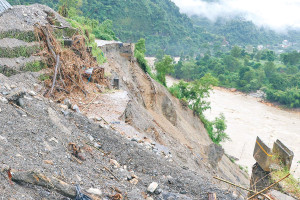
A 1,126-metre long tunnel is under construction in the most perilous stretch of the road section. The tunnel aims to mitigate such tragedies, but locals remain skeptical about the safety on the outer road even after the tunnel opens. The most hazardous four-kilometre stretch from Dobhan to the Siddhababa Temple area is notorious for year-round landslides that bury vehicles and sweep passengers into the Tinau river.
The Chinese contractor was awarded the project worth Rs7.34 billion on February 17, 2022. According to the contract terms, construction must be completed by March 22, 2027.
January 2025 marked a milestone when after months of blasting and drilling the main 1,089-metre tunnel achieved “breakthrough,” signalling full excavation was nearly complete. Bypasses for ventilation and emergencies—three tunnels of 151 metres, 161 metres, and 130 metres, respectively—were also completed.
The tunnel is vital for Nepal’s infrastructure. The existing section is one of the country’s most treacherous—every year landslides, even during the dry season, frequently claim lives. Once completed, the tunnel is expected to offer a safer, faster connection between the Tarai plains and hill districts including Palpa, Gulmi, Syangja, Baglung, and Myagdi.
Yet, despite the ambitious timeline, recent inertia has sparked doubts. “We have ordered materials for electrical, ventilation, and fire-safety equipment,” Gyawali said. “But the contractor says they will only proceed with external work after vehicles begin using the tunnel. Without full installation, vehicles cannot be permitted inside.”
At present, while the main tunnel’s structural lining and invert floor are in place, crucial components—including lighting, ventilation, drainage and fire-safety systems—remain undone. Slope-stabilisation efforts around the tunnel have advanced unevenly. Just 1,495 metres of the total 2,300 metres in the southern slope protection and just 495 metres of the total 1,100 metres on the northern side have been completed so far.
Project chief Krishna Raj Adhikari acknowledged that while the tunnel remains the priority, continued delays may jeopardize the deadline.
Siddhababa Tunnel, with a width of 10.5 metres and a height of 7 metres, features modern engineering. The lining prevents water leakage, ensures durability, and enhances safety. Once completed, the tunnel is expected to provide safer and more efficient travel along the highway between the districts of Lumbini and Gandaki provinces. More than 10,000 vehicles ply this road section every day.




 16.91°C Kathmandu