ICYMI: Here are our top stories from Thursday, January 16
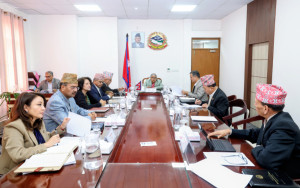
Here are some of the stories from The Kathmandu Post (January 16, 2020). Almost all of Nepal’s parties have organisational structures that are top-down, and they don’t find it necessary to discuss issues of vital importance with a wider audience. Post File Photo
Here are some of the stories you might have missed from today's The Kathmandu Post.
Despite federalism and local elections, power still resides in the hands of a few
Three dozen lawmakers from the 110-member Province 3 Assembly did not want Hetauda as their provincial headquarters. These 36 members had argued that Hetauda should not be the capital since it was not accessible to people from the mountains.
However, the nine-member secretariat of the Nepal Communist Party (NCP) decided that the province would be named Bagmati and Hetauda, which was a temporary capital, will be its permanent headquarters. The NCP’s provincial Parliamentary Party accepted the secretariat’s decision and duly issued a whip to its members to follow. When a vote was held in the assembly on Sunday, not a single lawmaker from the party stood against the decision. Read more on the story here.
All commercial banks to now report suspicious transactions via goAML
Now that the Nepal Rastra Bank has made it mandatory for commercial banks to report suspicious transactions and transactions above the governmental threshold via the goAML software, the Financial Information Unit, effective from Wednesday, will no longer receive manual reports.
The Financial Information Unit, an independent body headed by a central bank official, is responsible for receiving, processing, analysing and disseminating financial information and intelligence on suspected money laundering and terrorist financing activities.
The goAML software was built by the United Nations Office of Drugs and Crime to specifically meet the Financial Information Unit’s data collection, management, analysis and statistical needs. More on the story here.
Aided by Indian drug traffickers, farmers are increasingly turning from marijuana to opium
On January 1, a joint team from the Makwanpur District Police Office and the Narcotics Control Bureau travelled to Raksirang Rural Municipality armed with sickles and petroleum products. They had received a tip-off that Raksirang locals were cultivating poppies for opium production and their aim was to destroy as much of the illegal crop as possible. But when they arrived, they realised that they were faced with a nigh-impossible task.
“We found that almost everyone from Raksirang was cultivating opium and marijuana on hundreds of bighas of land. Almost 90 percent of the rural municipality was growing poppy,” Inspector Sujan Pathak of the Makwanpur District Police told the Post. “It was impossible to destroy all of it in a short period of time.”
The police team only had limited rations for five days and not nearly enough personnel or destructive implements to get rid of all the poppy and marijuana, said Pathak. In the end, they ended up deploying 78 police personnel to destroy poppy plants on 50 bighas of land. No farmers were arrested. More here.
A fraud company swindles millions off farmers in Lamjung and Tanahun
Two years ago, on December 29, 2017, the Association of Agriculture Nepal (AAN), an organisation marketing itself as a pro-farmers entity, established a branch office at Jhingekhola in Besishahar, Lamjung.
The association allegedly headquartered in Kohalpur, Banke, soon published a vacancy notice calling for networking officers on a local daily. It received applications from 110 candidates, of which the company hired 50 of them promising a monthly salary of Rs10,000. But the employment entailed one condition: the newly hired officers would have to set up 15 farmers’ groups with at least 20 members and collect Rs500 from each farmer as a registration fee.
The amount, according to the company, would go into helping farmers obtain seeds, saplings, chickens, improved breeds of goats and buffaloes. The employees were given four months to accomplish the job. Click here for more on the story.
Local and provincial governments have been allowed to draft laws fixing jail terms and fine in civil offences
Cross-party lawmakers have agreed to allow the provincial and local governments to formulate laws to fix jail terms and monetary fines in civil offences. Legal experts say while there is nothing unconstitutional in letting provincial and local governments introduce laws with jail terms and fines in civil offences, there must be an assurance that they don’t contradict the federal laws.
Revisiting the original bill registered by the government, the Legislature Management Committee under the National Assembly agreed to authorise the two tiers of government to formulae the laws fixing the penalties.
The Bill on Management of the Inter-relations Between the Local, Provincial and Federal Levels prepared by the Prime Minister’s Office didn’t have such provisions, for it could create disputes with the federal government. More here.




 9.89°C Kathmandu
.jpg&w=900&height=601)