ICYMI: Here are our top stories from Wednesday, November 27
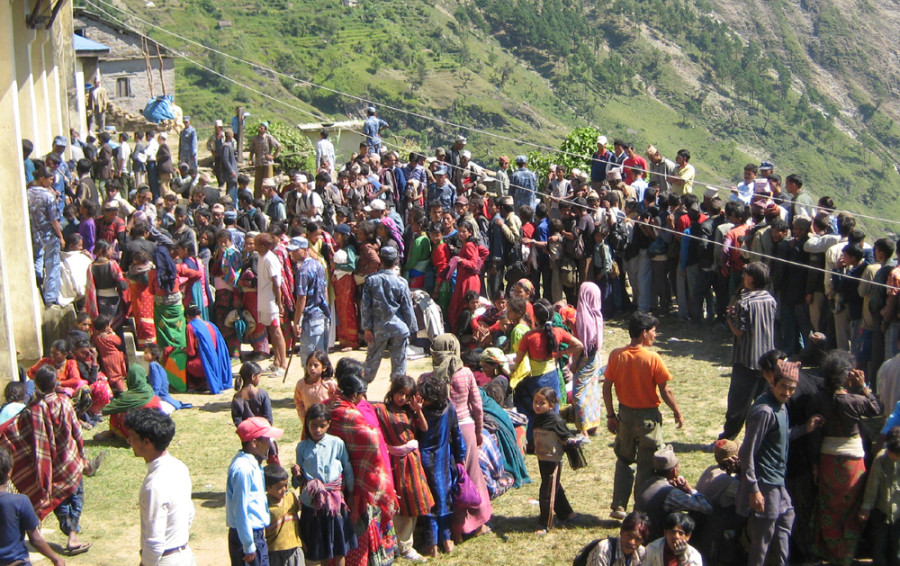
Here are some of the top stories from The Kathmandu Post (November 27, 2019). People flock to the Nepal Food Corporation depot in Manma for rice shipped by helicopters during the Maoist insurgency. Now there are few takers of the corporation’s rice. Post File Photo: Tularam Pandey
Here are some of the top stories from The Kathmandu Post (November 27, 2019).
Karnali does not have a food shortage—it has a rice shortage, locals say
Nama Raj Pyakurel’s paddy field did not yield a single grain this year when last year, the same field had produced five sacks of rice. Pyakurel doesn’t quite know why this happened but wonders if it’s the fault of the seeds he brought from Kailali.
“For us, this is a subject of perennial worry,” he said. “But this year hit a new low.”
Despite a lack of paddy production, Pyakurel harvested a decent amount of other crops—three sacks of maize, four of millet, five sacks of potatoes, a sack each of buckwheat and beans.
“But rice is important,” said Pyakurel, whose farm is in Palata, Kalikot. “Even if we produce other crops, we purchase rice after selling them.”
Medical college owners have finally agreed to refund or adjust the additional fee they charged students
Following the government’s threat to arrest them, medical college owners have finally given a written commitment to return or adjust the additional fee they charged students.
The government on Monday had directed Nepal Police to arrest college operators if students don’t receive their money back by Tuesday. The college operators, though tried their best to not commit for the refund, later agreed to return the fees they had charged by breaching the government’s ceiling, as the Ministry of Education remained firm on initiating the administrative actions.
Representatives of private medical colleges forged a two-point agreement with the government at midnight on Tuesday, agreeing to abide by the government ceiling and refund or adjust the additional fee they charged for arbitrary reasons.
Nepal’s economic growth tapers off as construction slackens and remittances slow in the first quarter
Bikas Maharjan has been wondering what will happen to his business if the demand for bricks continues to fall. For years, he sold as many as 50,000 bricks a day, but in recent months, that number has fallen to 20,000 units.
“Since late summer, there’s been a sharp decline in the demand for bricks from Kathmandu Valley,” says Maharjan, who owns Hira Bricks, a brick manufacturing company.
A slump in the demand for bricks suggests that the construction sector is slowing down in the Valley, an assumption supported by a slowdown in housing loans in recent months. Construction is considered a key indicator of the health of the economy as it shows consumption patterns.
For Grammy-nominated musician, the flute sings to the soul
When an eight-year-old Manose Singh Newa first held a flute, he had no idea of the passion he would develop, nor that it would lead him to be nominated for a Grammy award. He is the first Nepali to accomplish such a feat on the world stage.
“I developed a taste for flute by the grace of Lord Krishna,” says the man, who considers his flute playing as a form of meditation.
Newa has been nominated for 'Best New Age Album of The Year' for his album Deva, which he produced in collaboration with German musician Deva Premal and England’s Miten. The 41-year-old played flute in the hymn “Gayatri Mantra” for the album, and has also contributed to the vocals and composition of the hymn.




 9.89°C Kathmandu