‘It is up to India's neighbours to decide or make a choice’
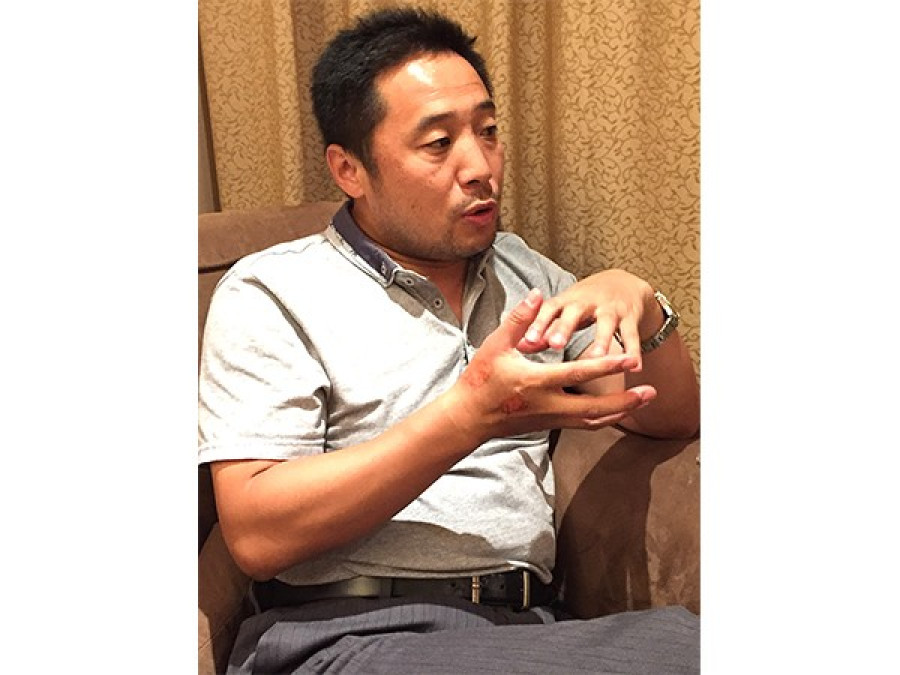
Professor Hu Shisheng, Director at the Institute of South and Southeast Asian and Oceanian Studies at China Institutes of Contemporary International Relations, keeps a close eye on Nepal issues.
Professor Hu Shisheng, Director at the Institute of South and Southeast Asian and Oceanian Studies at China Institutes of Contemporary International Relations, keeps a close eye on Nepal issues. Sanjeev Giri of The Kathmandu Post spoke with Hu about the signing of framework agreement on China’s Belt and Road (BOR) initiative, days ahead of a summit in Beijing where an ambitious plan to build a modern-day Silk Road trade routes and lead a new era of globalisation would be unveiled.
1. What is the significance of signing of framework agreement on Belt and Road (BRI) initiative between Nepal and China?
The signing will bring bilateral economic and social cooperation especially in the area of post-earthquake reconstruction in Nepal. The process will move in a more rapid and undisturbed way.
2. What do you think is the way forward for the two countries now? What are the things that can be carried out in the near future under the BRI initiative?
In the coming months, it is very important to set up a joint working mechanism focusing on the match between the post-earthquake reconstruction works and projects in Nepal along with the potential BRI projects.
It is also important to speed up the feasibility studies of trans-border railway linkages and speed up the studies on how to materialise the Free Trade Agreement between these two countries. Government of both the countries should make sure that all the work remain undisturbed by the process of the political and administrative restructuring efforts in Nepal. There should be consensus among the major political parties in Nepal while undertaking the joint efforts guided by the Memorandum of Understanding (MoU). Perhaps this should be the priority of Nepal government.
3. How will this agreement deepen cooperation between Nepal - China?
The MOU will provide critical guidance and policy support for the two governments to undertake cooperation in major projects related to development programmes and strategies matchup or interface, physical connectivity, trade facilitation, financial assistance, and people-to-people and institutional exchanges. And when the time is ripe, we can initiate the construction of much touted China-Nepal (and India) Economic Corridor.
4. As New Delhi hasn't agreed on BOR framework, how beneficial will the agreement with Nepal be for China?
I strongly believe when Indian neighbors are all involving into the effort in building connectivity and industrial cooperation in the guidance of the BRI and when India has also made solid progress in its sub-regional integration effort such as Bangladesh Bhutan India Nepal (BBIN) initiative, Bay of Bengal Initiative for Multi-Sectoral Technical and Economic Cooperation (BIMSTEC), Mekong-Ganga Cooperation, India will naturally become a part of BRI, whether New Delhi accepts it or not.
However, before that, there is one outstanding concern that whether India's neighbors (except Pakistan) can afford or can stand up against the pressure and even disturbance from India.
It is up to India's neighbours to decide or make a choice. However, the benefit from BRI should not be taken for granted forever.




 9.89°C Kathmandu