



 23.78°C Kathmandu
Mon, Oct 19, 2026
Money
India’s pilgrimage rush tests Nepal’s tourism readiness
Rising Indian visitor numbers to sites like Muktinath and Swargadwari expose gaps in accommodation, food and basic services while officials argue the surge is an untapped economic opportunity.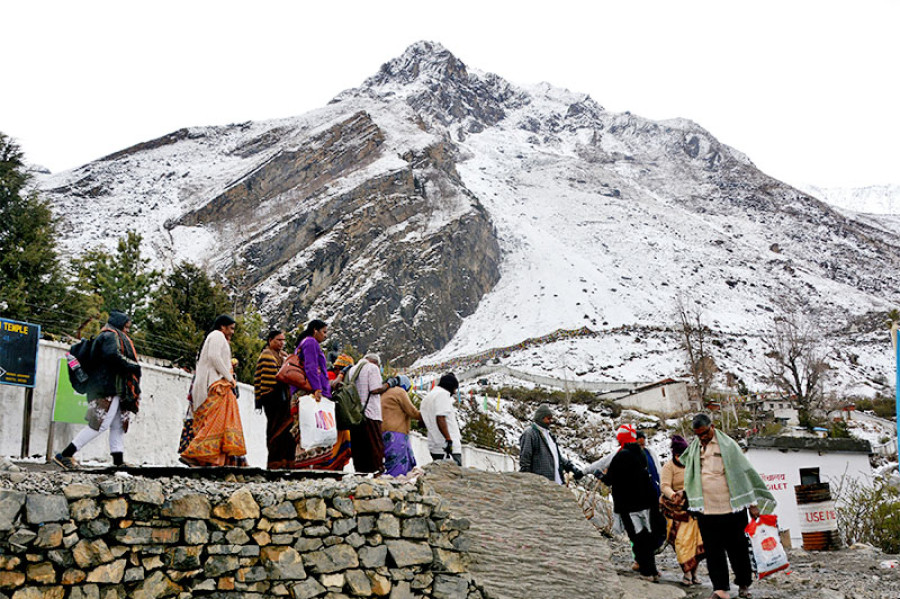
bookmark
Suraj Kunwar
Published at : June 15, 2026
Updated at : June 15, 2026 11:04
Kathmandu
Social media in Nepal has been flooded in recent weeks with videos and images of Indian tourists travelling across the country. Some show groups cooking food by the roadside, others depict pilgrims resting on the route to Muktinath.
The visuals have triggered two parallel debates. One questions whether such visitors contribute meaningfully to Nepal’s economy. The other, largely from an Indian perspective, asks whether Nepal has adequate infrastructure, food options and accommodation for religious travellers.
Amid the discussion, the Ministry of Tourism on Sunday issued guidance for Indian pilgrims entering Nepal via road routes to major religious sites. The notice outlines what visitors should and should not do while travelling in the country. Tourism Minister Khadkaraj Paudel spoke to Kantipur, arguing the issue needed to be viewed differently.
He said the current trend was not simply an influx of Indian tourists but a changing pattern of Nepal–India religious tourism.
“Even if only one percent of India’s population visits Nepal, the country could receive at least 10 million religious tourists annually,” Paudel said. “That would represent a major opportunity for Nepal’s tourism market.”
In recent months, the number of Indian pilgrims arriving via road has risen significantly. Popular religious and hill destinations such as Pokhara, Muktinath, Supadeurali, Swargadwari and Hile in Dhankuta have seen growing pressure from visitors. According to the ministry, most arrive for religious purposes.
Officials said Muktinath received around 30,000 Indian pilgrims in a single day recently, while Swargadwari recorded more than 10,000 in one day.
However, the minister acknowledged that Nepal’s infrastructure is not yet prepared to handle such volumes in an organised manner.
“There is a shortage of accommodation and vegetarian food facilities for this number of visitors,” Paudel said. “We are prioritising the construction of dharmashalas and expanding vegetarian food options. From the next fiscal year, we plan to begin building dharmashalas in major religious destinations.”
Food habits of Indian pilgrims have become a central point in the ongoing debate. Many visitors travelling to sites such as Muktinath and Swargadwari are vegetarian. Yet Nepal has a limited number of dedicated vegetarian restaurants, and there is no systematic listing of such establishments. As a result, many pilgrims cook their own meals along the way, a practice that has been widely shared on social media.
The minister said criticism based only on such visuals was misplaced.
“Just as our parents look for ‘pure food’ when they visit pilgrimage sites in India, Indian pilgrims expect the same here,” Paudel said. “If there were enough vegetarian restaurants and dharmashalas, they would not need to cook on the roadside.”
The ministry has also announced plans to catalogue vegetarian hotels and restaurants along key pilgrimage routes from Bhairahawa to Pokhara and Muktinath. Officials said information would be provided to tourists at entry points into Nepal.
Another common perception in Nepal is that Indian pilgrims spend very little money. The ministry and the Nepal Tourism Board reject this claim.
According to Paudel, even if pilgrims do not stay in hotels, they contribute through multiple channels, including transport, food purchases, souvenirs and road tolls.
“The state has invested billions in road infrastructure,” he said. “Vehicles using those roads pay tolls. Tourists buy goods and use services. Local economies are activated. It is not correct to say they do not spend.”
Subash Chandra Joshi, former executive director of the Pashupati Area Development Trust, said religious tourism should not be assessed only through direct spending.
He said such travellers may spend less on hotels or entertainment compared to other tourists, but their broader economic, social and cultural impact is long-term.
Joshi said informal promotion was one of the most important aspects of religious tourism. “Pilgrims share their experiences with family and communities. Today, this has expanded through social media, where photos, videos and experiences are widely circulated,” he said. “This can have a stronger impact than formal advertising. A satisfied pilgrim can inspire dozens of future visitors.”
He also pointed to India’s growing state-supported religious tourism programmes, where several states subsidise pilgrimages for senior citizens. States including Uttar Pradesh, Madhya Pradesh, Rajasthan, Gujarat and Haryana operate such schemes.
“Millions of elderly citizens are now travelling on religious tours supported by state governments,” Joshi said. “If Nepal can connect destinations like Pashupatinath, Muktinath, Janakpur, Lumbini and the Kailash route corridor with these programmes, the country could benefit significantly.”
Minister Paudel added another dimension, arguing that pilgrims also act as informal promoters of Nepal.
“They share their experiences on social media”, he said. “That encourages more Indian tourists to visit Nepal. Over time, it can also attract higher-spending visitors.”
India is currently one of the world’s largest outbound tourism markets. Rising incomes and expanding road connectivity have accelerated religious travel within the country and across borders.
Following the circulation of videos showing pilgrims cooking in public spaces, the ministry on Sunday issued a code of conduct for visitors, outlining what is expected during travel in Nepal.
Officials said preparatory work on information materials in Nepali, Hindi and English began around two weeks ago. The Department of Tourism has been assigned responsibility for implementation.
The materials cover entry procedures, road safety, conduct at religious sites, sanitation, trekking, mountaineering, local culture, environmental protection and emergency contacts.
With no district-level structure of its own, the ministry plans to distribute posters at entry points, starting from the Bhairahawa border, in coordination with Nepal Police and local administrations.
Officials say the rise in Indian pilgrimage tourism has become a new reality for Nepal’s tourism sector. The question, they argue, is no longer whether these visitors should come, but how they can be managed effectively.
Nepal has set an ambitious target of doubling tourist arrivals. At the same time, key destinations such as Muktinath and Swargadwari continue to struggle with basic infrastructure, including accommodation, sanitation, vegetarian food facilities and information management, even as thousands arrive in a single day.
Dhananjaya Regmi, former chief executive officer of Nepal Tourism Board and Rastriya Swatantra Party lawmaker, said the state had not given sufficient attention to Indian tourists.
He said discriminatory treatment at border points and during currency handling needed correction.
“If arrivals are made smoother and more pilgrimage sites are promoted properly, Nepal’s tourism sector can gain momentum,” Regmi said. “Indian pilgrims can make a significant contribution to the economy.”
Suraj Kunwar
Suraj Kunwar is a senior correspondent with over two decades experience covering Aviation, Tourism and Mountaineering. He received the IFJ Tolerance Award in 2005.


Most Read from Money
Nepal travel agents threaten to stop selling Thailand trips over visa rules

Why does an hour long flight to Dhangadhi cost more than a flight to New Delhi?
Malaysia rejects Nepal’s demand to open recruitment to all manpower agencies
No school, but a graduation cap for women dairy farmers
Nepal arrests four medical service providers as Malaysia recruitment row deepens
Editor's Picks




E-PAPER | October 19, 2026

×