



 19.26°C Kathmandu

Wed, Oct 21, 2026
Money
Hormuz Strait closure takes its toll on global economic growth
Middle East conflict casts shadow over global economy.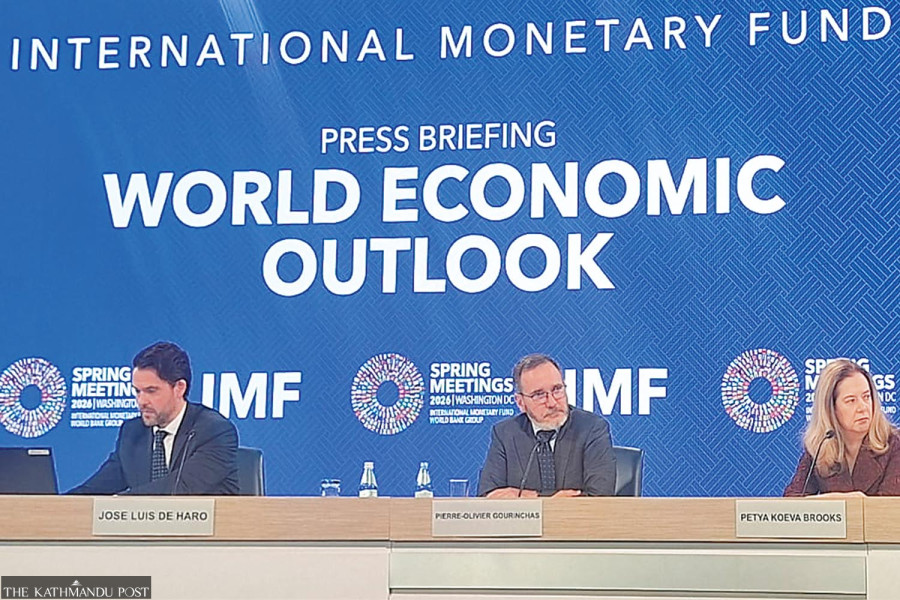
bookmark
Krishna Acharya
Published at : April 16, 2026
Updated at : April 16, 2026 07:52
Washington Dc
The International Monetary Fund (IMF) has warned that the ongoing conflict in the Middle East could derail global economic recovery, casting a shadow over growth prospects and disproportionately affecting developing countries.
According to the latest assessments, the turmoil is expected to disrupt global growth trajectories significantly, with developing countries projected to suffer an impact twice as severe as their developed counterparts.
Releasing its World Economic Outlook and Global Financial Stability Report in the US capital on Tuesday, the IMF detailed a landscape of mounting risks and policy dilemmas. The IMF has revised its global growth forecast for 2026 down to 3.1 percent, a notable 0.3 percent point decrease from its January projection of 3.4 percent.
If hostilities continue unabated, the IMF warns that global economic growth could shrink further to 2.5 percent. This projected figure of 3.1 percent sits well below the historical average of 3.7 percent recorded between 2000 and 2019.
"Had the Middle East conflict not erupted, the potential for global economic growth would have been even higher," reads the IMF report. "The current slowdown is primarily a consequence of the Middle East crisis."
Pierre-Olivier Gourinchas, the IMF’s Economic Counsellor, highlighted the abrupt shift in momentum during the report's launch. Despite major trade disruptions and policy uncertainties, the global economy showed resilience last year, he said. According to him, the IMF was initially optimistic about an upward revision for 2026 but the war has halted that progress.
“The closure of the Strait of Hormuz and damage to critical energy infrastructure have triggered a sharp spike in prices of oil, gas and chemical fertilisers."
Its ripples, according to the IMF projection, are being felt across all sectors, with diesel, aviation fuel, and chemical fertilisers seeing steep price hikes. It anticipates global inflation to reach 4.4 percent in 2026, with the potential for further spikes if the war continues. This inflationary pressure is expected to weaken the purchasing power of households globally, while supply chain bottlenecks further complicate the recovery.
The slowdown is not confined to smaller counties; it will also affect world's economic giants like the USA, China and India. The IMF projects growth in the USA to settle at 2.3 percent, China at 4.4 percent, and India at 6.5 percent in 2026—all reflecting a downward trend compared to 2025.
For Nepal, the outlook is particularly serious. The IMF has slashed the country’s growth forecast to 2.9 percent for the current fiscal year 2025-26. This aligns with a similar downgrade by the Asian Development Bank (ADB), which last week projected Nepal’s growth at 2.7 percent. Both figures stand in stark contrast to the Nepal government’s ambitious target of 6 percent, as set in the federal budget.
The conflict in the Middle East is certain to cause serious economic impact in Nepal. A decline in remittance inflows, disruptions to trade, a contraction in foreign employment opportunities, risks to Nepali workers in the Gulf region and a slowdown in tourism are now almost inevitable in Nepal.
Although the full extent of the impact is yet to be determined, preliminary estimates suggest a heavy blow to economic growth. The IMF report states that there is a risk of further damage to energy infrastructure in conflict zones, which would have an even greater impact. The fallout for developing economies will be nearly double that for developed nations. Geopolitical tensions could worsen, potentially turning the current situation into the largest energy crisis in modern history, the report warns.
To navigate such a volatile situation, the IMF has urged the governments, central banks and finance ministries. The primary focus remains on stabilising prices and maintaining fiscal discipline without delaying essential structural reforms.
Gourinchas advised that while short-term subsidies are often politically popular, they can create market distortions and strain the national treasury. According to him, the fiscal situation has narrowed due to rising public debt.
Governments must adopt appropriate fiscal policies that protect the vulnerable within existing budget limits. He further emphasised the need for a transition toward renewable energy development to mitigate future shocks.
The IMF has specifically urged central banks to remain alert. The report says that the central banks must be prepared to take clear and decisive action in line with their responsibilities.
The report suggests credible measures are essential to ensure transparency and uphold central bank autonomy. Vigilance must be maintained through robust oversight. To protect vulnerable groups, spending priorities should be established and resources provided within current budgetary limits. If this is not feasible, a clear plan to restore fiscal balance must be made public.
Furthermore, the IMF has recommended establishing contingency funds to withstand such crises in future, expanding revenue streams, and reprioritising expenditure. It also stressed the need for effective budget implementation and the effective management of distributive programmes. To build long-term economic resilience and recurring crises, the IMF advised addressing deep-seated internal imbalances.



Most Read from Money

Nepal travel agents threaten to stop selling Thailand trips over visa rules

Why does an hour long flight to Dhangadhi cost more than a flight to New Delhi?

Malaysia rejects Nepal’s demand to open recruitment to all manpower agencies

No school, but a graduation cap for women dairy farmers
Nepal arrests four medical service providers as Malaysia recruitment row deepens
Editor's Picks




E-PAPER | October 21, 2026

×