Chinese planes continue to be a costly burden for Nepal Airlines
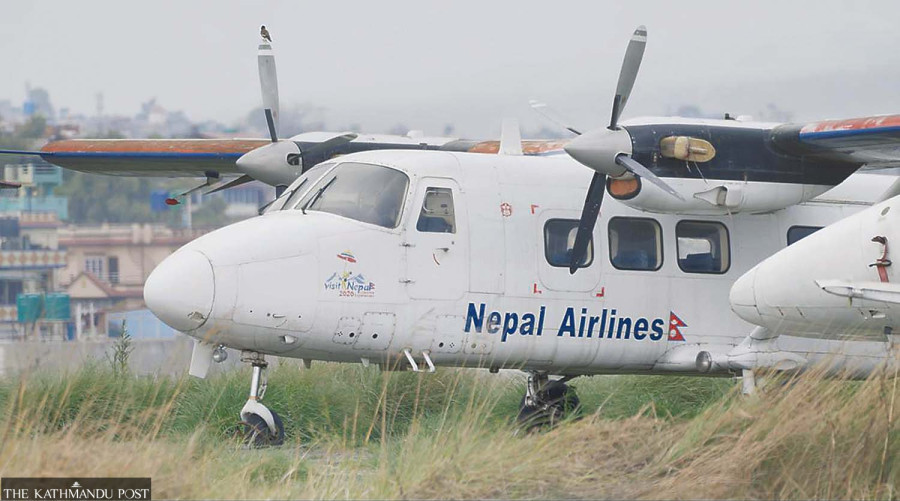
Grounded for years, the aircraft continue to drain millions as efforts to sell, lease, or return them fail amid financial and diplomatic constraints. Today, the Chinese aircraft remain where they have been for years—parked, unused, and steadily decaying. Post file photo
For nearly five years now, a cluster of Chinese-built aircraft has sat idle at Kathmandu’s airport, their presence turning from promise to burden. What was once projected as a step toward strengthening Nepal Airlines’ domestic fleet has instead become a lingering financial and operational dilemma—one that the national flag carrier has been unable to resolve despite repeated efforts.
The aircraft, unused and silent, have effectively become an albatross. Nepal Airlines cannot sell them. It has failed to lease them. It has not been able to return them to service. Nor can it send them back to China. In the meantime, they generate no revenue, only losses—quietly draining the already fragile finances of the state-owned airline.
That strain is significant. Nepal Airlines is already weighed down by a debt exceeding Rs50 billion, and the grounded Chinese fleet has only deepened the crisis.
Loans taken by the government of Nepal to procure these aircraft continue to accrue interest. In the past year alone, the interest burden tied to the Chinese-made Modern Ark 60 (MA-60) and Yùn-12 (Y-12e) aircraft added more than Rs681 million to outstanding liabilities.
The financial drain does not stop there. Even while grounded, the aircraft require upkeep.
Insurance, parking, engine maintenance, and manual revisions together cost the airline nearly Rs200 million annually. Of this, approximately Rs115 million is spent on the MA-60 aircraft and Rs85 million on the smaller Y-12E planes, the Office of the Auditor General, a constitutional body and the supreme audit institution of Nepal, said in its report.
Inside Nepal Airlines, there is growing frustration. “We have been trying to sell or lease the aircraft since 2022, but no one—nationally or internationally—has shown an interest,” said a senior airline official, speaking on condition of anonymity. The lack of buyers or lessees reflects not only market hesitation but also deeper concerns about the aircraft’s viability.
The story of these planes dates back more than a decade.
Nepal Airlines received its first MA-60 aircraft on April 27, 2014, followed by a Y-12E on November 14 the same year, both as grants from China. In the years that followed, the airline expanded the fleet by purchasing additional units: another MA-60 in January 2017, a Y-12E in February 2017, and two more aircraft later in February 2018.
The acquisition was financed through a mix of grants and loans provided by China, totaling 408 million yuan—equivalent to around Rs6.67 billion at the time. Of this, 180 million yuan came as grants, while 228 million yuan was extended as a soft loan. Under the loan terms, Nepal’s Ministry of Finance, which holds ownership of the aircraft until the loan is repaid, pays an annual interest rate of 1.5 percent plus service fees, and in turn charges Nepal Airlines 1.75 percent interest.
Initially, the financial burden was muted by a seven-year grace period during which the airline was not required to make repayments. That grace period ended in March 2021. By then, however, the aircraft had already begun to fall out of active service.
Operational challenges emerged early. Nepal Airlines struggled with a shortage of trained pilots qualified to operate the Chinese aircraft. Spare parts were not readily available, and when they were, they came at high cost. Insurance premiums were steep. Market demand for the aircraft, especially in Nepal’s challenging terrain and competitive aviation sector, proved insufficient. Training pilots and engineers required significant additional investment.
Faced with mounting complications, the airline’s board of directors decided on June 29, 2020 to ground the fleet entirely. Since then, the aircraft have remained parked, exposed to the elements and slowly deteriorating.
Attempts to find a way out have repeatedly failed. In September 2022, Nepal Airlines issued a public notice seeking to lease the planes, extending the deadline after receiving no response. Not a single bidder came forward. Subsequent attempts to sell the aircraft met the same fate—silence from the market.
The airline then turned to diplomatic channels. In December 2024, then Executive Chairman Yubaraj Adhikari raised the issue with Aviation Industry Corporation of China (AVIC), the supplier of the aircraft. He proposed that the company take back the planes as a gesture of goodwill, given the close bilateral ties between Nepal and China. He also suggested coordinating with AVIC to facilitate a sale.
The proposal, however, ran into complications rooted in the original agreement.
AVIC representatives clarified that under the intergovernmental deal, the aircraft had first been transferred to the Chinese government before being handed over to Nepal Airlines. As such, any decision to sell them would require approval from Beijing.
While AVIC declined to grant immediate consent for a sale, it did offer limited support. The company indicated it could help identify potential operators, noting that some Y-12E aircraft are still in use within China. It also suggested that domestic institutions such as the Nepal Army or the Civil Aviation Authority of Nepal might consider deploying the planes.
With no clear resolution, the matter escalated to higher levels of government. In a recent development, Nepal’s finance secretary directed Nepal Airlines to explore the possibility of bringing the aircraft back into operation. The Chinese government, officials say, is not comfortable with allowing the sale of planes acquired through a government-to-government agreement.
This directive has effectively pushed the airline back to square one. Officials have been instructed to attempt to return the planes to the skies, despite the obstacles that led to their grounding in the first place.
But reviving the fleet is no simple task.
According to airline officials, doing so would require an investment of more than Rs2 billion. The airline would need to hire instructor pilots—who are scarce both domestically and internationally—and train new captains, a process that could take years. Ensuring a steady supply of spare parts remains another critical challenge.
“The issue is complex,” one official admitted.
Meanwhile, time is taking its toll. The aircraft, unused for years, are visibly deteriorating. Their value has dropped sharply. In 2023, an independent appraisal by an American firm estimated the entire fleet to be worth just Rs220 million—a fraction of its original cost.
Concerned about public backlash and potential scrutiny from anti-corruption bodies, Nepal Airlines conducted its own valuation. The airline set a significantly higher asking price, totaling nearly $19.6 million for the five remaining aircraft. The gap between external and internal valuations has further complicated efforts to sell them.
There have been faint signs of interest. Recently, a private party from Pakistan expressed willingness to purchase the smaller planes, formally approaching Nepal through diplomatic channels.
Officials say there may be other potential buyers as well. However, any such deal hinges on approval from the Chinese government.
“If the government seeks consent from Beijing, the sale could move forward,” said an official at the Tourism Ministry. “We have asked Nepal Airlines to handle the matter.”
Behind the financial and operational challenges lies a deeper controversy about how the aircraft were acquired in the first place. In 2011, a technical team from Nepal Airlines visited China to inspect the planes after the Chinese government indicated it could provide some aircraft as grants—on the condition that Nepal also purchase additional units.
At the time, Bangladesh had also evaluated the same aircraft but decided against acquiring them, deeming them unsuitable. Nepal, however, proceeded with the purchase based on the recommendations of its technical team.
Critics have long questioned that decision. Former Nepal Airlines board member Achyut Pahari has described it as one of the worst choices made by the airline, alleging that the evaluation process was flawed and influenced by vested interests.
“The Y-12E was compared with the Twin Otter, and the MA-60 with the ATR-72,” Pahari said in a past interview. “Flying these planes now would mean throwing good money after bad.”
In 2012, Nepal Airlines formalised the deal with AVIC, agreeing to procure six aircraft. Within less than five years, most of them were grounded.
Since then, calls for investigation have surfaced repeatedly—from within the airline and from civil society.
Questions persist about why the planes were purchased, why they failed so quickly, and why no accountability has followed. Yet, because the deal was conducted at the government-to-government level, even the country’s anti-graft bodies have not pursued a formal probe, according to former officials.
Today, the Chinese aircraft remain where they have been for years—parked, unused, and steadily decaying. Around them, Nepal Airlines continues its struggle to stay afloat, burdened not only by debt but also by decisions made long ago, whose consequences are still unfolding.
Sangam Prasain is Business Editor at The Kathmandu Post, covering tourism, agriculture, mountaineering, aviation, infrastructure and other economic affairs. He joined The Kathmandu Post in October 2009.




 25.92°C Kathmandu