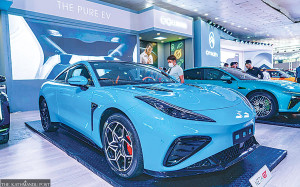
The NADA Auto Show, the country’s biggest automobile exhibition organised by Nada Automobiles Association of Nepal, kicked off on Tuesday at Bhrikutimandap Exhibition Hall in Kathmandu.
The NADA Auto Show, the country’s biggest automobile exhibition organised by Nada Automobiles Association of Nepal, kicked off on Tuesday at Bhrikutimandap Exhibition Hall in Kathmandu. As in the past, NADA’s six-day flagship event is expected to draw auto enthusiasts and traders, suppliers of automobile accessories and ordinary citizens looking forward to buying a four- or two-wheeler. This time too, renowned auto brands and companies dealing in lubricants, spare parts, batteries, tyres, vehicle security technology, garage equipment and other auto components besides financial institutions providing auto loans are expected to pull a notable number of customers to the extravaganza. Organisers of the event and experts in the sector had this to say during a roundtable meeting held by the Kantipur Media Group.
Anjan Shrestha
President, NADA
Following the grand success of 11 editions of the NADA Auto Show, we have launched the 12th edition in response to growing market demand for the latest automobiles. The auto show will display products of 16 four-wheeler and 19 two-wheeler brands. Most of them have featured their high-value products. Vehicle sales in Nepal usually start picking up from September right after the NADA Auto Show, and continue till mid-December. Sales during this period account for almost 40-45 percent of the annual automobile business. But there are problems in this sector. Poor infrastructure, lack of qualified human resources, traditional technology and lack of coordination have been impeding speedy growth of the sector. As the pace of road construction in the last two decades has remained slow, the government must prioritise expansion of road infrastructure. Also, vehicular traffic congestion should be handled properly.
Shekhar Golchha
Former President, NADA
The automobile sector has seen a positive growth in the last few years. The auto business has been growing at a rate of 15-20 percent per annum. The sector’s growth is also an indicator of growing economic activities in the country. Still, many who aspire to own a motor vehicle are reluctant to purchase one due to poor road conditions. Since the auto sector is making quite a big contribution to the state coffers, the government should ramp up investment in related infrastructure.
Krishna Dulal
General Secretary, NADA
Good road infrastructure is a prerequisite for proper development of the automobile sector. There is a need for joint efforts to solve this problem of roads filled with potholes. Dangerous road conditions are likely to claim more lives than natural disasters like the recent flooding in the Tarai. The Traffic Police should also work proactively to reduce congestion on the streets. Also, heavy trucks and tippers should be barred from plying inside the periphery of the Ring Road in the Kathmandu Valley during office hours, and new roads should be built along the Valley’s rivers to enable smooth vehicular movement. The auto sector also suffers from the high taxes, especially excise duty, collected by the government. Also, the government, contrary to the spirit of the preferential treatment facility of the South Asian Free Trade Area (Safta), has doubled the import duty on tyres.
Surendra Kumar Upreti
Lubricant Committee Chairman, NADA
The market for lubricants has been expanding rapidly along with a surge in automobile sales. The lubricant market is growing at a rate of 30 percent per annum. One of the main problems faced by the lubricant market is the wide variation in customs duty which ranges from 5 to 30 percent. We have been demanding that the government impose a single tax, but it has turned a deaf ear towards us. Also, the government should set a standard for customs valuation.
Karan Chaudhary
Executive Director, Chaudhary Group
We often express dissatisfaction at the performance of the traffic authorities, but they have done a praiseworthy job of managing traffic congestion on the Valley’s roads. We can directly feel the effectiveness of the anti-alcohol drive and lane discipline initiative.
In the last two years, the automobile business witnessed multiple ups and downs triggered by the April 12 earthquake and Nepal-India border obstruction followed by an unfavourable monetary policy. Automobiles have changed the living conditions of the people. The cost of vehicles is considerably high in Nepal. They should be taken as a matter of essential requirement rather than luxury.
Pravin Khatiwada
Officer, Sipradi
The automobile business, considering the performance in the last few months, presents a gloomy picture. However, recent developments are positive, even though they are not significant. Vehicle prices have now come within the affordable range of the people. Recently, need based consumers have been seen as automobile aspirants, which is, of course, a positive sign.
Kapil Siwakoti
Officer, IME Group
The imposition of VAT on tractors from the beginning of this fiscal year is a matter of concern for everyone. The government has levied VAT on tractors claiming that the farm machinery was being misused in crusher factories. However, the reality is different: Farmers are suffering because of the new rule. There is inconsistency in the way tax has been charged. When a person buys a tractor, no VAT is charged; but when a factory buys a tractor, it has to pay VAT.
Since farming is a seasonal activity, farmers cannot operate their tractors on their farms the whole year round. So they use them as per their requirement, including as a means to transport essential supplies, mainly in remote districts. There is a dearth of operators of heavy equipment due to the government’s unfavourable policy. At present, a separate four-wheeler driving licence is a must for heavy equipment operators. Driving a car and operating a piece of heavy equipment are completely different issues. In fact, the existing provision could lead to an increase in road accidents.
Bikram Singhaniya
Chairman, Tyre-Tube Committee, NADA
The domestic tyre and tube market is worth Rs6 billion annually. The country’s sole tyre factory, Gorakhkali Tyre, shut down several years ago. There is a need to conduct a study on the potentiality of manufacturing tyres in Nepal. As in the case of tractors, the tyre business has been affected by the change in the customs harmonic code. Although we used to receive various facilities under the South Asian Free Trade Area (Safta), it has been kept in the sensitive list in the new provision. We have been trying our best to draw the attention of government bodies in this regard.
Gopi Neupane
Chairman, Vehicle Committee, NADA
Poor infrastructure is the main obstacle to the development of the automobile sector. Lack of coordination among various government authorities is another key problem. The authorities related with road development, drinking water supply and electricity supply and local bodies always try to pass on their responsibilities to one another. The road and traffic management system could be enhanced to resolve the ever present problem of traffic congestion.
Despite the apparent road problems, vehicles are still the choice for a select class of people. An estimated 30 percent of the total population uses motorbikes while only 1 percent of the people own four-wheelers. Following the reduction in power cuts, electric vehicles could be promoted to increase access to automobiles. Improvement of the traffic information system could help a lot to minimise the problem of traffic congestion. In this regard, the Traffic Police needs to work by joining hands with the Ministry of Information and Communication. Use of high-tech road construction mechanisms should be adopted for local level road development. NADA is always open to working in collaboration with the traffic authorities.
Anup Baral
Member, NADA
NADA has been facing a shortage of exhibition halls of international standard. Due to this reason, we have not been able to include a number of brands in the auto show. Compared to the past, the exhibition is seeing a greater number of banks and financial institutions offering finance schemes to potential car buyers.
Abhishek Shrestha
Head, Personal Bank Acquisition, Standard Chartered Bank
Standard Chartered Bank is launching an attractive scheme for automobile aspirants during the NADA Auto Show. Nepal Rastra Bank’s recent move to raise the lending margin for private vehicles to 65 percent from 50 percent has given a cushion to banks to increase their investment in this sector. Standard Chartered Bank is planning to introduce fixed interest at premium rates for those seeking auto loans to prevent interest rate variation. The new provision is expected to provide relief to our customers and reduce the financial burden.
Sarbendra Khanal
DIG and Traffic Police Chief
The automobile business should not only look at urban areas, rather it should be associated with highway movement and rural areas. Automobile traders need to abide by the ethical principle of expanding service instead of only maximising their profits. The Traffic Police has been trying its best in effective management. However, the private sector should also cooperate with the traffic authorities to produce the desired results.




 21.71°C Kathmandu