Solve water crisis and get our vote, Rekcha village declares
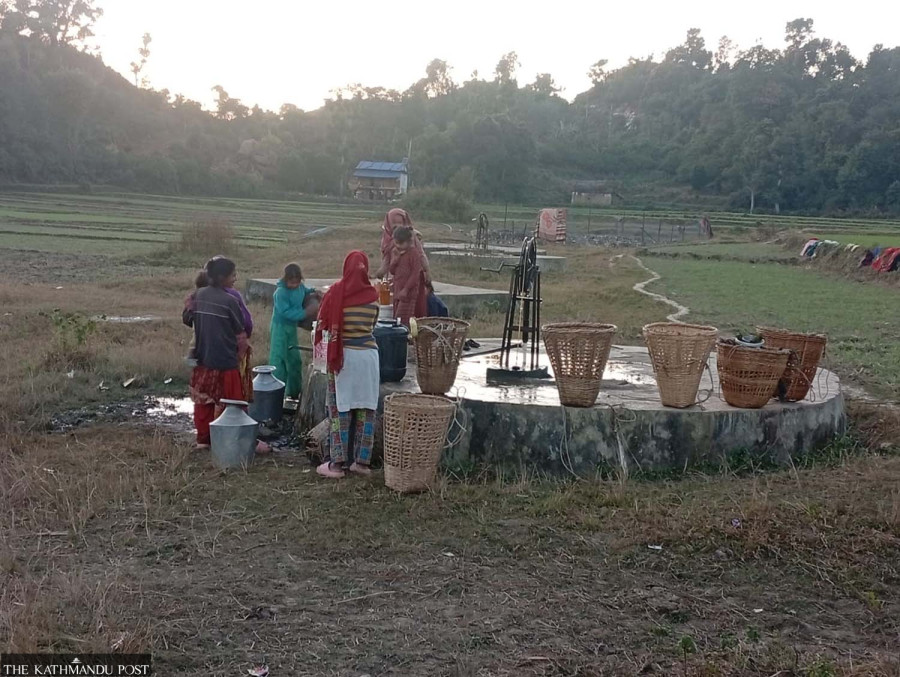
The village in Surkhet has seen more than half of its residents migrate elsewhere over the past five years mainly because of water scarcity. Women in Rekcha village in Surkhet district take turns drawing water from a public well in this recent photo. Tripti Shahi/TKP
Eligible voters across the nation are enthusiastic, and may be worried at the same time, to exercise their franchise as the House of Representatives election draws near. Electors have their own political inclinations and preferences when choosing candidates and parties.
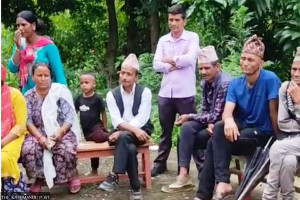
However, residents of Rekcha village in ward 5 of Chaukune Rural Municipality have set a condition for supporting candidates contesting the March 5 polls. The villagers unanimously say they will vote only for candidates who can resolve their long-standing drinking water crisis, as chronic shortage continues to drive families away from the settlement.
Situated in western Surkhet, a hill district of Karnali province, the village has struggled with acute water scarcity for years. According to the locals, the lack of reliable drinking water has become so severe that residents have been forced to ration supplies and even appoint night watchmen to guard wells during the dry season to ensure fair distribution.
As per ward office records, Rekcha once had 180 households until five years ago. Now, only about 70 households remain. More than half the population has migrated elsewhere in search of basic services, mainly drinking water. Families displaced from their ancestral homes have moved to nearby areas such as Chaukune, Panchapuri and as far as Kailali district.
Although the village has 18 wells, only 10 remain functional, and most are in a dilapidated state. The limited water available barely meets daily needs. “We are drinking water cautiously, almost by estimation,” said Tapendra Budha Chhetri, a local resident who is also an elected member of ward 5 of Chaukune Rural Municipality. “Even the water we use is unsafe, with frogs and snakes often found in the wells. Despite repeated appeals to authorities, no one has taken serious interest in resolving the chronic problem.”
Locals complain that they have to wait for hours to fill their water pot and they have to be extremely frugal in using water. Lok Bahadur Budhachhetri said villagers take turns drawing water from old wells, especially during drought periods. To prevent overuse, locals hire a watchman at night to monitor access. “We have no choice. If water is drawn freely, some households would be left without any,” he added.
Beyond water scarcity, the village faces persistent shortages of electricity and all-weather road access. Residents say the lack of basic infrastructure has compounded outmigration and deepened economic hardship.
“We live in darkness without reliable electricity, and the road exists only in name. Vehicles cannot operate,” said Lok Bahadur.
With more than 300 registered voters still living in the settlement, elections have historically brought promises of drinking water projects. However, villagers say such pledges have remained unfulfilled for decades. “Leaders have asked for votes by promising water since the 1991 elections, but nothing has changed,” said Laxmiram Budha, expressing frustration shared by many.
According to the villagers, public trust in political leaders has eroded as candidates often visit only during election campaigns and fail to return afterwards. “We have reached a point where people question the value of voting at all. This time, we are discussing it collectively. Whoever presents a credible plan to manage water resources will get our vote,” said Tapendra.
Water scarcity has increasingly emerged as a major factor of rural depopulation across the hill region. The lack of reliable drinking water, alongside poor infrastructure and limited public investment, has accelerated migration from remote settlements, leaving villages ageing and economically fragile.
In Rekcha, the villagers say the issue is no longer about development promises but survival. As wells continue to dry and families leave, the community hopes that the coming election will finally bring tangible action rather than another cycle of assurances.




 12.62°C Kathmandu