Piped water reaches most households in remote Jumla village
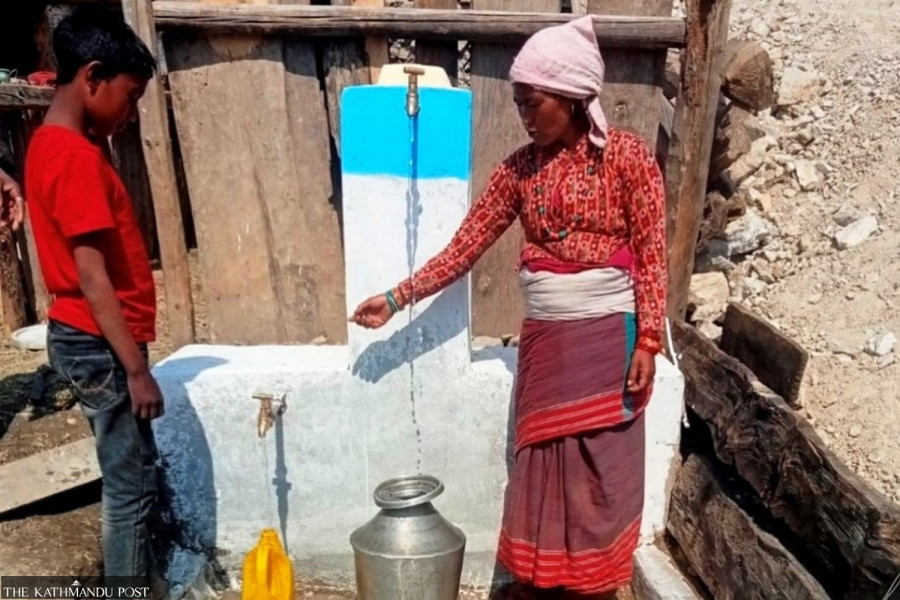
Residents of Hima Rural Municipality say they are finally free from daily water worries and can focus on other household chores, hygiene and even kitchen gardening. Villagers filling their pots in a household tap in this recent photo. Over the past three years, more than 1,200 households in Jumla’s Hima Rural Municipality have had their own taps. Post Photo
Until a year ago, Karishma Rokaya of ward 2 of Hima Rural Municipality in Jumla constantly worried about managing drinking water for her family. With no nearby natural springs and only a public tap built for the entire settlement, queuing for hours was unavoidable. “The very thought of fetching water would grip me with anxiety,” she recalled the ordeal.
That worry is now a thing of the past. Each household in her village, Koireli, has its own tap, supplying water round-the-clock. “There is water flowing all day. The time I once spent just collecting water is now used for other household chores. Water isn’t just for drinking anymore; it has helped keep the household clean and kitchen gardening possible too,” said Karishma, smiling. Koireli is a village of 44 households and all now have full access to drinking water.
According to Hima Rural Municipality, Rs6.2 million was spent to bring water from distant sources to the settlement. “Drinking water was the biggest crisis here. After such a long wait, it has finally been resolved,” said Karishma with a sigh of relief.
Similar relief is echoed in Bajagad village in ward 5 of the rural municipality. Chhumkali Rokaya remembers her children missing school to fetch water, meals delayed because water was unavailable, and families relying on neighbours. “Sometimes we queued until late at night, wasting hours. Now, with taps at every doorstep, there is no such worry,” she said.
Bajagad once depended on just a handful of public taps. As population increased and forests were depleted, natural water sources began to dry up. In many settlements across the local unit, there were only one to five public taps, some of which had stopped flowing altogether. In others, water was stored in tanks during the day and released for only an hour or two in the morning and evening.
Identifying villages facing the most severe water shortages, the rural municipality launched targeted drinking water projects. “Earlier, non-functioning taps outnumbered working ones. Seeing villagers struggle for water was heartbreaking. Now, watching water flow to every home gives us immense satisfaction,” said Laxman Bahadur Shahi, chairman of the rural municipality.
Recognising Hima’s efforts in solving the acute drinking water crisis, former federal minister for water supply Pradeep Yadav had earlier visited the village and launched a sanitation conference, according to municipal officials.
Access to drinking water has now expanded to public institutions including schools, health posts, ward offices. Hima has 23 settlements, most of which have already achieved the one house, one tap target. The municipality plans to build 400 additional taps by mid-July.
For Dhanpura Shahi of Bajagadkhola, memories of drinking contaminated river water remain vivid. “We were forced to drink polluted water from Himakhola and stand in long queues at small spouts. Important household work was often left undone just to fetch water,” she said. Today, water flows freely from the tap in her courtyard. “Seeing it overflow still fills me with joy,” said an elated Dhanpura.
Over the past three years, more than 1,200 households in Hima have received individual taps. Construction continues across all seven wards after mapping drinking water shortages. Fourteen large drinking water projects have been completed so far at a cost of Rs 40.56 million, out of a total allocation of Rs 53.54 million. The schemes are jointly funded by the rural municipality and the SUSWA project.
Villages including Badki, Dyargaun, Acharyalihi in Hima-1; Odigaun in Hima-2; Jarji, Simtoli, Khetu, Sana Chiudi and Koireli in Hima-4; Bajagad, Bajagad of Hima-5; Khaldhunga, Dadabada, Bagbazaar and Bhugolpata of Hima-6; Mathikudu, Dhachugaun and Marchigaun in Hima-7 are among those that have achieved full household coverage.
Local unit chief Shahi claims that within five years, all the households will have access to safe drinking water. “Most homes are already connected; the rest will be covered by mid-July,” he asserted.
To address sustainability, Hima organised a water conference in June last year, focussing on source identification and conservation. The conference concluded that rapid population growth, forest loss and wildfires are drying up water sources. A resolution was issued, pledging to formulate guidelines for sustainable water management, implement municipal water, sanitation and hygiene plan, levy minimal user fees, and require annual reporting from every drinking water project to wards and the rural municipality.




 25.92°C Kathmandu