Kulman Ghising on the lessons Nepal must learn from the hydropower disaster
The former NEA chief discusses the damage to hydropower projects, lessons from the rescue operations and the design and safety reforms Nepal’s hydropower sector needs after the Bhotekoshi floods.
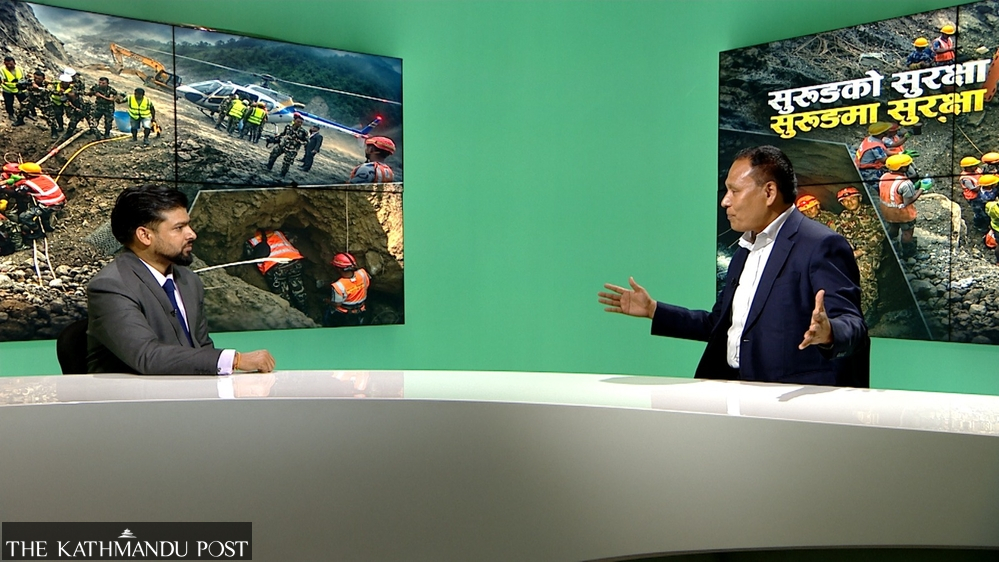
The recent catastrophic disaster in the Bhotekoshi river caused massive damage to 13 hydropower projects and transmission infrastructure across Rasuwa and Nuwakot districts. In the immediate aftermath, reports emerged that 934 people working at these sites were out of contact. Amid this, Kantipur Television’s DP Upadhyay spoke with Kulman Ghising, former managing director of the Nepal Electricity Authority and chairperson of the Ujyalo Nepal Party, regarding the disaster’s impact on energy infrastructure, human casualties, search and rescue coordination, and future mitigation measures.
Following the Bhotekoshi disaster, have hydropower projects and their tunnels become major safety concerns for us?
Given Nepal’s geography, hydropower plants are naturally built along riverbanks. Due to climate change, melting glaciers, expanding glacial lakes upstream, and sudden flash floods or cloudbursts, the risk of water inundating powerhouses and access tunnels has increased significantly. The recent disaster exposed the vulnerabilities. It has not only heightened structural risks but also presented serious challenges to human safety.
You have been involved with power projects in Rasuwa and Nuwakot, including Trishuli-3A, from the beginning. How do hydropower tunnels differ from road tunnels in terms of design and safety systems?
Hydropower tunnels are built to divert water, whereas road tunnels are designed for vehicular movement. Their structural features and safety considerations are entirely distinct. In a hydropower system, water is diverted from the headworks through a tunnel to the powerhouse. Before entering the tunnel, the water passes through a desander basin, which can be located either outdoors or underground. Outdoor structures carry higher risks during floods and natural disasters.
Water flows to the powerhouse through a surge tank and penstock pipes, driving the turbines under high pressure to generate electricity. Unlike standard buildings, a powerhouse is constructed inside a large underground mountain cavern. For instance, a powerhouse in Rasuwagadhi features a cavern roughly 75 metres long and 15 to 20 metres wide. Access tunnels lead to these powerhouses, entering anywhere from 10 to 60 metres above the riverbed, depending on topography and river levels.
Inside, the powerhouse contains turbine and generator floors, a control room, a GIS floor, battery rooms, and other equipment. Additional channels include cable tunnels for wiring and tailrace tunnels to discharge water back into the river. In the Trishuli-3A project, two surviving engineers were rescued through the cable tunnel.
Two people were rescued alive from Trishuli-3A, while others remain missing inside. How do you view this situation?
At Trishuli-3A, the tailrace tunnel at the lowest section was buried, along with two entry tunnels and the cable tunnel. This made it a unique case, as all entry points were blocked. The powerhouse was completely sealed without airflow, yet two individuals survived because oxygen remained trapped in the upper section of the cavern.
Based on conversations with engineers at the site and rescue teams, the Load Dispatch Centre had alerted the plant that a massive flood was approaching and urged immediate evacuation. Around 30 to 35 maintenance workers ran out. While many escaped the powerhouse, information indicates that those who ran outside were caught in the sudden torrent and did not survive.
Conversely, those who stayed inside managed to climb higher into the cable tunnel section. The water level did not reach the top of this 18-20-metre-high space. Had the water filled it completely, survival would have been impossible. They attempted to escape through that tunnel, but the exit on the other end was plugged by debris, trapping them. Because water did not submerge the cavern from above, they survived in that air pocket for 10 days. One deceased individual was later found on that upper level during an inspection. Those who were able to reach that specific high level survived.
Similarly, projects like Chilime and Rasuwagadhi have upper utility floors and designated assembly points equipped with kitchen facilities and battery backup, offering basic shelter during emergencies.
How severe is the overall infrastructure damage across affected hydropower projects, and is reconstruction feasible?
In operational projects where powerhouses have been buried by landslides and mud, the debris must first be cleared. We will then need to assess how much machinery remains salvageable, though I anticipate that most electrical and mechanical equipment will require replacement.
Replacing powerhouse machinery will take time, but the underground headrace tunnels themselves remain intact. For instance, the desander and headrace tunnel at Rasuwagadhi are safe. Once headworks are repaired and water is redirected, power generation can resume after rebuilding the powerhouse. Chilime’s tunnel and headworks are also fine, with damage largely confined to its powerhouse.
Trishuli-3A lost its headworks and external desander, but its tunnel remains structurally sound. Its damaged powerhouse will need to be reconstructed. While operational projects face these specific restoration paths, under-construction projects face a different set of issues.
What is the status of under-construction projects?
Projects under construction do not yet have fully operational powerhouses. For example, at the 216 MW Upper Trishuli-1 project being built by a South Korean firm, 200 to 300 workers inside the excavation area survived because their access route was connected to an audit tunnel coming from Mailung, far from the flooded riverbank. Water could not enter that passage, allowing everyone inside to exit safely.
However, constructing long tunnels—such as Upper Trishuli-1’s 12 to 13-kilometre stretch—requires multiple intermediate audit tunnels. Workers stationed at headworks, desanders, and these audit access points were severely affected. Since the project is still under construction, water flow systems were not operational, and the disaster struck while crews were actively working around the desander area. Ten to eleven workers managed to walk out on the second and third days. Between 100 and 200 people were initially reported trapped there, and total losses will become clearer over time.
There are concerns about winter power cuts due to this damage. Is load-shedding likely?
About seven operational hydro plants, both small and large—including Rasuwagadhi, Chilime, Mailung, and Trishuli 3A—have suffered severe damage. Together, this represents an operational loss of approximately 255 MW.
However, I do not foresee loadshedding this winter. Nepal’s current total installed hydroelectric capacity stands at around 4,200 to 4,500 MW, alongside roughly 200 MW of solar power. Even with 250 MW offline, we maintain an operating capacity of around 4,000 MW. During the monsoon, we produce surplus power and export 800 to 1,000 MW to India.
While winter generation drops during peak hours, importing modest amounts of electricity will cover any deficit, with baseline generation staying around 1,500 MW. When loadshedding was said to have ended in 2016, total installed capacity was merely 800 MW, which dropped to 300 MW during winter. Today, our capacity is over 4,000 MW and continues to grow, with 7,000 to 8,000 MW of projects currently in various stages of construction.
What is the total estimated financial loss to the hydropower sector alone from this disaster?
Combining physical damage, loss of generation, and restoration costs across operational and under-construction projects in both public and private sectors, total losses are estimated between Rs100 billion and Rs150 billion, if not more.
The loss of energy generation itself is significant. For instance, Trishuli-3A generates Rs4 to 5 billion worth of electricity annually. A two-year outage translates to direct energy losses of nearly Rs10 billion for that single plant.
Given that survivors were found on the tenth day, could faster response efforts have saved more lives?
Rescue operations were constrained by available resources, command structure, and specialised expertise. Had project engineers and technical experts been brought together immediately on day one to map out structural entry points and coordinate equipment, response times could have been faster. There was a delay in setting up that initial integrated planning phase.
The Nepali Army, Armed Police Force, and Nepal Police worked really hard with the resources at their disposal, but they lacked detailed familiarity with underground tunnel layouts. A unified approach combining security forces and engineering experts from the start would have been ideal. Security personnel took significant risks entering the tunnels, and their efforts deserve praise. However, it would have been far better had an integrated team, along with the necessary equipment and resources, been mobilised from the outset.
At Chilime, Indian and Sherpa rescue teams managed to penetrate 70 to 80 metres into the tunnel before being stopped by thick mud. Advancing further required excavators or heavy pumps to clear debris.
Although space was cleared to drop an excavator, subsequent floodwaters washed away the access area.
Nepal also lacks heavy-lift helicopters capable of moving 5 to 10-tonne equipment. The military’s Mi-17 helicopters can carry a maximum payload of about 3 tonnes. Equipment had to be dismantled, transported in parts, and reassembled on-site.
Furthermore, rescue workers could only operate for about four to five hours a day because keeping them on-site overnight posed severe flood risks. Rapidly restoring road connections toward Betrawati, Syaphrubesi, and Chilime and deploying Bailey bridges would have aided the rescue effort. I have suggested to the prime minister that heavy-duty drilling machinery and specialised airlift equipment be imported from abroad if necessary. Nevertheless, the security personnel are making every possible effort from their side.
Would reservoir-based projects have prevented this level of destruction?
Unprecedented disasters should not deter us from developing hydropower, but they must force us to rethink design standards and safety protocols.
First, emergency exit stairwells should be built inside long tunnels, 300 to 400 metres above the cavern, enabling workers to climb out. Second, access tunnel portals should be placed 150 to 200 metres higher up mountain slopes rather than 50 metres above riverbeds. Though this increases tunnel length and construction costs, it significantly reduces flood inundation risks. Third, portable emergency oxygen cylinders must be pre-positioned inside all underground powerhouses.
Fourth, and most important, powerhouses should transition to digital remote operations, managed from urban control centres, as is common in countries like Norway. This minimises permanent on-site staffing during routine operation. Fifth, desander basins should be located entirely underground.
Sixth, comprehensive basin-wide analyses are necessary. Real-time monitoring and data-sharing systems must be established for high-altitude glacial lakes upstream, requiring technical collaboration with China to safely drain lakes that pose outburst risks. Seventh, early warning sirens must be installed downstream to alert workers and residents in time.
While high-hill terrain is unsuitable for massive storage reservoirs due to steep topography, multi-purpose storage projects must be developed across the Gandaki, Koshi and Karnali river basins. In China, rivers like the Yangtze feature a series of reservoirs—such as the Three Gorges—that regulate massive seasonal floods. Creating storage reservoirs across Nepal's major basins would provide effective flood control, absorbing sudden upstream flash floods safely. When a major flood lasting 10 to 15 minutes collects in a reservoir, the water level may rise by only two to three metres, making it easily manageable.




 23.34°C Kathmandu