Deteriorating bridges turn Kaligandaki Corridor travel risky in Baglung–Gulmi stretch
Around a dozen ageing bridges built by the Nepali Army remain unreplaced for over a decade, forcing vehicles to cross in unsafe conditions amid delayed infrastructure upgrades.Prakash Baral/TKP
Travel along the Baglung-Gulmi section of the Kaligandaki Corridor has become increasingly risky as around a dozen bridges along the route have fallen into a dilapidated condition.
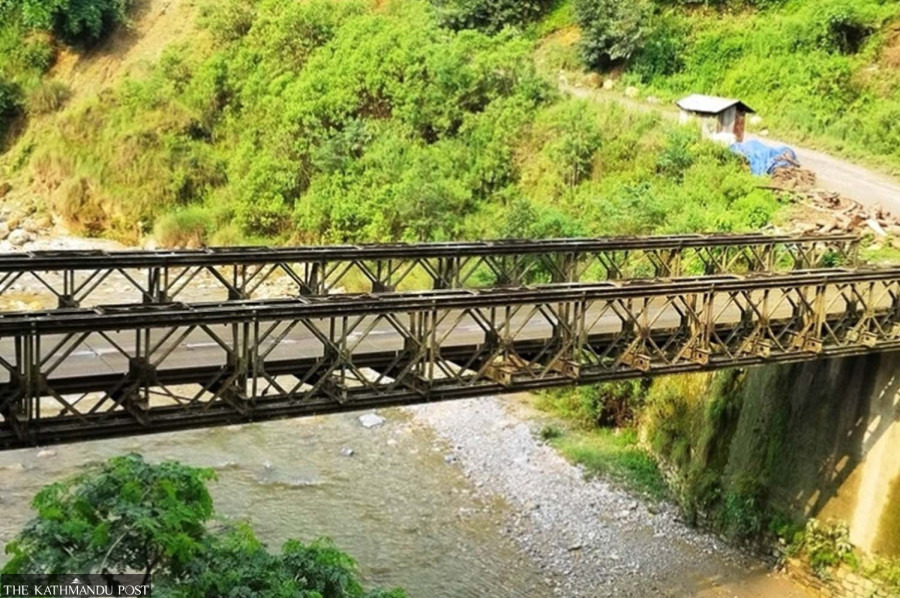
The temporary bridges installed by the Nepali Army around 12 years ago, while opening the road track, are now worn out. Of the bridges along the corridor, nine are in a vulnerable state, including three in Baglung and six in Gulmi. With no permanent bridges built at these points, transportation continues to operate under risky conditions.
Although the road has been blacktopped and sees dozens of vehicles daily, repair work on the old bridges or construction of new ones has not taken place. Vehicles are currently crossing the ageing structures at risk. The bridges show heavy rusting, with deck panels shaking in several places and surfaces becoming worn and slippery.
The corridor has seen a rise in traffic in recent years, especially pilgrims and tourists travelling from Bhairahawa to Muktinath. Indian tourists and religious visitors also frequently use the route. Heavy trucks carrying goods from Bhairahawa to Baglung and Beni have also begun operating along the road.
“The bridges are in a dangerous condition, and there is real fear of accidents,” said Hari Bahadur Chhetri of ward 5 in Jaimini Municipality. “It has already been 12 years since these temporary bridges were installed by the Army, but there is still no sign of permanent structures.”
The most vulnerable crossings include the Theule river bridge linking Jaimini-1 and 5, the Launwa river bridge in Jaimini-7, and the Palung river bridge connecting Baglung and Gulmi. The Kathe river bridge connecting Maldhunga in Baglung Municipality-1 with ward 10 is also in poor condition. Built in 2009 by the then District Development Committee for small vehicles, it was damaged on its northern pillar by a flood in the Kathe river four years ago. Although it has been repaired for continued use, officials say it remains risky.
“This bridge was only designed for small vehicles, so heavy traffic is dangerous,” said Dipendra Bhandari, an engineer at Baglung Municipality.
Local resident Omkar Thapa noted that even pedestrians are at risk at the Palung river bridge in Dhus, which connects Baglung and Gulmi. The deep river and cliffs make it difficult even to move cattle across, according to Thapa. With the corridor development, settlements such as Baralba in Kaligandaki Rural Municipality of Gulmi and Dhus village in Baglung have turned into roadside hubs, but the deteriorating bridges have increased the risk of accidents.
Some bridges, including the Kala river bridge connecting wards 10 and 13 of Baglung Municipality, were constructed three years ago. Others, such as the Dhapa river and Arjewa bridges, were completed last year and are already in operation.
“Bridges at major and high-risk locations have still not been built,” said Thag Bahadur Chhetri, chair of Jaimini Municipality-5. “Either they have not been recognised as risky, or they have been ignored.” He added that in the event of accidents, local governments are often blamed.
He also recalled that last year’s flood in Theule river washed away houses near the bridge, while damage to a southern pillar was temporarily addressed by the municipality through embankment construction.
Senior Divisional Engineer Shivalal Dahal at the Kaligandaki Corridor Project Office in Palpa said a total of 14 permanent bridges are needed: nine along the Baglung and Gulmi stretch of the corridor and five along the Kaligandaki Highway section in Parbat.
“We have sent proposals through the National Planning Commission for approval from the Ministry of Finance,” Dahal said. “Once approved, construction can begin in the dry season.” He added that cost estimates have already been submitted and work could start in the winter if approval is granted.
The road section from Balewa to Maldhunga remains incomplete. The project deadline was extended twice, first in November 2022 and again on May 31, 2025, for another year, but blacktopping has still not been completed. A landslide at Kalakhola last year further delayed work as the contractor focused on clearing debris.
Although awarded to Khadga Krishna B and JV, the work is being carried out by Bidari Construction. The company claims around 90 percent of the work has been completed on the 8-kilometre stretch awarded for Rs990 million.
Officials said the remaining blacktopping will be completed soon, after which the road will be handed over. Safety works such as installation of roadside pillars, dividers and painting will be carried out within a year after handover, preferably in the coming winter to avoid monsoon disruption.
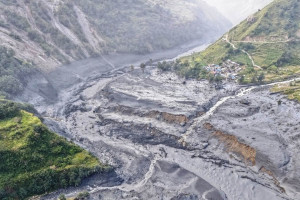
A landslide at Eklesal along the Maldhunga–Kushmishera road section has remained unresolved for five years, repeatedly blocking the corridor during the rainy season. Last year, the road was fully disrupted from mid-June to October due to frequent landslides.
Authorities have attempted to control the slide by constructing retaining walls this year. If successful, it will improve access to the southern Baglung municipalities. During past closures, residents of Balewa and Jaimini were forced to cross suspension bridges to reach Kusma in Parbat before travelling onward to Baglung headquarters.
With the monsoon already underway, locals fear another difficult season ahead. “We are worried this year will also bring the same hardships,” said Tamsam Rana of Jaimini Municipality-7.




 22.41°C Kathmandu
.jpg)