‘SAFF moving to take South Asian football further’
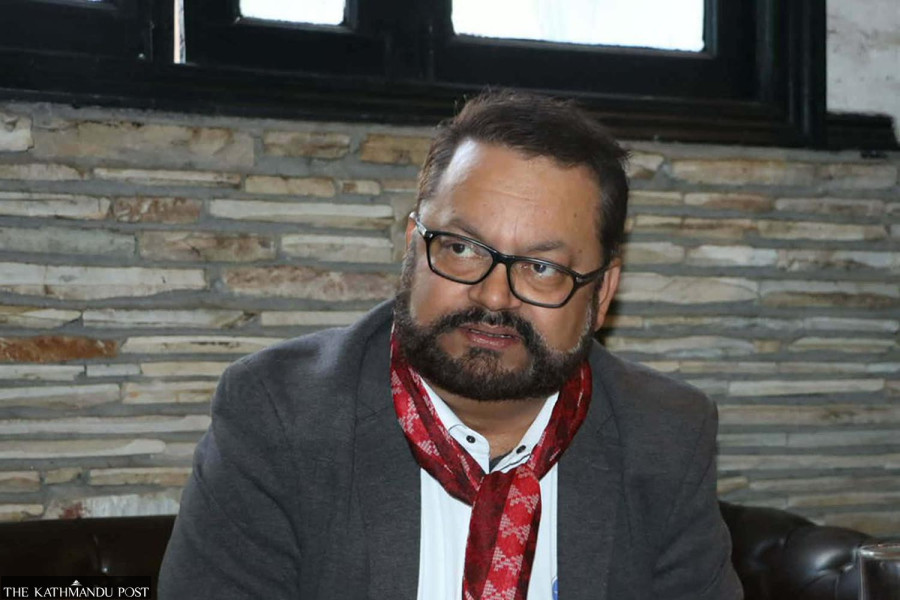
From women’s club football to futsal championships and referee development to producing pro-license coaches, SAFF General Secretary Purushottam Kattel outlines a packed calendar aimed at building the game on and off the pitch. SAFF General Secretary Purushottam Kattel speaks to journalists in Kathmandu on Wednesday. Post Photo
The inaugural SAFF Women’s Club Championship, which started in Kathmandu between five top clubs of the sub-continent on December 5, marked a new era in South Asian women’s football.
“We initiated this tournament to further develop women’s football, for which the craze is growing exponentially in the region,” said Purushottam Kattel, general secretary at the South Asian Football Federation (SAFF).
A former Head of Unit of South Asia at the Asian Football Confederation (AFC), Kattel assumed the role of SAFF General Secretary on April 1. In less than two months, the South Asian footballing body revealed an ambitious calendar, which also revealed the first edition of the Women's Club Championship.
“We are not a governing body,” Kattel clarified in a small discussion with journalists on Wednesday. “SAFF is an entity that organises competitions and different workshops for capacity building of players and officials in the sub-continent.”
SAFF tournaments in full swing
After the calendar was revealed, the SAFF U19 Men’s Championship took place between six SAFF countries, except Pakistan, in Arunachal Pradesh, India from May 9 to 18. The hosts lifted the trophy defeating Bangladesh 4-3 on penalties after a 1-1 draw in the final.
Similarly, the month of July saw the organisation of SAFF U20 Women’s Championship in Bangladesh. The hosts won the tournament.
The next month, Thimphu, the capital city of Bhutan, hosted the SAFF U17 Women's Championship from August 20 to 31, which India won with 15 points.
In mid-September, Sri Lanka hosted the SAFF U17 Men's Championship with the participation of all seven SAFF countries. It is a rare sight to see all seven countries participate in the South Asian event due to some countries’ unwillingness to travel to the other.
“Sometimes it might feel that the SAFF is organising more tournaments in Nepal,” said Kattel. “It is due to the country being an easy destination for other countries to travel and play.”
Nepal is also hosting another tournament soon. “We recently inspected Pokhara Stadium for the SAFF U19 Women’s Championship,” Kattel informed. “Organising SAFF tournaments outside the capital cities of the member nations is to take football to different corners.”
Meanwhile, there are more events in the pipeline. “The SAFF is also planning a school-level tournament, alongside the U20 Men’s Championship in the Maldives in March and U17 Women’s Championship in Bhutan in April next year,” Kattel informed.
The first week of June will see the SAFF Women’s Championship hosted by India during a FIFA window. “As the window is not long, we are planning to begin the SAFF Women’s Championship a bit early and have the semi-finals and final matches within the window,” said Kattel. “It will allow key players of the participating countries, who are playing in foreign leagues, to be available for the main events.”
Likewise, Pakistan will host the U17 Men’s Championship in August 2026. After that, the most-anticipated 15th SAFF Men’s Championship, which was planned in a home-and-away format in June 2025, will be organised in September or October.
“The tournament was postponed due to different problems,” said Kattel. “This time, the SAFF Men’s Championship will take place in a centralised venue, most probably in Bangladesh. The months of September and October will be favourable for it as FIFA is combining the windows.”
Meanwhile, when asked about the plans for the SAFF Men’s Club Championship, Kattel said that it was not feasible unless the leagues were regular.
Inaugural SAFF Futsal Championship
Futsal is an emerging sport in South Asia—the increasing number of futsal throughout the region cements the fact. In order to adhere to the attraction towards the five-a-side game, the SAFF is organising the first edition of the game—in both men’s and women’s categories—in January.
“Futsal is a growing sport throughout the world. But South Asian countries are struggling in international events,” said Kattel. “The SAFF Futsal Championship aims to increase international exposure to our member nations.”
Meanwhile, when asked why the tournament was taken outside South Asia, Kattel said that the major reason was the lack of proper infrastructure and organising capabilities.
“It is the first time that a South Asian-level futsal event is being 0rganised, and we do not have member associations with experience of organising such a big-level futsal event,” Kattel said. “We will be taking around 300 players and officials to Thailand for the event.”
Upgrading abilities of officials
Alongside providing platforms for players, the SAFF is also prioritising capacity building activities of match commissioners, referees and coaches, Kattel shared.
“We organised a two-day (July 1 and 2) South Asia Match Commissioners Conference and Workshop in Kathmandu. It was the first-of-its-kind event in South Asia,” said Kattel. “The event helped bring together current match commissioners from South Asia alongside aspiring ones, and create an environment for sharing ideas, experiences and strategies to enhance the sport.”
South Asia lacks sufficient match commissioners. “There are around 15-16 match commissioners in the region, of whom eight are from India. And there are only three women match commissioners in South Asia,” Kattel said. “We now plan to produce more match commissioners.”
Similarly, citing the lack of referee assessors in the region, SAFF is also planning to organise a programme to increase their numbers, Kattel said. “We will be asking all member associations to send three individuals, including one woman mandatorily, for a programme we have planned for next year,” he added. “While we will provide accommodation to all, the SAFF will bear the cost of even the flight tickets for women participants.”
The SAFF is also planning a futsal referee course and a Level 1 coaching course. “We will also be producing Pro License coaches in the region,” Kattel said. “The programme for pro license will be organised in Bhutan. The SAFF will provide some financial assistance for the pro-license course.”
Nayak Paudel covers sports for The Kathmandu Post. He previously worked at the Post (2018–19) and spent over five years at The Rising Nepal. His reporting spans crime, health, education, and social issues.




 22.6°C Kathmandu