ANFA targets AFC competition through National League. But ‘club licensing’ issue remains
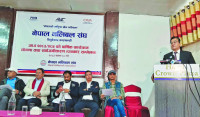
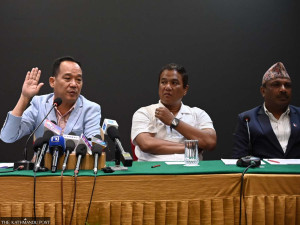
Inviting additional A Division clubs to participate, ANFA pushes for the National League as Nepal’s route back to continental football. But the absence of any AFC-licensed clubs exposes a deeper, unresolved structural gap. (From right) ANFA’s General Secretary Kiran Rai, CEO Indraman Tuladhar and Competition Director Sanjib Mishra during the press meet at the ANFA Complex in Satdobato, Lalitpur on Monday. Photo: Courtesy of ANFA
Last month, during a meeting between representatives from a dozen A Division clubs with Minister for Youth and Sports Bablu Gupta, Karma Tsering Sherpa, president of Himalayan Sherpa Club, said that the major prize for the club winning the Martyr’s Memorial ‘A’ Division League is to participate in the club competition of the Asian Football Confederation.
Nepal’s top-tier league winner qualifies for the AFC Challenge League, the third-tier continental club competition among the clubs from the nations that did not receive direct qualifying slots either for the second-tier AFC Champions League Two or the top-tier AFC Champions League Elite.
As part of the slot provided to Nepal, Church Boys United, winner of the 2023 A Division League, faced Bhutan’s winner Paro FC, which arrived with former Japanese international Keisuke Honda, in the preliminary stage of the 2024-25 Challenge League at the Kathmandu-based Dasharath Stadium on August 13, 2024.
However, Nepali clubs missed the opportunity to play in the 2025/26 season of the AFC Challenge League, as the governing body of Nepali football, the All Nepal Football Association (ANFA), failed to organise the A Division League.
To not miss the opportunity, the ANFA, on March 7, proposed a league-cum-knockout tournament between the A Division clubs, with the winner qualifying for the AFC club tournament. However, the clubs denied.
The 2025/26 AFC Challenge League then began on August 12, with 18 teams competing in the preliminary stage. The group stage between 20 teams began on October 20 and concluded on November 1, with the top eight teams progressing to the knockout stage, which will kick off on March 4 next year.
Meanwhile, to not miss the chance to play in the 2026/27 season of the AFC club tournament, the ANFA now plans to organise the National League as a consolation for the A Division League.
The ANFA showed big promise by declaring to organise the top-tier league in a home-and-away format at a time when the majority of the clubs did not have a home ground. As a result, on November 3, the clubs and the ANFA decided to organise the National League this time, and the A Division League next season.
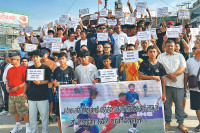
Nonetheless, the decision led the Nepal Football Players Association (NFPA), the umbrella body of Nepali footballers, which has been demanding the continuity of the league cycle regularly, to protest on the streets, with the players leaving their medals hanging at the ANFA gate on November 6.
With the newly appointed Sports Minister Bablu Gupta taking the initiative to pressure the stakeholders to organise the league and allow thousands of Nepali footballers to earn a livelihood from the sport, the ANFA, clubs and NFPA, on November 11, agreed to not use the National League as a replacement and organise the A Division League within 120 days.
However, three weeks later, the ANFA, on Monday, declared that the National League will pave the way for the AFC club tournament.
All A-Division clubs invited to National League
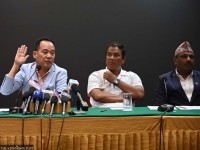
Speaking at the press meet organised to inform the decisions of the emergency executive committee meeting at the ANFA Complex in Satdobato, Lalitpur, on Monday, ANFA General Secretary Kiran Rai said that the National League will be organised from January 9 next year.
“But we are expanding the number of participants,” Rai informed. “Except for the top four teams qualifying from the President League and the top six from the previous A Division League, the other eight A Division clubs can also play in the tournament. The deadline to express interest is Tuesday.”
Laligurans Association Club, Chitlang FC, Nawa Jana Jagriti Yuwa Club and Kakre Bihar Youth Club qualified for the National League after finishing as the Top 4 from the President League, which concluded in mid-November.
Once the number of clubs is finalised, the ANFA will decide on the format of the National League. The format is essential because only a league is insufficient to fulfil the criteria for the winning club to qualify for the AFC tournament.
“Either the league should be six months long, or there should be 90 matches, including the matches in the qualifying round,” ANFA’s Chief Executive Officer Indraman Tuladhar told the Post. “The President League’s matches will also be counted, and we will try to fulfil the latter criteria.”
The NSL and other local tournaments—such as the 25th Aaha Rara Pokhara Gold Cup—will also see their fixtures amended to be easy for the participating teams to not be disturbed during the National League, Rai said.
Nonetheless, the ANFA informed that the A Division League will commence within a month of the completion of the National League.
“It will be difficult to organise the upcoming A Division League in the home-and-away format,” Rai said. “But it is a necessity. We aim to implement the home-and-away format from the next season by completing the requirements.”
AFC Club licensing roadblock
No Nepali clubs were on the list when the AFC, on June 10, revealed the names of the licensed clubs for the AFC Club Competitions 2025/26.
Nepali clubs have been struggling with the AFC club licensing for a long time now. The ANFA has even been slammed with fines for granting the licenses by violating the regulations of the AFC.
“It is not easy to fulfil the AFC club license criteria for the Nepali clubs,” Sherpa, who is also the former president of ANFA, said during the November 12 meeting. “And without the AFC club license, winning the league doesn’t guarantee participation in the continental tournament.”
Thus, when the Post asked the ANFA regarding the licensing issue during the press meet on Monday, Rai said that they will manage it.
From requiring a club to have youth development programmes—an under-10 team and three youth teams for players aged 10 to 21—the regulations require a team’s own stadium (or one leased to them) that follows the AFC’s stadium regulations, training facilities available throughout the year, and around two dozen administrative personnel (such as general manager, team doctor, physiotherapist, financial officer, safety and security officer, legal advisor, technical director and specific coaches for different roles, among others).
Similarly, there are a number of financial and legal criteria to be met before applying for the club licensing.
“The major thing we need is a home stadium,” Rai said, “And we are coordinating with the ministry to complete the renovation work on Dasharath Stadium and lift the AFC suspension. It will then be used by the National League winner as the home ground for the AFC tournament.”
If the move works with the AFC, it is great. But if not, the club licensing wall will hit Nepali football hard.
Meanwhile, there is a provision called ‘Extraordinary Application’ in the club licensing regulations that could also be used by the ANFA. As per Article 15, if a club qualifies for an AFC club competition(s) on sporting merit but has not undergone any licensing process at all or has undergone a licensing process which is lesser/not equivalent to the licence required for the competition, it can use the provision.
“Based on such an extraordinary application, the AFC may grant special permission to the club to enter the corresponding AFC club competition(s) subject to the relevant AFC club competition regulations. Such an extraordinary application applies only to the specific club and for the season in question,” the Article reads.
“Organising the National League and providing a platform for the players is now the main priority because there is a lot of pressure on the ANFA,” a senior ANFA official said, requesting anonymity. “Regarding the eligibility for the AFC tournament, it is a matter that will come later.”
Other Ex-Co decisions
The emergency executive committee meeting of the ANFA on Monday has also decided to use ‘Edel Grass’, a leading turf company, for the artificial ground construction in Dhulikhel and Dhangadhi under the FIFA Forward Programme.
Likewise, the ANFA will also be proposing to the AFC to prepare a hybrid grass ground at the Dasharath Stadium. Jagadamba Moktan JV has been granted the bid, at Rs12,648,815, to construct dressing rooms, toilets, an office and a parapet in Sindhupalchok Ground under the AFC’s Enhance Programme, under which the ANFA is also buying a shuttle bus and a luggage van.
The ANFA has also extended the contract for the national team’s jersey and sports equipment with Kelme by a year until October 21, 2026. The governing body of Nepali football will also be agreeing with FIFA+, the OTT platform of the governing body of global football, to broadcast Nepal’s domestic and international events live.
“A Division League will also be included in the FIFA Contract of Agreed Objectives (CAO) through amendment,” Rai said. “It will allow us to utilise FIFA’s funds for the event.”
The SAFF Women’s U19 Championship will be organised in Pokhara, while the national women’s club-level knockout tournament will be hosted by Udayapur. Regarding the Martyr’s Memorial National Women’s League, the top-tier women’s club tournament of the country, the venues in Jhapa, Morang, Makawanpur and Sunsari districts are being studied.
The process for a franchise league in women’s football is also underway, Rai said.
ANFA also informed that the preparations for the SAFF Club Women’s Championship, which will take place from December 5 to 20 at Dasharath Stadium, were almost complete. The league winners from five countries—APF Club (Nepal), East Bengal FC (India), Nasrin Sports Academy (Bangladesh), Transport United Ladies FC (Bhutan) and Karachi City FC (Pakistan)—are participating in the tournament.
Nayak Paudel covers sports for The Kathmandu Post. He previously worked at the Post (2018–19) and spent over five years at The Rising Nepal. His reporting spans crime, health, education, and social issues.




 28.33°C Kathmandu