How Delhi's grand diplomacy distracts us from the ongoing territorial occupation of Nepali land
Kalapani is not a “boundary issue.” It is our land under illegal occupation. Until we state this clearly, we will continue to be misled. Post Illustration
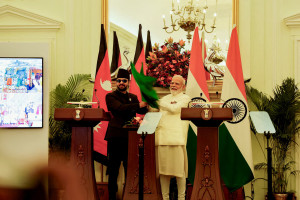
There was much hope when Prime Minister Balendra Shah went on a two-day visit to India. Upon his return, those hopes remain largely unmet. Some economic packages were agreed, but the yawning trade deficit with India remains unaddressed. In geopolitics, India sent our Prime Minister home empty-handed.
There is an old Nepali saying: “Haathiko dekhaune dant eutaa chabaune dant arkai.” Elephants have one set of teeth to show, and another to chew with.
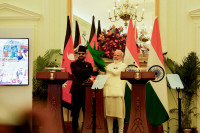
At the conclusion of PM Shah’s visit to India, the Joint Vision Document signed in New Delhi on November 23, titled “Viksit Bharat and Samunnat Nepal: Re-imagining the Partnership”, is the perfect modern embodiment of the old Nepali saying. It shows us 10 beautiful pillars while hiding the foundation on which everything else stands—our land.
If one reads the grand vision as a patriotic Nepali, not as a diplomat trained to applaud every comma, one will find it is not a vision at all. Instead, it is Delhi’s sleight of hand.
What the Vision contains
On paper, the document is impressive: Rs240 billion in assistance (Rs56 billion in grants for post-flood reconstruction following the August 2026 Rasuwa-Trishuli disaster and Rs184 billion in concessional loans for energy projects).
Then come the 10 pillars: economic partnership, physical and digital connectivity, energy and climate, good governance, technology and space, education, sports, culture and tourism, health and agriculture.
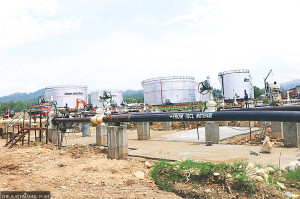
There are cross-border Special Economic Zones, an Ayodhya-Janakpur train, the Raxaul-Kathmandu railway, the Siliguri-Jhapa pipeline, access to Kandla and Paradip ports, a startup centre in Kathmandu, a Nepali-language LLM, a cricket academy, Jan Aushadhi Kendras and an agro-industrial park in Chitwan.
Who could object to cricket academies and Ayurveda? Who would say no to a train to Janakpur? No one. That is precisely the point. The Vision is designed to be unobjectionable, because it is designed to be a distraction.
One sly sentence in the preamble
Buried in the preamble is a sly sentence that severely impinges upon our sovereignty. It proudly states, “All outstanding matters, including those related to water resources, energy, trade & commerce and boundary, are to be resolved through mutual discussion and dialogue.” Upon close reading, it mentions no timelines, mechanisms, deadlines, commitments, or reference to Kalapani, Lipulekh or Limpiyadhura. There is no mention of withdrawal or occupation.
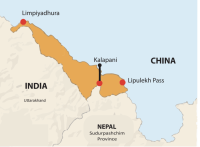
The entire issue of territorial occupation is merely mentioned as “boundary”, lumped together with water, energy and trade, as if a 372 square kilometre under foreign military occupation is the same as other boundary encroachment issues. This is not an oversight but Delhi’s technique of deception.
For eight years, Nepal demanded that the Eminent Persons Group (EPG) report—completed in July 2018 after nine meetings among eight eminent persons from both countries—be formally received. It was a document that actually tried to deal with the 1950 Treaty, the border and the structural imbalance.
What did Delhi do? First, it refused to receive it. For eight years, Prime Minister Modi was “too busy”. Then, the day after PM Shah’s visit, Foreign Secretary Vikram Misri pronounced it dead: “It pertains to the past... to me therefore, the report is not relevant.” And what replaced it? The Vision. We traded a serious document for a ‘dream’.
Occupation is not encroachment
Delhi, and much of our own press, call Kalapani a “border dispute,” an “outstanding boundary issue,” an “encroachment. It is none of these.
An encroachment occurs when your neighbour’s fence moves two feet into your property. A survey team can settle an encroachment. What India has done in Kalapani, Lipulekh and Limpiyadhura is fundamentally different. It is a unilateral, illegal military occupation of Nepali territory.
According to the Sugauli Treaty of 1816, the Kali River is Nepal’s western boundary. It originates at Limpiyadhura, and the territory east of the Kali, including Kalapani, Lipulekh and Limpiyadhura, rightfully belongs to Nepal. Until 1962, Nepal collected taxes, conducted census, and issued land ownership certificates in this area. However, in 1962, in the context of the India-China war, Indian troops came and stationed themselves there. They never left.
Since then, India has built roads through Lipulekh, built military camps, included the area in its official maps in 2019, and agreed with China to use Lipulekh as an India-China trade route—without Nepal’s involvement, as if Nepal did not exist.
And now the Indian Foreign Secretary tells journalists that “Lipulekh is the India-China border.” If that is not occupation, what is? To call this a “boundary issue to be resolved through mutual discussion” is to downgrade a violation of sovereignty to a technical disagreement. It is akin to calling an invasion a “border management problem.” Language matters. Once we accept Delhi’s language, we have already lost half the battle.
Grand diplomacy
Delhi’s grand diplomacy works in four steps.
First, by overwhelming with generosity. Second, by killing the inconvenient document. The EPG report posed a danger because it was a joint effort. Indian eminent persons also signed it. So it must be killed not by rejection, but by irrelevance. Declare it “of the past.”
Third, by replacing a legal commitment with a process. The Vision establishes a High-Level Monitoring Group to meet every six months. It directs Foreign Secretaries to “work on outstanding boundary issues.” We have had such mechanisms for decades, but what have they produced? More meetings, more minutes. A process without a deadline is a burial ground for a problem.
Fourth, by buying time with “mutual consent.” The Vision says the 1950 Treaty “could be reviewed on the basis of mutual consent.” This phrasing gives India a permanent veto. If India does not consent, nothing is reviewed.
As a result, Nepal returns home with a vacuous Vision, and India is successful in keeping our land occupied.
A real vision would have said: A mutually agreed-upon joint commission with a set timeline will determine the origin of the Kali based on historical maps and treaties. The EPG report would be formally received within 30 days and made public.
Nepal is not against friendship with India. But friendship without justice is not genuine. It is mere patronage. A Vision that speaks of youth aspirations and innovation hubs while remaining silent on military occupation is not forward-looking. It says one thing and means quite the opposite.
Kalapani is not a “boundary issue.” It is our land under illegal occupation. Until we say that clearly, in every forum, in every document, and refuse to sign any Vision that erases it, we will keep being misled.
In diplomacy, however, patience is the name of the game. The destruction in Bhotekoshi, the huge amount required to rebuild it, and securing airspace for incoming flights to Bhairahawa were perhaps too compelling for us to ignore.
But the territorial occupation issue has not died down, nor will it, since it is already enshrined in our constitution. Our future generations will surely take it back.




 9.12°C Kathmandu