What it means to be a peripheral country in the age of uncertainties
The government tricks the public into feeling that it is steering a steady ship, while structural policy, economic reality and disaster response crumble underneath. Combo of Post photos
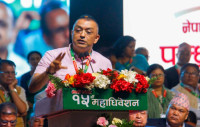
Prime Minister Balendra Shah doesn’t seem to have any business on his first foreign trip after taking up office other than delivering a routine address to the United Nations General Assembly. However, he will probably be staying in a country ruled by climate change denier President Donald Trump.
President Trump has been busy eliminating USAID—the fig leaf for the US’s strategic interests in the Global South; extraditing undocumented immigrants bound in chains; insulting a ‘hellhole’ in an extension of his disparaging ‘shit hole countries’ screed; abducting the head of state of a sovereign country and conducting an unprovoked attack on one of the world’s oldest civilisational states.
Prime Minister Shah probably knows the ‘friendliness’ of the highly unpredictable and the most powerful leader on Earth. Chinese President Xi Jinping will be on a state visit to the US during the same period. It’s extremely unlikely that President Trump will have time to hear his cry from the UN platform for climate justice.
Some comparisons are in order here. Following the catastrophic monsoon floods of 1954, the US announced a relief package of approximately $2 million. Adjusted for inflation, that grant is equivalent to approximately $24.8 million in 2026. The ‘Disaster geopolitics’ of the 1950s made the US back its crocodile tears with apparent generosity.
In April 1960, US President Dwight Eisenhower made an unexpected $15 million pledge—$170 million in today’s term—directly to King Mahendra, which was clearly an investment in the political manipulation of a peripheral country. It didn’t take long for King Mahendra to stage a royal-military coup to transform the monarchy into a pawn of Western powers on the geopolitical chessboard.
Soon after receiving US largesse, King Mahendra allowed Mustang to be used as the base of the Khampa Rebellion. A dedicated airstrip in the Kathmandu Valley facilitated the supply line for the rebels. The campaign became counterproductive for US interests after the Nixon-Mao rapprochement, and Khampas were mercilessly crushed in 1974. The rumour that trained Chinese fighters, dressed as soldiers of the Royal Nepal Army, assisted an apparent Nepali campaign was never acknowledged or corroborated.
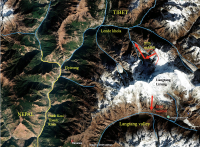
In the wake of the devastating flash floods that struck the Rasuwa district and surrounding areas, the world’s most powerful and richest country has announced $0.5 million in emergency assistance to be channelled through Catholic Relief Services. Compared to the disaster geopolitics of the 1950s and geopolitical manipulations of the 1960s, the humanitarian response of the US government has been indicative of the character of all foreign aid: Unless financial assistance serves strategic interests, only symbolic support is thought to be sufficient.
Attention age
Advances in geosciences, meteorology, infrastructure design and building regulations have vastly improved early-warning systems and disaster preparedness. However, predicting seismic activity or complex, cascading events—such as the Himalayan dynamic where creeping slope failures, glacier dislodgement and intense rainfall converge into a sudden glacial lake outburst—involves too many variables to model with precision. In such fragile terrain, disaster response often transcends pure science, turning relief efforts into an exercise of resilient optimism and profound faith.
The Himalayan Tsunami—perhaps Kunda Dixit coined the expression in 2009 for the devastating Glacial Lake Outburst Flood (GLOF)—has slowly begun to recede from the headlines. The death count has slowed. The disappeared have become statistics. It has been said that in the age of broadband, a wealth of information creates a poverty of attention. The important gives way to the urgent, and both have to bow to the trend of the moment.
In the wake of the Bhotekoshi catastrophe, urgency meant rescue and relief. Rescue itself isn’t yet complete. Relief is far from over. Recovery will take a while in an area where very little remains—from rural municipalities to police posts, everything has been washed away.Rehabilitation will be even more time-consuming with dysfunctional institutions that force a survivor to negotiate procedures built for everyday affairs in normal times.
Reconstruction is apparently in everybody’s mind—it’s the only term that hints at Bhotekoshi devastation in Finance Minister Swarnim Wagle’s interview quoted in this newspaper—because it entails budgets, consultancies, contractors and everything else that goes with such ‘developments’ in Nepal. Climate justice is the buzzword—the trending topic at every conversation and op-ed punditry in the press.
There is no point in repeating ad infinitum that Nepal’s production of greenhouse gases is negligible—less than 0.1 percent—but it has to bear the brunt of global warming and its consequences. What else can be the fate of one of the poorest countries in the world located in one of the most sensitive ecological zones on Earth? But to expect that such invocations will make bleeding hearts of mega-polluting countries open their purse strings is perhaps delusional.
The military-industrial complex and ultrarich corporations that control the reins of government have more interest in war in Ukraine, genocide in Gaza and sales of fighter jets to Saudi Arabia than a prime minister from a poor country presenting the case for climate justice at an international forum that has nothing more than moral authority in the amoral games of geopolitics.
The development-speak of performative empathy aside, perhaps the greenhorns that were propelled to the top of the power heap by the force of Chartreuse Revolt need to consult their yellowing backers to rethink the whole rebuilding plans: The coping strategy has to be neither big nor small but practical and flexible that recognises the limitations of existing institutional capability in Nepal.
Prime Minister Shah will be returning home from his overseas sojourn when heavy rains predicted for September 24-28 have begun to destabilise fragile mountains and force topsoil—already saturated from monsoon downpour—to flow down the valley, making rivers even more ferocious. Rainfall has been modelled; its impact will have to be endured.
Synthesised illusion
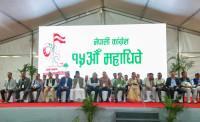
The political class and the opinionators in Nepal have consistently sold the idea that instability of government was not the symptom but the reason for the prevalence of widespread corruption, naked nepotism and persistent backwardness. The fiction that political stability was the surefire cure for all ills of governance is so popular that voters gave a massive majority to a completely untested class of politicos in a hurriedly held general election early this year.
Leaders weaponise election results to project an image of absolute control. Girija Prasad Koirala did so in 1991; his own flock caused the fall of government in less than three years. The ‘stable’ government of Khadga Prasad Sharma Oli lasted a little longer and inflicted irreparable damage to the constitutional order and international relations with his whimsical shenanigans.
The present government relies heavily on performative visuals. Viral video clips, aggressive comment-section attack and defence squads, curated populist posturing, and staged displays of decisiveness create a digital dominance. It tricks the public into feeling that the government is steering a steady ship, while structural policy, economic reality and disaster response crumble underneath.
Little wonder, the establishment is becoming increasingly intolerant of any criticism—so much so that it had to arrest geopolitical fabulist Bharat Dahal! The ousted UML-NC coalition has established the theory that stability implies prosperity—Achhe Din in the phraseology of Indian Prime Minister Narendra Modi—and the Rastriya Swatantra Party will bring it home. The digital sheen of performative governance can’t hide the reality of a synthesised illusion. Meanwhile, the Men’s Room Reloaded cult can continue with its Kirtan-Bhajan for the blessings of 330 million gods.




 22.97°C Kathmandu
.PNG&w=200&height=120)
.png&w=900&height=601)